
|
 28th November 2010, 03:49 PM
|
#1 |
|
Member
Join Date: Feb 2010
Location: switzerland
Posts: 299
|
 ask for more details
Hi
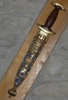
I would like to introduce you to my latest acquisition. I have now bought this Sumatran keris. Handle: Molar Java Demam (absolutely huge!) would like to know more about this keris, approximate dating blade, handle, Sarung. Thanks Chregu |

|

|
|
30th November 2010, 09:02 AM
|
#2 |
|
Member
Join Date: Jan 2007
Posts: 238
|
Hello Chregu, I wouldn't go far due to my limited knowledge on Sumatran keris. But I'm in the impression that the blade would link more to 'classical' Javanese-including Madura blade in how it is presented. I like this kind of Pamor and if memory serve well I thought I have seen it on Palembang blade. If you find the indication that the blade fit well into the sheath, I would buy the idea about trade blade. As for the hilt, it look a little 'oversize' compare to the sheath on how I see it. And goes to the hilt material, I thought this can't be very old because I learn that this material is later invention so to speak, you know kind of alternative when ivory are getting harder to obtain. I believe other members with more knowledge will share their views. Thanks.
|
|
|
|
|
30th November 2010, 10:42 AM
|
#3 |
|
Member
Join Date: Jun 2009
Posts: 1,740
|
Hello Chregu,
I would basically agree with Chandra, the sheath and hilt look Minang to me (the front part of the sampir is damaged) and the blade rather looks from Cirebon (from the shape and deep tikel alis) or may be Madura but it is old. Best regards Jean |
|
|
|
|
30th November 2010, 11:25 AM
|
#4 |
|
Member
Join Date: May 2006
Posts: 7,229
|
I have seen geraham in a hilt that came into Australia pre-WWI.
Musium Radya Pustaka in Solo has a weapon with a geraham hilt that has been there since the mid-1970's and was already old then. (pictured). I have several keris from South Sumatera that use this style of pendongkok. I have seen a blades of this style in South Sumatera wrongkos. This wrongko appears to be South Sumatera, but also appears to have been damaged. I'd be inclined to vote for South Sumatera, Palembang-Lampung general area, but possibly with a bit of mating along the way. |
|
|
|
|
30th November 2010, 12:54 PM
|
#5 |
|
Member
Join Date: Jun 2009
Posts: 1,740
|
Hello Chregu,
Attached are pictures of: . A Cirebon kris with a similar blade as yours but may be longer (41cm without peksi) . A Minang kris with a similar pendongkok as yours . A Palembang kris with a fossil molar hilt in Jawa demam style similar to yours but smaller and in a different style. Best regards Jean |
|
|
|
|
30th November 2010, 02:15 PM
|
#6 | |
|
Member
Join Date: Dec 2004
Location: Singapore
Posts: 1,180
|
Quote:

|
|
|
|
|
|
30th November 2010, 04:58 PM
|
#7 | |
|
Member
Join Date: Jan 2007
Posts: 238
|
Quote:
Anyway, by nature I think it is not a preferred material by true artisan who are looking into detail-I don't know about modern tool, but haven't seen anything which is elaborately carved yet. And the psychedelic color effect might be too dominant for some cultures I guess-when viewed from traditional point of view. But economy always need to create new product called substitution (of exotic material) which can generate the same or better profit-I hope I don't offended anyone by mentioning this. Nevertheless, I like how it ranges from soft yellow to dark orange and adore it as luxury, something once I want to have but couldn't afford 
|
|
|
|
|
|
30th November 2010, 08:39 PM
|
#8 |
|
Member
Join Date: May 2006
Posts: 7,229
|
I've owned a number of hilts and wrongkos from geraham, and frankly I do not like it.
Some has been fossilised material, some has been from fresh elephant teeth. It is a swine of a material to work, and I cannot imagine how the old ones I've seen were worked. I think it is relatively certain that we will not find hilts from geraham that date back too far into the 19th century. I have seen more geraham in hilts and wrongkos during the last ten years than I saw in the previous 40 years. However, all that said, it can look absolutely fantastic in a photo or on display, and it is very popular with collectors. As Tunggulametung says, there is no comparison between geraham and ivory from the point of view of tradition, or just plain, pure class. Ivory carves magnificently, geraham will not support fine carving and is inclined to chip very easily. |
|
|
|
|
30th November 2010, 09:57 PM
|
#9 |
|
Member
Join Date: Aug 2007
Location: Germany, Dortmund
Posts: 9,788
|
When I look to Chregu's hilt I think that it isn't new carved and have a good age and have a other colour like the many new/recent geraham hilts and wrongkos and in my opinion it's possible that this ensemble is long together like this.
In this matter I want remember to my own Sumatra keris which I have shown at this place some time ago. I think that the hilt of my keris is a good sample of a well crafted geraham hilt. And I believe that my example also have a age pre WWI. http://www.vikingsword.com/vb/showthread.php?t=8761 Regards, Detlef |
|
|
|
|
1st December 2010, 09:26 AM
|
#10 |
|
Member
Join Date: Jun 2009
Posts: 1,740
|
I was told by an experienced Javanese seller that fossil or old geraham has a pale yellowish colour (like Chregu's hilt specimen) as compared to fresh elephant molar which has a darker colour with brownish stripes, has anybody heard the same? I have few genuine fossil geraham samples collected in the prehistoric site of Centre Java but I would need to grind them for assessing the colour.
Jean |
|
|
|
|
1st December 2010, 10:41 AM
|
#11 |
|
Member
Join Date: May 2006
Posts: 7,229
|
No Jean, I have not heard this, but if I recall all the items of geraham that I've had through my hands, I'd say it is probably true.
|
|
|
|
|
1st December 2010, 08:48 PM
|
#12 |
|
Member
Join Date: Feb 2010
Location: switzerland
Posts: 299
|
Good evening together
I thank you very much for the wealth of information and suggestions. I think the handle is made before WWI had no direct comparisons, but when I see the cracks and chips, are not new, the wear and tear are used uniformly. certainly it is can not be as fine as ivory carving, I find the material to the coloring still beautiful. thanks again. gruss Chregu |
|
|
|
|
2nd December 2010, 08:31 AM
|
#13 |
|
Member

Join Date: Feb 2007
Location: Kaboejoetan Galoenggoeng Mélben
Posts: 484
|
Hullo everybody,
Apologies for this rather belated contribution. This thread was brought to my attention by someone who thought that I might have something of value. I searched through my archives and found this, which may be of interest. I think this was made by probably the last Soenda panday (traditional craftsman) - as opposed to goeroe teupa (equivalent to poe/empoe/mpoe)- circa 1900. Yes, the handle is rather large, barely fitting in my palm. Geraham is a hard material to work, harder than Asian ivory. (Similarly, African elephant ivory is harder to work than Asian elephant ivory.) No surprises about relationships between Tatar Soenda and Lampoeng, as there are those who would argue that the eastern boundary of the Soenda-Galoeh kingdom during the 15thC was Lampoeng (Lampoeng becoming part of the kingdom, a federation, through marriage of the ruling houses). Please forgive any shortcomings. Best, |
|
|
|
|
2nd December 2010, 03:17 PM
|
#14 |
|
Member

Join Date: Jan 2005
Location: Singapore
Posts: 1,248
|
Hi Amuk Murugul,
Nice hilt. Looking at your ensemble, it seems that the hilt is a tad too big for the fittings.. the geraham looks more like a Palembang or Minangkabau jawa demam to me as compared to elsewhere.. Thanks for showing the pics |
|
|
|
|
2nd December 2010, 09:03 PM
|
#15 |
|
Member
Join Date: May 2006
Posts: 7,229
|
Interesting Amuk Murugul.
Very interesting. |
|
|
|
|
3rd December 2010, 01:01 AM
|
#16 | |
|
Member
Join Date: Feb 2007
Location: Kaboejoetan Galoenggoeng Mélben
Posts: 484
|
Quote:
I had questions in my mind about the ensemble when I held the item in my hand a few years ago. However, I remained silent, as I was there to admire it and not to express an opinion. Unfortunately, I don't have the authority to change the ensemble. Even if I had, I would need to know its background before I'd even consider making any alterations and then decide whether such alterations would be appropriate. BTW ..... I think we may differ about the ethnic groupings of Soematera. To me, the main groups are Minangkabaoe, Batak and Atjeh (just..., depending on how far back one goes). As for Palembang, to me, their relationship to the Minangkabaoe is more like the Betawi in relation to the Soenda (as Palembang was essentially a Chinese port city under the command of a Chinese captain). Best, Last edited by Amuk Murugul; 3rd December 2010 at 02:06 AM. |
|
|
|
|
|
3rd December 2010, 03:45 AM
|
#17 | |
|
Member
Join Date: Jan 2005
Location: Singapore
Posts: 1,248
|
Quote:
When fitted on a keris, and tucked in the waist or waistband, it tends to tip to one side (due to the weight of the hilt).. when held in the hand, the balance tend to be off too, unless it is offset with a heavy keris blade.. imho, not suitable to engage in a fight.. I've seen one being used in a keris fight demo, unfortunately the hilt broke into half.. adding to the list of repaired geraham hilts.. I've see it geraham treated to enhance its colour, although I do not know the process. Alan, I tend to agree with you that it's a later development.. probably used for ornamental or ritualistic (mystical) purpose, although I'm not prepared to support this opinion..
Last edited by Alam Shah; 3rd December 2010 at 03:18 PM. |
|
|
|
|
|
3rd December 2010, 04:03 AM
|
#18 | |
|
Member
Join Date: Jan 2005
Location: Singapore
Posts: 1,248
|
Quote:
Sorry if my opinion upset you..  I'm just stating an opinion, it may be true or otherwise. I'm not asking you to change anything, but merely stating what I see in this ensemble.. As for Sumatra, my knowledge is limited.. The recent exhibition in Singapore's Asian Civilisations Museum, "Sumatra: Isle of Gold", gives some pretty good idea regarding the rich cultures of Sumatra, in a nutshell. The accompanying book with the same title and another, "Sumatra: Crossroads of Cultures" are good books to read. It gives us a peek at the past with the various insights. Although not exhaustive, it's still recommended for reading. It gives us the various timelines in Sumatra's colourful history. I'm just stating an opinion, it may be true or otherwise. I'm not asking you to change anything, but merely stating what I see in this ensemble.. As for Sumatra, my knowledge is limited.. The recent exhibition in Singapore's Asian Civilisations Museum, "Sumatra: Isle of Gold", gives some pretty good idea regarding the rich cultures of Sumatra, in a nutshell. The accompanying book with the same title and another, "Sumatra: Crossroads of Cultures" are good books to read. It gives us a peek at the past with the various insights. Although not exhaustive, it's still recommended for reading. It gives us the various timelines in Sumatra's colourful history.
|
|
|
|
|
|
3rd December 2010, 01:56 PM
|
#19 |
|
Keris forum moderator
Join Date: Aug 2006
Location: Nova Scotia
Posts: 7,297
|
I think what Shahrial might have been suggesting (which is the question in my mind as well) was that this hilt might well have been a latter addition to this ensemble since it does not seem to quite fit. So we may be able to date the blade to circa 1900, but the hilt itself might well be much younger. This is only important since we do seem to be trying to date the appearance of geraham as a hilt material.

|
|
|
|
 |
|
|


 Linear Mode

