
|
 3rd February 2010, 11:06 PM
|
#1 |
|
EAAF Staff
Join Date: Dec 2004
Location: Louisville, KY
Posts: 7,421
|
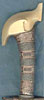
 Ivory Silver Swassa Barong
Greetings folks!
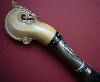
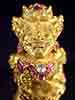
I just got this piece from Ashokaarts. The pommel is junggayan ivory with cord wrapping beneath. The punto sleeve is made of silver with a swaasa bottom. No laminations that I can see (etched). A smaller piece, but nice one. Enjoy 
|

|

|
|
3rd February 2010, 11:11 PM
|
#2 |
|
(deceased)
Join Date: Feb 2005
Location: Centerville, Kansas
Posts: 2,196
|
Hello Jose, Yes a VERY nice one indeed!! Congratulations. Did it come with a scabbard? If not I can't wait to see the one you will probably make for it.
Robert |
|
|
|
|
3rd February 2010, 11:13 PM
|
#3 |
|
Vikingsword Staff

Join Date: Nov 2004
Posts: 6,441
|

Sha-Weet !!
|
|
|
|
|
4th February 2010, 02:54 AM
|
#4 |
|
EAAF Staff
Join Date: Dec 2004
Location: Louisville, KY
Posts: 7,421
|
Thanks guys - no it did not come with a scabbard but I do plan to make one this year. Will post when done.
|
|
|
|
|
4th February 2010, 05:39 AM
|
#5 | |
|
Member
Join Date: Dec 2004
Posts: 1,038
|
Quote:
What are the dimensions?? It's definitely a beauty....Big UP to you Jose!!!! Last edited by kino; 4th February 2010 at 05:55 AM. |
|
|
|
|
|
4th February 2010, 02:04 PM
|
#6 |
|
Member

Join Date: Dec 2004
Location: Greenville, NC
Posts: 1,854
|
Goooorgeeeeez Jose!!! Looking forward to seeing it. Now you can stop lamenting over the one I have that is practically a twin.
|
|
|
|
|
5th February 2010, 03:22 AM
|
#7 |
|
EAAF Staff
Join Date: Dec 2004
Location: Louisville, KY
Posts: 7,421
|
Kino, I took another look at it and may etch it again - there may be laminations in it after all.
Dimensions: the whole thing is 20 3/4 inches long and the blade is 12 3/4 inches long. Charles it is the same size as your great piece. |
|
|
|
|
5th February 2010, 04:37 PM
|
#8 |
|
Member
Join Date: Aug 2007
Location: Germany, Dortmund
Posts: 9,788
|
Congrats Jose, beautiful Barong!
Detlef |
|
|
|
|
5th February 2010, 07:35 PM
|
#9 |
|
EAAF Staff
Join Date: Dec 2004
Location: Louisville, KY
Posts: 7,421
|
Thank you folks. Just re-polished and re-etched and still no lamination. I think there were some problems with the original heat treatment and this may have done something to the lamination.
 Just a thought. Just a thought.Still it is indeed an early piece and I like the ivory, silver, and swassa. 
|
|
|
|
|
10th February 2010, 09:34 PM
|
#10 |
|
EAAF Staff
Join Date: Dec 2004
Location: Louisville, KY
Posts: 7,421
|
Another recent thought - on some very high end pieces the emphasis was on the hilt and not the blade, meaning a plain blade. My ivory kampilan has this feature and I have seen ivory and silver kris with plain or nearly plain blades. I believe Cato talks about this as well.
|
|
|
|
|
12th February 2010, 07:56 PM
|
#11 | |
|
Member
Join Date: Jan 2005
Posts: 478
|
Quote:
|
|
|
|
|
|
12th February 2010, 09:22 PM
|
#12 | |
|
EAAF Staff
Join Date: Dec 2004
Location: Louisville, KY
Posts: 7,421
|
Quote:

|
|
|
|
|
|
12th February 2010, 09:49 PM
|
#13 |
|
Member
Join Date: Jan 2005
Posts: 478
|
sorry, KP = Kampilan
|
|
|
|
|
12th February 2010, 11:08 PM
|
#14 |
|
EAAF Staff
Join Date: Dec 2004
Location: Louisville, KY
Posts: 7,421
|
Is your kampilan a status piece as well?
|
|
|
|
|
15th February 2010, 04:00 PM
|
#15 | |
|
Member
Join Date: Jan 2005
Posts: 478
|
Quote:
|
|
|
|
|
|
15th February 2010, 05:37 PM
|
#16 |
|
EAAF Staff
Join Date: Dec 2004
Location: Louisville, KY
Posts: 7,421
|
Yes, that makes sense. Nice. I had a whalebone one too (sold it for my ivory kampilan) and it did not have a laminated blade either.
The other problem with this barong is that it does not have much of a temper line either. |
|
|
|
|
16th February 2010, 02:28 AM
|
#17 |
|
(deceased)
Join Date: Dec 2004
Location: OKLAHOMA, USA
Posts: 3,138
|
CONGRADULATIONS JOSE YOU HAVE COMPLETED THE MORO TRIFECTA. 1. IVORY KRIS 2. IVORY KAMPILLIAN 3. IVORY BARONG.
YOU LUCKY VARMIT. 
|
|
|
|
|
16th February 2010, 02:53 AM
|
#18 |
|
Member
Join Date: Aug 2009
Posts: 338
|
I love suasa (Second only to my affinity for silver); it's such a gorgeous metal to work with. That red hue is just beautiful.
I wonder, do you think the suasa part of the Punto was a later addition to this piece or was the inclusion of two metals on the hilt part of the original piece? |
|
|
|
|
16th February 2010, 03:05 AM
|
#19 | |
|
Keris forum moderator
Join Date: Aug 2006
Location: Nova Scotia
Posts: 7,303
|
Quote:

|
|
|
|
|
|
16th February 2010, 03:32 AM
|
#20 | |
|
EAAF Staff
Join Date: Dec 2004
Location: Louisville, KY
Posts: 7,421
|
Quote:
Thanks guys - trifecta - good for us here in Kentucky. I'm pleased. I am researching and designing the scabbard as we speak.
|
|
|
|
|
|
19th February 2010, 04:48 PM
|
#21 |
|
Member
Join Date: Jan 2005
Posts: 478
|
I have a theory on these status pieces. This is just a theory, with no way to prove it one way or another. I believe the status pieces that do not show laminations are made with imported steel. Imported steel does not have to be folded to make it suitable for use, it already is ready to be forged to shape. Here is my line of reasoning. Status pieces are by definition commissioned by someone of high status, which usually coincides with wealth. I find it hard to believe that you would spend all that money on the handle and then take no consideration of the blade. I do not know how these where used but if they where drawn and shown about people are going to see the blade. Plus if things do go bad and you need to use it, you don’t want a blade that will not perform. So the use of imported steel would be another indicator of status, as very few could afford it if they could get it.
Comments, opinions? |
|
|
|
|
22nd February 2010, 10:55 PM
|
#22 |
|
EAAF Staff
Join Date: Dec 2004
Location: Louisville, KY
Posts: 7,421
|
Another possibility. Had not thought of that. May be similar to the unlaminated blades made by Chinese smiths in the Philippines.
|
|
|
|
|
23rd February 2010, 07:21 AM
|
#23 |
|
Member
Join Date: Aug 2008
Posts: 264
|
I also have my own theory of "status pieces" and why they typically do not have laminated blades. I have one non-laminated status piece(Kampilan) that is excessively large...it is very long, blade at the tip is large, and it is way to heavy for slashing...the balance is way off. Now-a-days in this day and age, laminations on a blade are seen as works of art and we now admire them...many fail to realize during that time a laminated blade was not for decoration but was specifically designed that way to last through battles; blade strength and balance took top priority over the looks of nice laminations. Non-laminated blades were essentially uniform with a much larger variety of looks to choose from, plus the fact you can shine them...can't really make a laminated blade shine. As my status piece has shown to have some type of brass mixed in to give off a golden look and hue to the blade. Having a laminated blade on a status piece may have been, not over kill, but to ordinary and typical for a piece that was meant for ceremony and decoration; and to them a laminated blade may have been considered impractical for that use. Even though the handles, scabbards, engravings, and shapes on some laminated weapons may have been elaborately designed; the laminated blades had a purpose, and that was strength above all else...so to me laminations were not mainly used as a decorative part of a weapon.
But thats just my opinion of the limited knowledge I have now. 
|
|
|
|
|
23rd February 2010, 10:50 PM
|
#24 |
|
EAAF Staff
Join Date: Dec 2004
Location: Louisville, KY
Posts: 7,421
|
You have a good point as well. Laminations would be unnecessary for many status pieces, although my ivory inlay barong does have laminations as well as my silver hilted kris.
|
|
|
|
|
23rd February 2010, 11:32 PM
|
#25 | |
|
Member
Join Date: Aug 2008
Posts: 264
|
Quote:
|
|
|
|
|
|
24th February 2010, 01:48 AM
|
#26 |
|
(deceased)
Join Date: Dec 2004
Location: OKLAHOMA, USA
Posts: 3,138
|
THOUGH SOME HIGH STATUS WEAPONS WERE CUSTOM MADE AS SUCH THERE WAS ANOTHER WAY THEY CAME TO BE.
I HAVE PROVENANCE ON ONE KRIS WHICH IN ITS ORIGINAL STATE WAS NOT FOR STATUS BUT USED IN BATTLE BY THE FAMILY HEAD IN HIS YOUTH. LATER WHEN THE FAMILY HAD PROSPERED AND HAD PLENTY OF WEALTH THE ELDER TOOK HIS KRIS AND HAD IT UPGRADED TO A STATUS SWORD WITH IVORY, SILVER AND THE WORKS. SO HE STILL HAD HIS OLD BATTLE SWORD BLADE AND NOW ALTHOUGH IT WAS NO LONGER FOR BATTLE IT SHOWED HIS STATUS AND WEALTH. THE MORO ALSO HELD WEAPONS IN HIGH REGARD SOMEWHAT LIKE THE KERIS IS CONSIDERED A FAMILY PUSAKA BY THE MALAY AND INDONESIAN PEOPLE. |
|
|
|
|
24th February 2010, 03:11 AM
|
#27 |
|
EAAF Staff
Join Date: Dec 2004
Location: Louisville, KY
Posts: 7,421
|
That was very helpful Vandoo, Dimasalang, and Mross. I think my barong was made this way for one already a datu (same with my ivory kampilan).
|
|
|
|
|
24th February 2010, 05:57 AM
|
#28 |
|
Member
Join Date: Dec 2004
Posts: 1,038
|
Or maybe the blades were replaced with the mono steel variety. Sort of like selling the baka-baka, or other silver/ gold fittings, but in reverse, sell the nice laminated blades, replace it with mono steel and hide it in the scabbards.
I dont' believe that a datu would intentionally comission a non-laminated blade, I think that the blade would be just as important as the hilt. The datu would have to show the blade off, just as we do now as collectors. Scenario: Datu Itom along with his posse bearing his ivory and silver hilted(insert weapon here), goes to visit Datu Puti's kotta. After all the nods, handshakes and baby kissing, they both retire to Datu Puti's crib. Datu Itom then unsheaths his (your choice), and shows off the nice twist core pattern, highly laminated blade. What does Datu Puti say.. . If it sported a non-laminated blade....  I've had 3 whale bone kamps pass thru and all of them had laminated blades. I have also seen ~5 with laminated blades. Same with my barung blades with chinese characters- they all have laminated blades. My theory is they have been replaced or maybe of post 1930's manufacture. |
|
|
|
|
24th February 2010, 03:28 PM
|
#29 |
|
Member
Join Date: Jan 2005
Posts: 478
|
Why is it that many think laminated blades are superior to mono-steel? They look much prettier and I whole heartily agree. I personally love the way they look, but it is an aesthetic thing and has nothing to do with functionality. Laminated blades come about because the steel used to make them has many impurities in it. The steel is folded to drive out these impurities making it suitable for sword making. Users of blades are not interested in how pretty they look but in how they perform. Prior to modern steel making methods this folding process was one of only a few ways to get quality steel. It is my theory that the polishing to show the laminations and other personalities of the steel where done as a form of advertising. The buyer could see the laminations and other activities and new that it was well made. Did they understand the metallurgy behind this? Probably not, but experienced told them that if a blade had these qualities it was a good blade that you could bet your life on. Because they did. If you take a couple of ball bearings (I’m using ball bearings because of the mention in the balisong thread) and forge to shape and heat treat it correctly it will perform as well if not better then any laminated blade. Please note the important concept here is heat treat correctly. The best steel in the world can be made useless if not heat treated correctly. As a side note a ball bearings most likely will be 52100. There is a very informative DVD by Ed Fowler on the high performance knife using this steel. I seriously doubt that many laminated blades would withstand the tests he put the blades through.
|
|
|
|
|
24th February 2010, 04:42 PM
|
#30 |
|
(deceased)
Join Date: Dec 2004
Location: OKLAHOMA, USA
Posts: 3,138
|
A BIG MACHINE IN A FORIGN COUNTRY MAKES STEEL BLADES AND EXPORTS THEM TO A COUNTRY THAT STILL MAKES BLADES AT THE FORGE BY HAND. WHEN THIS MONO STEEL IS FIRST SEEN EVERYONE IS IMPRESSED AND THE SALESMEN SELL AND TRADE LOTS OF THEM. THE TRADER PRESENTS A FANCY WEAPON TO THE DATU AS A SELLING POINT TO ATTRACT OTHERS TO HIS GOODS.
LATER IT IS LEARNED THAT A MACHINE MAKES THESE BLADES NOT A SMITH OR EMPU AND NO HANDS ON RITUAL HAS BEEN PERFORMED SO THERE IS NO SPIRIT OR MAGIC IN THE BLADE. THOSE WHO WORKED AND STILL WORK AT FORGEING BLADES WERE ATTRIBUTED TO HAVE SOME MAGICAL SKILLS THAT HAD OFTEN BEEN PASSED DOWN FOR GENERATIONS. SO JUST AS A SAMURAI WANTED A SWORD FROM A MASTER WHO WAS FAMOUS AND IN DEMAND IT IS LIKELY A DATU FELT THE SAME WAY. THE PATTERNS STARTED BECAUSE OF THE NATURAL PROCESS OF USING SMALLER BITS OF METAL AND FOLDING THEM TOGETHER BUT SOME FOUND WAYS TO CONTROL AND DEVELOP PATTERNS. I HAVE NOT READ OF ANY POWERS ATTRIBUTED TO CERTIAN PATTERNS IN PHILIPPINE KRIS BLADES BUT HAVE LITTLE DOUBT THAT THERE WERE SOME JUST AS THERE ARE WITH THE INDONESIAN KERIS. THESE PATTERNS ARE A PLEASURE TO LOOK AT AND SHOW THE SKILL OF THE MAKER BUT I THINK THERE WAS MORE MEANING TO THEM THAN JUST LOOKING PRETTY THAT HAS BEEN LOST. AS MENTIONED ABOVE SOME OF THE MONO STEEL DATU WEAPONS WERE MADE BY FORIGNERS WHO WANTED TO IMPRESS THE LOCAL DATU BY GIVING HIM A FANCY WEAPON TO HELP GAIN THE INSIDE TRACK FOR TRADE. SO EVEN IF A MONO STEEL BLADE MAY BE AS GOOD OR BETTER THAN A HAND FORGED PATTERENED BLADE THERE WERE MAGICAL, TRADITIONAL AND SPIRITUAL REASONS TO WANT A WEAPON MADE IN THE OLD WAYS. THIS IS ALL CONJECTURE BASED ON LOGIC BUT TO MY KNOWLEGE THERE IS NO WRITTEN PROOF SO THINK OF IT AS AN INTERESTING STORY NOT PROVEN FACT. 
|
|
|
|
 |
|
|


 Linear Mode

