
|
 10th April 2005, 09:30 PM
|
#1 |
|
EAAF Staff
Join Date: Dec 2004
Location: Louisville, KY
Posts: 7,415
|
 Mughal Kard?
I had posted this once before on this forum. Now that we have some other folks more invested in India arms, I would like to post this again. I got this some years ago. The scales are ivory, the blade with very subtle watering, and the koftgari is gold. I have some questions:
1. Would this be considered a kard (or a type of Mughal steak knife)? 2. The plant motifs circled in red and green - what are they and what is there significance (keeping Jen's thread of Indian decorations in mind)? 3. How old do you think this is? |

|

|
|
11th April 2005, 12:59 PM
|
#2 |
|
Member

Join Date: Dec 2004
Location: Europe
Posts: 2,718
|
Hi Battara,
As no one else has answered you as yet, let me try, although I doubt you will be satisfied with my answer. Only very few authors comment on the flowers used for decoration, 98% write floral decoration, which is a very safe way to describe it. It is a most interesting and very difficult area, as some of the goldsmiths were more artistic than others, some wanted the decoration to look like the real flower while others wanted it to be more stylistic. Another thing is, that I don’t have the names of all of the flowers most used, as far as I know – but I am working on it. Amongst the flowers used is Chrysanthemum Indicum, notice that this is a different kind than the one used in China and Japan, as this is a plant with a lot of small flowers, and can be found in many colours, where as the flower used in China and Japan are very big flowers, although both flowers have many petals, they are quite different. One of the flowers, which often are the easiest to recognise, is the poppy, but you should not concentrate on the flower alone, you should also look at the leaves, as these can help you in the search. I can not, at the moment, tell you what flowers are shown on your knife, but, as I said I am working on it, and when I know more I will return, one other thing you must remember is, that any decoration on Indian weapons were not only decoration, they had a symbolic meaning, and sometimes they show flower buds, which could be almost from any flower. Have a look at the two pictures, they are from the same tulwar, but the floral decoration shown is different on the over and underside of the disc. I think the flowers, shown on the underside are Chrysanthemum Indicum. It is a very nice knife you show. It looks very slim but also very long, how big is it? It is hard to tell from a picture, but I would say it is late 18th or early 19th century. |
|
|
|
|
11th April 2005, 04:47 PM
|
#3 |
|
Arms Historian

Join Date: Dec 2004
Location: Route 66
Posts: 10,867
|
Hello Battara,
I would consider this a Mughal kard, although it does seem quite elongated. I think what Jens has said concerning the floral motif is right on target, and some very focused evaluation will be necessary as this subject in these weapons is quite important. As Dr. Robert Elgood has noted in his outstanding new book "Hindu Arms & Ritual" (p.129), "...it follows that a plant depicted on a weapon is likely to represent more than its decorative value". While this of course focuses on Hindu weapons, it should be remembered that the iconography on Indian weapons often was duplicated on both Mughal and Hindu weapons indiscriminantly. In his book, Dr. Elgood brilliantly describes symbolic meanings of flowers in this iconography and how certain flowers were even used to identify opposing armies in days before uniforms. To the best of my knowledge, his approach and perspective in the subjective study of these weapons is seminal, and distinctly notes the way ethnographic weapons should be studied. Until now, virtually all references that have described the weapons of India have focused on the western application of study that is primarily typology and categoric description. It must be remembered as well in the study of Indian weapons that such floral motifs were often widely copied by subsequent artisans, and in many cases such imitation was not necessarily faithfully duplicated. Thus without awareness of such symbolic importance, the renderings often became highly stylized and degenerated. In many cases the number of flower petals, typically key symbolically, were altered, and the meaning was lost. In many cases this degenerated motif is a determining factor in estimating authentiity and age of certain weapons. Best regards, Jim |
|
|
|
|
11th April 2005, 07:20 PM
|
#4 |
|
Member
Join Date: Dec 2004
Location: Europe
Posts: 2,718
|
Well written Jim, 'Hindu Arms and Ritual' is a must. Robert Elgood has indeed, as one of the very few dealt with the floral decoration. Besides from him, there are very few - unfortunately - who found the strength to do so. T.H.Hendley, from around 1850 did so, but rather vaguely, although he gives some examples in his book ‘Jodphur Enamels’. It is of course easier to recognise the flowers when they are made in enamel, rather than cut in steel, or maybe cast – although the cast flowers are much easier to recognise, as they were made in wax from the start, which mostly gives far more details.
Jens |
|
|
|
|
11th April 2005, 10:16 PM
|
#5 |
|
Member
Join Date: Dec 2004
Location: Greensboro, NC
Posts: 1,099
|
I think Jose will share the overall dimensions of the knife but it is a small, petite knife that seems to have a delicate nature. Jose has found some early Mughal court wear with small, petite knifes stuffed behind a sash and so perhaps these little knives were meant for court wear. I have examined Jose's example and it is a lovely knife but slender, long and well proportioned. I had often wondered if it was a knife that might have originally been part of a trousse but some of the pictures Jose dug up the knives bore similiarity to his example. That would move the dating back a bit on the piece if this is the case.
|
|
|
|
|
12th April 2005, 02:17 PM
|
#6 |
|
Member
Join Date: Dec 2004
Location: Europe
Posts: 2,718
|
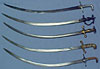
RSword, do you mean that the knife is a bit like this one?
The one shown was made in the first quarter of 1600. Total length 21 cm, length of blade 12 cm. It is in the same scabbard as a katar, and the knife is defenately not meant for fighting - more likely for eating. |
|
|
|
|
12th April 2005, 08:00 PM
|
#7 |
|
Member
Join Date: Dec 2004
Location: Europe
Posts: 2,718
|
RSword, is it so, that Battara has lost interest in this subject?
|
|
|
|
|
12th April 2005, 08:13 PM
|
#8 |
|
EAAF Staff
Join Date: Dec 2004
Location: Louisville, KY
Posts: 7,415
|
NO, just listening...er...reading and trying to find a time to give measurements and even some pictures of Mughal miniature research. Maybe tomorrow.
I do have another question, though, regarding the end of the pommel where a piece used to hang - would this be on a trousse or "Mughal steak knife"? BTW - just finished reading Elgood's new book. Thus the background to some of my questions. |
|
|
|
|
13th April 2005, 01:50 AM
|
#9 |
|
Member
Join Date: Dec 2004
Location: Houston, TX, USA
Posts: 1,254
|
Jens' little knife bears a striking resemblance to European knives of the same period, though it seems to have a long ferule and stalk tang? While the European type is more often with a forged or applied bolster, and scale handle.
|
|
|
|
|
13th April 2005, 01:11 PM
|
#10 |
|
Member
Join Date: Dec 2004
Location: Europe
Posts: 2,718
|
Very well done Tom. The knife was made in London by John Jencks (1576-1625). He got his cutlers mark 1606-7.
Jens |
|
|
|
|
14th April 2005, 02:11 AM
|
#11 |
|
Member
Join Date: Dec 2004
Location: Greensboro, NC
Posts: 1,099
|
It is an interesting little knife and I have had the opportunity to handle it. It is unlike any other Kard and so I was thinking out loud in regards to it maybe originally part of a trousse. To me, it does not resemble the knife you posted, Jens, other than maybe the dimensions somewhat. I think Jose's research into early miniatures depicting what look like slender elegant knives might be revealing. As far as trousse, it seems more like oriental examples, just in that it is long and slender, no more.
|
|
|
|
|
20th April 2005, 08:48 PM
|
#12 |
|
EAAF Staff
Join Date: Dec 2004
Location: Louisville, KY
Posts: 7,415
|
Finally, I got the dimensions of the piece - it is 12.5 inches long overall.
I also have some pictures from 16c-17c Mughal miniataures to share that show what look like similar pieces being worn (all seem to have ivory hilts). It is from paintings like these that I base some of my supositions: |
|
|
|
|
21st April 2005, 06:28 AM
|
#13 |
|
Member
Join Date: Dec 2004
Location: Santa Barbara, California
Posts: 301
|
I don't recognize the knives, but I sure do recognize the instrument in the second mughal miniature.
It's a rabab, the ancestor of the sarod, which is the instrument that I play. |
|
|
|
|
21st April 2005, 07:00 PM
|
#14 |
|
EAAF Staff
Join Date: Dec 2004
Location: Louisville, KY
Posts: 7,415
|
Montino, even though it is not a knive or sword, I appreciate the information and the picture of your instrument. Thank you.
|
|
|
|
|
27th December 2005, 07:47 AM
|
#15 |
|
EAAF Staff
Join Date: Dec 2004
Location: Louisville, KY
Posts: 7,415
|
Ok it has been a while, but I just ran across this picture from Hermann-Historica in catalogue 47 (or 46?). It is called a kard and a by-knife: a shakshaki . Could this be what my knife is? Could someone tell me more about the shakshaki?
|
|
|
|
|
27th December 2005, 08:14 PM
|
#16 |
|
Member
Join Date: Dec 2004
Location: Europe
Posts: 2,718
|
Hi Battara, I think you are getting close, when you ask if your knife could be a ‘shakshaki’. I will see what I can find out to morrow, but your question is interesting.
|
|
|
|
|
28th December 2005, 04:37 AM
|
#17 |
|
EAAF Staff
Join Date: Dec 2004
Location: Louisville, KY
Posts: 7,415
|
Thank you Jens. Any information would be helpful (soo excited - just like Christmas
 ). ).
|
|
|
|
|
28th December 2005, 01:22 PM
|
#18 |
|
Member
Join Date: Dec 2004
Location: Europe
Posts: 2,718
|
Hi Battara,
I don’t hope you hope for too much, as I, to my surprise, have not found much. You most likely have been through almost all your books, just like I have, without finding the word anywhere – at least not in the Index’. This made me slightly irritated, so I thought I better look for the auction catalogue – and there the knife was, Hermann Historica auction catalogue no 46 #548. I tried ‘more’ and got a lead, Catalogue over the Moser Collection, 1955, #209-211 and 213. From then on it was easy, especially as I have the catalogue. On page 200 the authors Rudolf Zeller and Ernst F. Rohrer describe ‘Messerbestecke’ (knife cutlery) together with kards, and here I saw the word, in a book, for the first time – in the text that is – as it is not in the index. This means that Shakshaki may be mentioned in some of the other books as well – in the text – but left out of the index. It does not say what the word means, nor does it says if a small knife attached in a scabbard to another type of knife is called the same, which it probably is – this said without safety line. If there are cutlery or tools as well, they are mostly hidden in the hollow hilt of the kard. In the Moser Collection there seems to be six kards with Schakschaki’s (this spelling is from the Moser Catalogue, notice the different spelling from Hermann Historica). Below find the measurers of the Schakschaki. #209 Blade 14.7 cm. Hilt 8.5 cm. Weight 140 g. #210 Blade 16 cm. Hilt 7.5 cm. Weight –. #211 Blade 11.5 cm. Hilt 8 cm. Weight 65 g. #212 Blade 13 cm. Hilt 4.3 cm. Weight 37 g. #213 Blade 12 cm. Hilt 7.5 cm. Weight 50 g. #215 this is rather special, as there, in the hilt of the schakschaki, is a folding knife. Blade 16/7.6 cm. Hilt 11/8.8 cm. Weight 85 g. Should someone have contacts in Iran or India, the word may be translated, but notice the different ways of spelling it. Sorry I could not get a better explanation for you, but that was all I could find in my books. |
|
|
|
|
28th December 2005, 02:04 PM
|
#19 |
|
Member
Join Date: Dec 2004
Location: Europe
Posts: 2,718
|
BTW I have not forgotten your question about the floral decoration. I am still studying it, and I have learned a bit, but not enough - I will return when I know more.
|
|
|
|
|
29th December 2005, 01:50 AM
|
#20 |
|
EAAF Staff
Join Date: Dec 2004
Location: Louisville, KY
Posts: 7,415
|
Thank you Jens. You have provided some very helpful information. What you have shown so far is that my knife does not fit the traditional shakshaki form. This lends more creedance to what Jim had mentioned earlier when he said that he would call this a "Mughal kard".
On the floral front, I appreciate all of your research into this thing. I too have come up with little. |
|
|
|
|
29th December 2005, 10:06 AM
|
#21 |
|
Member

Join Date: Dec 2004
Location: What is still UK
Posts: 6,018
|
 Silly question
Please excuse my silly question, I was under the impression that food is eaten with the fingers in the Indian subcontinent. Only western barbarians cut thier food and eat with Knives. Or are these knives, from the the most wealthy echelon of Indian society, from the early period of trade with Northern Europe when each others habits were adopted? As to the floral decoration, I realise we are not talking about a consumerist economy more feudal, but there would still have been the need to cut your cloth according to your pocket so I would imagine some variation should be expected? I hope that does not appear very stupid. Tim
Last edited by Tim Simmons; 29th December 2005 at 10:22 AM. |
|
|
|
|
29th December 2005, 02:07 PM
|
#22 |
|
Member
Join Date: Dec 2004
Location: Europe
Posts: 2,718
|
Hi Battara, I agree that what you have is not a shakshaki, but rather a kard – a small one but still a kard, like the one on the upper picture shown in mail #12.
I just bought ‘Bidri Ware’ by Susan Stronge. Maybe this book hides some secrets about floral decoration, judging from the pictures it might, but I will know when I have read it  . .Hi Tim, You may be right that the Indians did not use the shakshaki for eating. The only reason why I wrote cutly knife was, be course they in the Moser Catalogue wrote 'Messerbestecke'. It was most likely used when the kard was too big for some purpose or other. |
|
|
|
|
30th December 2005, 05:38 PM
|
#23 |
|
EAAF Staff
Join Date: Dec 2004
Location: Louisville, KY
Posts: 7,415
|

Thank you Jens. Based on my research, your learning and on Jim's learning: a kard it is.
Now if we can just get that darned floral stuff down (though Jim has a point on some artists copying without understanding). |
|
|
|
|
30th December 2005, 09:42 PM
|
#24 |
|
Member
Join Date: Dec 2004
Location: Europe
Posts: 2,718
|
Hi Battara,
Yes I think Jim has a very valid point about the artists copying, as well as artists being lesser than others. All of this makes it very difficult to move on – it is as if you stay in clay to your knees. But let’s see what the new year brings . Happy new year to all of you.
|
|
|
|
|
31st December 2005, 08:49 PM
|
#25 |
|
EAAF Staff
Join Date: Dec 2004
Location: Louisville, KY
Posts: 7,415
|
I also want to give some credit and thanks to Phillip Tom and Rsword for their earlier help in this endeavor.
|
|
|
|
|
4th January 2006, 09:41 PM
|
#26 |
|
Member
Join Date: Dec 2004
Location: Europe
Posts: 2,718
|
Hi Battara,
Would you say that this is a kard - I would. |
|
|
|
|
5th January 2006, 01:20 AM
|
#27 |
|
EAAF Staff
Join Date: Dec 2004
Location: Louisville, KY
Posts: 7,415
|
Jens, not only would I call that a kard, but a perdy one at that.
(again - nice enamel work) |
|
|
|
 |
|
|


 Linear Mode

