
|
 24th March 2005, 03:17 PM
|
#1 |
|
Member
Join Date: Dec 2004
Posts: 215
|
 An Unusual Ethiopian Short Sword
Guys,
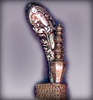
I picked this up recently from a friend in NZ. It had been in a local Antique shop there and he knew I was interested in Abyssinian blades. So, now it resides in the hills of east TN. It's about 2 feet long, the blade has a faint gilded color, and the scabbard and coins seem to be plated. The plating is chipped in a few places, especially evident on one coin. The coins are silver Birrs from Abyssinia, one is 1898 with Menelik's face. They have both been drilled through to make the ends of the horn grip. The rings in the grip do not appear to be aluminum and are probably silver. Overall, it's a pretty nicely done piece, and it's consistent with the look of Abyssinian weapons, but I'm a little confused about the fact that someone drill their monarch's face twice mounted it to a sword. Usually the coins seen on Abyssinian swords are repros of a much older european coin from the 1700's. Would it not have been considered bad to punch holes in your ruler's (or past ruler's) likeness?    
|

|

|
|
24th March 2005, 03:50 PM
|
#2 |
|
Member
Join Date: Feb 2005
Location: Clearwater, Florida
Posts: 371
|
That's a beautiful sword, one of the nicest that I've seen.
The national ruler was often of little or no importance to many nomadic tribesman, while a man's weapon would likely be among his most prized possesions, and often a badge of honor, rank or status as well. The coins in this case may well just be another indicator of a superior weapon, as it appears to be. I wouldn't be surprised if all of the spacers were originally coins and even the scabbard/sheath, which appears to be either silver or well done silvered brass. Mike |
|
|
|
|
24th March 2005, 04:50 PM
|
#3 |
|
Member
Join Date: Dec 2004
Posts: 215
|
Thanks, Mike.
It's definitely an odd one. Rudy D'Angelo has an extensive collection of Abyssinian and North African weapons and this one stumped him a little. The scabbard is like the coins in that it appears to have silver metal under a gold plating of some sort. The blade is more gold "washed" or gilded, but very faint. I saw one like it (same size, similar scabbard) on ebay months ago and let it pass. I almost wish I had it now for comparison. Anyone on the forum pick that one up? -d |
|
|
|
|
24th March 2005, 05:14 PM
|
#4 |
|
Member
Join Date: Dec 2004
Location: Athens Greece
Posts: 479
|
I am sorry to play devils advocate but does a tribal weapon and a silver plate metal match?
I dont know a lot about Abyssinian swords (I wish I had one) but I have the feeling of something more recent than the coin. The usual hilt of shotels (I think this is in this category) is one piece of horn. Here we have something lot more esthetic. The usual scabbard is wood and leather, sometimes with silver chape and throat. Here we have something more elaborate. I don’t say it is tourist piece. But I have the feeling that is not "correct" somehow. Also it has a Syrian “touch” that I cant define. I hope these devilish words don’t hurt anybody and I will be glad to learn that I am wrong. |
|
|
|
|
24th March 2005, 05:20 PM
|
#5 |
|
Member

Join Date: Dec 2004
Location: What is still UK
Posts: 6,026
|
Hello, Thats rather nice,Menelik was fighting to unify the country,perhaps it is a weapon from an opposing war lord.It is most unlikly to be aluminimun as up untill ww1 world prodution was still in relativly low thousands of Tons.It may possibly be used as an exspence exotic metal.I have recently rekindled my interest in the horn of Africa.I will post pics of some of my examples.Tim
|
|
|
|
|
24th March 2005, 05:38 PM
|
#6 |
|
Member
Join Date: Feb 2005
Location: Clearwater, Florida
Posts: 371
|
LOL!
I can't see anyone getting offended over your statements, Yannis, and you're somewhat correct in your observations, but I'd say only in relation to tribal level pieces. Gold plating has been seen in pieces as old as the 1500's, I believe. N Africa had a lot of exposure, being at the hub of many trade routes and was even part of the ancient Greek empire, with a lot of European influence as far back as the Crusades, being a staging area for armies heading to the Holy Lands. While this particular sword doesn't appear extremely old, the early to mid 19th century wouldn't surprise me if it was well cared for, and possibly even a little older. For the type, it's a beautiful specimen, and, as I said earlier, I'd suspect a presentation piece much moreso than a "tourist" sword, having all of the earmarks of a real weapon. Africa is unusual in that it's not unusual to find pieces from the superb to the rudimentry found side by side and with all levels in between. One Uzbekistan sword I have was purchased by a Michigan college professor from a camel caravan camped outside of Jerusalem in the early 1990's, indicating that some old ways continue on, even today. Mike |
|
|
|
|
24th March 2005, 05:44 PM
|
#7 |
|
Member
Join Date: Mar 2005
Posts: 306
|
Nice sword
Hi all!
Very nice shortsword.Interesting design. |
|
|
|
|
24th March 2005, 05:53 PM
|
#8 |
|
Member
Join Date: Dec 2004
Location: What is still UK
Posts: 6,026
|
Plating has been done since ancient times,by what is known as fire gilding, now illegal in most of the western world.The precious metal is disolved in mercury appied to the piece and burnt off as gas leaving the item plated.Mercury is very piosonous.Tim
Last edited by Tim Simmons; 24th March 2005 at 06:46 PM. |
|
|
|
|
24th March 2005, 07:01 PM
|
#9 | |
|
Member
Join Date: Dec 2004
Posts: 215
|
Quote:
All comments welcome! Let me point you to some Abyssinian examples with both multi-piece grips and gilding on the blade. These first pics are all multi- piece hilts:     The gilding will be harder in pics to show but here are a few that still show it:   Yannis, the Syrian thing, I see what you mean. It's the little addition at the end of the scabbard that really does it. I think maybe "tribal" conveys something unintended when discussing Abyssinian weapons. By the mid-late 1800's they had acquired a lot of European weapons designed to their specifications. The gilding, plating, blueing were all present in weapons imported from the west. -d |
|
|
|
|
|
24th March 2005, 07:21 PM
|
#10 |
|
Member
Join Date: Dec 2004
Location: What is still UK
Posts: 6,026
|
Gosh! what a lot.
|
|
|
|
|
24th March 2005, 07:36 PM
|
#11 |
|
Member
Join Date: Dec 2004
Posts: 215
|
Thanks, Tim.
This shotel is my favorite in my collection, Abyssinian design but made in Solingen, hilt is bakelight (top):   This one came from NZ as well, actually, and was supposedly once owned by chess champion Peter Romanovsky. |
|
|
|
|
25th March 2005, 05:56 AM
|
#12 |
|
Member
Join Date: Dec 2004
Location: Houston, TX, USA
Posts: 1,254
|
How dare you own such lovely swords that I don't!
 ha ha! ha ha!I note that all the shotels (but one) that have multiple part hilts have a single grip piece and seperate upper and/or lower guards (pommel and handguard), whereas the stacking on the threadstarter is multistacked and insterspaced with metal, more like a billao; much like a billao. Interesting is the way the metal stands above the horn. I've seen quite a bit of this; it seems to be because the horn shrinks with time, while the metal doesn't; I say this because the pieces often seem to have all been shaped together while assembled? Accident or on purpose, I bet it gives a good grip. |
|
|
|
|
25th March 2005, 08:49 AM
|
#13 |
|
Member
Join Date: Dec 2004
Location: Athens Greece
Posts: 479
|
Derek and Conogre
Thank you for the fellow feeling. As I said, I don’t know a lot about these swords so I enjoyed the the info and the photos. I am sad because recently I lost the opportunity to get a fine example of them. 
|
|
|
|
|
25th March 2005, 02:43 PM
|
#14 |
|
Member

Join Date: Dec 2004
Posts: 987
|
Here is something sort of out of left field. This sword has a flavor of a koumyya (or jambya I suppose) in the shape of the blade. One possibility is that this is a piece from Eritrea, which was not part of the Ethiopian empire until after WWII, i.e., well after after Menelik's reign. Abyssinia actually refers specifically to Eritrea, though a lot of Eurpeans call the whole place Abyssinia. Nearer the Red Sea the population is mostly Muslim, and there were close contacts with Arabian and Yemeni ports, which would explain both the Arabish look of the pieces, and the drilling of the Ethiopian emperor's face. There was, and still is, a lot of animosity between Eritrea and Ethiopia, as well as between Christian and Muslim groups.
Perhaps another explanation is that the piece is from the reign of Haile Selassie, Menelik's successor, so there might not have been quite the respect for Menelik's image as there might have been while he was on the throne. Finally, there was a lot of silver in the horn of Africa coming in the form of European coins, particularly so-called Empress Maria Theresa coins from Austria. Thus, there is a lot of silver work from that area and it would not be terribly surprising so see so much silver on a scabbard. |
|
|
|
|
25th March 2005, 03:00 PM
|
#15 |
|
Member
Join Date: Dec 2004
Posts: 1,712
|
What a fascinating collection Derek! Great pieces. very interesting! my tastes are broadening!
Thankyou! I know the Austrian thalers used on some of the east African pieces are usualy dated 1780 but if they have an x after the date it means they are much more recent restrikes. But I expect you knew that already!  Spiral Last edited by spiral; 25th March 2005 at 06:48 PM. |
|
|
|
|
25th March 2005, 06:51 PM
|
#16 |
|
Member
Join Date: Dec 2004
Posts: 215
|
Tom,
Very good observations -- I definitely see the billao in the grip, as you say. Mark, Your points on the history of the region are dead on, there are 101 ways those coins could have found themselves there. I was looking at this piece as "gurade-like" in general style and that had me focusing on an Amharic-speaking, Abyssinian origin. Maybe that's not the case at all. Just curious, Spiral: why would they restrike a 1780 coin in quantities? There are many Abyssinian swords that bear this coin on the pommel. I haven't collected coins since I was a kid, is this commonly done? Yannis, there are many fine Abyssinian swords to be found all over Italy. It would be an easy trip for you (at least easier than for me). In fact, Czerny's usually has some very good ones on auction. |
|
|
|
|
25th March 2005, 07:04 PM
|
#17 |
|
Member
Join Date: Dec 2004
Posts: 1,712
|
Here is an article about them from a leading UK bullion supplier that may help with thier history Derek.
I have also heard it said by a dealer in coins , that it was liked because it featured a large european woman,with an uncovered face. Apparently queen Victoria gold soveriegns were popular in some countrys for the same reason..... They were considered "Naughty" in some way. Have you ever seen a sword with a Thaler that doesnt have the restrike X on it? Spiral. .................................................. ......................... The world`s most famous silver coin. The Empress Maria Theresa (1740-1780) The 1780 Taler The silver taler was the currency of the Empire and of the Austrian hereditary lands. The silver taler was very important for trade with the Levant (parts of Turkey, Lebanon, Syria) and the Maria Theresa Taler became the best known and most popular silver coin in the Arabian world. After the death of the Empress, Joseph II permitted the mint at Günzburg (today in Bavaria, but at that time Austrian territory) to continue striking with the 1780 dies in order to meet the demand from the Middle East. The 1780 taler was the only silver coin that the Arabs trusted and would accept. Thus began the long minting history of the "Levantine Taler" of the Empress Maria Theresa. Since then the Günzburg taler has been restruck for trade purposes at Vienna, as well as at mints in Prague, Milan and Venice from time to time. The taler became the unofficial currency of some of the lands in North Africa, and it can still be found today in many Arabian bazaars. This version of the taler became so important that it was restruck even in London, Bombay, Paris and Rome. The "Levantine Taler" lost its status as legal tender in Austria in 1858, but thanks to an imperial edict of 1857 as well as the present laws of the Austrian Republic, the mint at Vienna still produces this famous trade-taler down to the present day. How Many? According to Krause, there have been an estimated 800 million Maria Theresa thalers struck since 1780. Specifications Diameter 39.5 mm Silver Content 833.3 / 1000 Copper Content 166.6 / 1000 Total Weight 28.0668 grams Fine Weight (Actual Silver Content) 23.3890 grams Fine Weight (Actual Silver Content) 0.7520 ounces Last edited by spiral; 25th March 2005 at 10:18 PM. |
|
|
|
|
26th March 2005, 10:52 PM
|
#18 |
|
Member
Join Date: Dec 2004
Posts: 215
|
800 million?? Man, people must be tripping over them.....
Thank you for posting the info. I've wondered about that coin popping up on Abyssinian swords for some time now. Here is an ended auction with a couple of interesting fellows (the spears are nice too). They look a lot like mine, but less ornate: 6517797165 http://cgi.ebay.com/ws/eBayISAPI.dll...tem=6517797165 These don't pop up much. At least I haven't seen them often. Is this a style that someone has seen documented? -Derek |
|
|
|
|
28th March 2005, 03:16 PM
|
#19 |
|
Arms Historian

Join Date: Dec 2004
Location: Route 66
Posts: 10,867
|
Hi Derek,
As I look at this interesting weapon I think of Arabian janbiyyas from the Hijaz (sabik) as well as the 'gile' from Danakil regions. There seem to be pronounced influences from the Moroccan koummya as well, especially in the fretted scabbard and the element at the tip resembling the 'thum' on these as well as other janbiyya. I would consider this possibly from Djibouti in Afars and Issas territory or Somalia, where both Abyssinian and Moroccan influences confluence via Red Sea trade routes. It seems that in earlier research it has become apparant that Morocco, although essentially transcontinental geographically, had significant trade ties both maritime and via trans-Saharan caravan routes.The so called 'Zanzibar' swords ('I' form hilt) as seen in Burton I have found to actually be s'boula from Morocco (Buttin) and are found in Ethiopia as well only in very limited occurence. It is interesting also that the curious so called Berber sabres with oddly profiled tip sabre blades have scabbards similar to the perpandicular appendage on Ethiopian sword seen in Spring, "African Arms & Armour". This example seems earlier to mid 20th c. as the bands in the hilt seem to suggest that but I cannot expand further on that speculation. Best regards, Jim Last edited by Jim McDougall; 28th March 2005 at 08:40 PM. |
|
|
|
|
28th March 2005, 03:50 PM
|
#20 |
|
Member
Join Date: Dec 2004
Location: Ann Arbor, MI
Posts: 5,503
|
"One Uzbekistan sword I have was purchased by a Michigan college professor from a camel caravan camped outside of Jerusalem in the early 1990's, indicating that some old ways continue on, even today.
Mike " Mike, Can you post pics of that one ? I am very interested to see it!!! |
|
|
|
|
29th March 2005, 05:31 PM
|
#21 |
|
Member
Join Date: Feb 2005
Location: Clearwater, Florida
Posts: 371
|
I was away for a couple of days, guys, sorry, and e-mailed the photos directly to Ariel.
It's a contemporary piece, nice for what it is, but nothing like the older pieces so I'll not unintentionally hijack another thread with it! **grin** Derek, a question if I may...how do you explain the bakelite hilt on the one gurade with the Solingen blade? I'm not doubting you, just the opposite, but find it both curious and fascinating. I have to admit to being extremely envious of all of these beauties....very well done! Mike |
|
|
|
|
31st March 2005, 03:14 AM
|
#22 |
|
Member
Join Date: Dec 2004
Posts: 215
|
Mike,
I don't know, but it's one of two that I have with bakelite grips cast in the "traditional" style. Most others were all hilted locally in horn or wood. Likewise, many times the scabbard was made locally (often of relatively poor quality). It must not have been too uncommon to find european manufactured hilts though, because many european military style sabres were imported, completely assembled, into Abyssinia. I have just one example (below), but I have seen many, including a fine one sitting in a large frame in Radu's home.   
|
|
|
|
|
17th July 2005, 12:16 AM
|
#23 |
|
Member

Join Date: Jun 2005
Posts: 243
|
Derek, thanks for the dagger. As you can see, I already had a very similar one. Same style of blade. Horn grip (much cruder) with an ITALIAN Fascist time coin as a capstan. Now, it's interesting for me to see that both scabbards are made with the terminal part of a sword scabbard. My old one is made of brass and covers a regular red leather scabbard. I have the feeling that the leather part is also part of the original sword scabbard. The brass is machine stamped with the same pattern found in the brass decoration of shields. The one I got from you is made of German silver and it basically copy the same pattern, though it is clearly hand made. I think that it may have had a leather insert as well. The blade seems to be of good quality and it may be part of the original sword blade. In short, these two daggers (I would not call them short swords) witness the practice of salvaging broken weapons. Most likely they were the weapons of enemies killed in battle.
|
|
|
|
|
17th July 2005, 12:24 AM
|
#24 |
|
Member
Join Date: Jun 2005
Posts: 243
|
Don't know why the pictures came out that small...
|
|
|
|
 |
|
|


 Linear Mode

