
|
|
|||||||
 |
|
|
Thread Tools | Search this Thread | Display Modes |
 27th November 2007, 09:40 PM
|
#1 |
|
Member

Join Date: Jan 2006
Location: Kent
Posts: 2,658
|
 Very Old Firangi with Rapier blade in need of restoration.
Very please to have added this Firangi
 . .The whole sword is quite rusty, and the pommel 'dome' and 'but-spike' is missing. The blade is 40" (100cms) long and centrally fullered with the Khanda styled hilt with guard. I would like to get the pommel end restored with replacement parts. I know that a number of 17thC Rapier blades were used in these swords ..... and I couldn't resist not buying it (It's a 'boyhood' thing...... Errol Flynn and all that  ) )I wondered what others thought..... Regards David |

|

|
|
27th November 2007, 09:55 PM
|
#2 |
|
Arms Historian

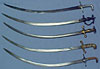
Join Date: Dec 2004
Location: Route 66
Posts: 10,870
|

Very, very nice David!!!!
But I would beg you, please show respect for this old warrior! If I was the lucky one owning this piece of history, I would stabilize it (just clean up any active rust with oil), and leave it intact. Its very unusual to see these mounted with rapier blades and especially that appear homogenous. I know that the Mahrattas would often obtain rapier blades from the Portuguese, but typically see the broadsword blades mounted in these khanda hilts. Just my opinion....but I love these rusty old swords for thier history, and care little for show There's nothing like reading on a historical period and place and holding one of these, as if its saying "..I know...I was there!!!" And I well understand the 'Errol Flynn' thing.....its pretty much his fault I got caught up in the 'swords' thing. I'll never forget my dads immortal words as I pursued fencing in school....."...good Jim...something you can always use!" and grumbled more unintelligibly as he stalked off. Envious regards, Jim |
|
|
|
|
27th November 2007, 10:08 PM
|
#3 | ||
|
Member
Join Date: Jan 2006
Location: Kent
Posts: 2,658
|
Hi Jim,
thank you very much for your reply, I am very pleased Quote:
 Quote:
 Kind Regards David |
||
|
|
|
|
27th November 2007, 10:45 PM
|
#4 |
|
EAAF Staff
Join Date: Dec 2004
Location: Louisville, KY
Posts: 7,417
|
Yeah, at this point, I also agree that an attempt at restoration would damage it. Active rust is the only living threat now.......
|
|
|
|
|
27th November 2007, 11:52 PM
|
#5 |
|
(deceased)
Join Date: Dec 2004
Location: Portugal
Posts: 9,694
|
Hi David,
I understand you are only allowed to touch it ... for taking better pictures That's a chest full of history. Congratulations. If ever you get fed up of having it ... just tell Fernando |
|
|
|
|
28th November 2007, 11:30 AM
|
#6 |
|
Member

Join Date: Oct 2007
Posts: 2,818
|
NNNNNNNnnnnnnnnnnnnniiiiiiiiiiiiiiiiiiiiiiiiiiiccc cccccccccceeeeeeeeee!!!!!!!!
Gav |
|
|
|
|
28th November 2007, 12:52 PM
|
#7 | ||
|
Member
Join Date: Jan 2006
Location: Kent
Posts: 2,658
|
Thank you Battara for your opinion
Quote:
if the blade ever tells me it's 'homesick' for Portugal ..... you'll be the first to know ..... but I'll warn you now... I'll probably just 'gag' it and ignore it's pleading  Quote:
Would anyone know how 17thC Rapier blades were marked ? When searching 'Firangi' I found an example that was cited as Moghul, the blade was the 'broadsword' type but the hilt had similar features including the 'line' detail on the knuckle guard. Could this be Moghul ? I am also interested in how this sword would have been used. Do you think the sword technique would be similar to European Rapier use? I wonder whether the wide pommel would limit the wrist action/movement often used to control a rapier. Would a 'main gauche' or small buckler be used in tandem with this sword ? Regards David |
||
|
|
|
|
28th November 2007, 02:17 PM
|
#8 |
|
Member

Join Date: Dec 2004
Location: Europe
Posts: 2,718
|
Hi David,
Congratulations with your ’new’ khanda, or should I say firangi, as the blade most likely is a European rapier blade as Jim writes. Some would clean it so it looked like the day it was used, finding this more ‘historic’, while others would stop any active rust and let it be at that, keeping the patina as part of its history – I would say it is up to the owner to decide. To me it looks as if the gild could be new, be course there seems to be rust under the gold – the surface looks very rough. You have the sword in your hand, so you are a better judge than I am – do you think there is rust under the gold? Fighting, using a sword with a blade of 100 cm, would only have been for the best swordsmen to handle, just like not any swordsman could handle a pata – don’t forget that the blade is 20-30% longer than most Indian blades. Jens |
|
|
|
|
28th November 2007, 05:18 PM
|
#9 | |
|
Arms Historian
Join Date: Dec 2004
Location: Route 66
Posts: 10,870
|
Quote:
I'm very glad you asked this question!!!!! There happens to be a concurrent thread titled EARLY MAKERS TRADE MARKINGS which we have had open for some time now. The purpose of that thread has been to develop a resource which talks about the many blade markings and inscriptions found on trade early trade blades, which indeed often included rapier blades as your example clearly illustrates. I have trying to convince the forum that the markings found on European trade blades is an important topic in the study of ethnographic swords and edged weapons, unfortunately the overall interest has seemed less than resounding. I am extremely grateful to the members who have actively participated in the thread thus far, and they have already developed the thread comprehensively as a resource that gives us excellent material on these markings. What is very exciting about your firangi, which is obviously in original state as mounted, proves that not only were early European blades mounted in swords in India, but more importantly, the thin rapier blades were as well. The questions you have so astutely asked are exactly in line with my contention on the markings thread We have discussed many times over the years, whether European swordfighting techniques actually influenced Indian swordsmen, or whether they simply used the blades to mount in the swords without particular concerns on the key movements applying to the blade or sword forms. One of the great conundrums has been whether the forefinger was scrolled over the quillon to grip the hilt, as often seen in use of 17th Italian and Spanish rapiers. I hope you and other readers will visit the thread on markings, and I think you will find many important answers on the markings and inscriptions found on these blades. Using the search will reveal some of the various discussions concerning the swordfighting techniques. Thank you for posting this important example David, and especially for addressing the key questions associated with these weapons! All very best regards, Jim Last edited by Jim McDougall; 29th November 2007 at 04:30 AM. |
|
|
|
|
|
28th November 2007, 07:01 PM
|
#10 |
|
(deceased)
Join Date: Dec 2004
Location: Portugal
Posts: 9,694
|
Hi David,
As Jens days, not any man could handle these things. Concerning their fighting style, while the experts don't post their saying, you may have to consider one of options, in my humble opinnion. If this were a basic khanda, a two thousand years old hindu weapon, the blade would be straight and single edged, some times with its back reinforced and adorned. The blade shape could widen towards the tip, thus only being efective for thrust if the adversary was not body armoured. Its slashing power, however, was most feared throughout Asia ... one blow could mutilate an arm, armoury included. Remember this is a sort of "bastard" or "hand and half" sword, with that extra spike in the hilt. Such hilt being padded, could absorse the impact. If it were a Firangi with a wide blade, the function could well be the same. But being mounted with a rapier blade, maybe the option could tend, at least partly, to thrust fighting, following the original blade purpose. On the other hand, those guys didn't use left hand daggers, nor did they go for fencing. When they used a support device, that would be the shield, very often a minuscle one. The Portuguese used to call it "rodela", to remind its round small size. Concerning the blade marks, it's the usual lottery; some were blank ( maybe most of them ), and others were single or even profusely marked. I would recomend you to check on the thread opened by Jim on this theme http://www.vikingsword.com/vb/showthread.php?t=5453 I hope all i said doesn't sound nonsense  Fernando |
|
|
|
|
30th November 2007, 06:12 PM
|
#11 |
|
Member
Join Date: Jan 2006
Location: Kent
Posts: 2,658
|
IT'S ARRIVED......
Hi Jens, thank you, the gilt colouring must have been caused by the lighting conditions when the original photographs were taken. Hi Jim and Fernando, thank you for your input. This is definately old , it seems that the rust has been stablised and the sword seems covered with a thin transparent coating The blade has a short central fuller, the blade 17mm wide, 5mm thick at the forte. Distally tapered thickness from 5mm - 1mm at the tip. Flatterned hexagonal in cross section and double edged. Tip is damaged. There is a row of 4 dots with a slightly smaller one above the second dot (see photo) I'll assume they are the original maker's mark and are present both sides of the blade. Also within the fuller there are 'dots' that appear to be a 'rivet' but it is not directly present on the exact opposite side of the blade, as if it is some sort of 'inlay' (see pics) As to construction.... the missing domed pommel and but spike is very revealing. The Rapier blade is held (two rivets) by two strengthening plates which are inverted 'T' shapes creating a cross guard. Fitted to this 'crossguard' is the 'shell' of the guard, this is one piece construction and includes the knucklebow and the inner 'domed' pommel end. The 'handle' is a contoured pipe which is fitted between the guard shell and the inner dome. Although the blade is secured to the hilt by the two rivets, it still has a tang which passes through the guard 'shell' through the handle and then through the 'inner' dome. The tang has sheared (a long time ago) but would have continued through the hilt 'outer domed' piece and would have been fixed to the but spike holding it all securely. I believe that there is a very strong possibillity that the damage occured during combat. I think that the sword was being used two handed (using the but spike) and after a powerful strike (perhaps against a hard object) the tang sheared ...losing the pommel spike and pommel dome. I have found that the pommel 'dome' is small enough not to interfere with wrist movement, which suggests to me that this could be used as a Rapier....cut and thrust style. Regards David Last edited by katana; 1st December 2007 at 12:54 PM. |
|
|
|
|
1st December 2007, 03:11 PM
|
#12 | |
|
Member
Join Date: Jan 2006
Location: Kent
Posts: 2,658
|
After reading Fernando's post on this thread...
http://www.vikingsword.com/vb/showth...?t=5453&page=1 Perhaps the 'dot grouping' of a row of 4 with one dot above is to signify the number 14 or 41. Quote:
|
|
|
|
|
|
1st December 2007, 06:22 PM
|
#13 |
|
Member
Join Date: Dec 2004
Location: Greensboro, NC
Posts: 1,099
|
Am I seeing lamination in the fullers?
|
|
|
|
|
1st December 2007, 06:44 PM
|
#14 |
|
Arms Historian
Join Date: Dec 2004
Location: Route 66
Posts: 10,870
|
Very astute observation David! That really does seem to tie in with the fascinating variables in concert with the numeric 7 as you have noted. Fernando has been instrumental in providing remarkable data on the numerics and markings that illustrate the importance of symbolism that exists on these blades from the Portuguese parlance. Clearly this is key with our topic on the thread we have going on 'Early Makers Trade Markings' and the history of the markings that occur on ethnographic weapons' blades.
This firangi of yours is perfect evidence for that topic! Nicely done!!! All best regards, Jim |
|
|
|
|
1st December 2007, 09:10 PM
|
#15 | |
|
Member
Join Date: Jan 2006
Location: Kent
Posts: 2,658
|
Quote:
Hi Jim, I thought the 'dot' pattern of 4 and 1 could be a possible reference to 14, I'm hoping that Fernando may be able to find a reference to this type of marking. Do you think I should repeat my last posting on the ' early maker's trade marking' thread ? I have been researching Rapiers in an effort to be able to approx. date the blade, it's combat use etc. and hope to post my findings soon. Kind Regards David |
|
|
|
|
|
1st December 2007, 09:38 PM
|
#16 |
|
Arms Historian
Join Date: Dec 2004
Location: Route 66
Posts: 10,870
|
Absolutely, please do post on the other thread David!
I'm looking forward to what you find on the rapier blade, and I think this sword will be a valuable addition to the thread on markings. It seems we are really expanding the understanding of the markings we are finding, from these simple numerically arranged dots to more complex forms of symbol. All best regards, Jim |
|
|
|
|
1st December 2007, 10:04 PM
|
#17 | |
|
(deceased)
Join Date: Dec 2004
Location: Portugal
Posts: 9,694
|
Maybe ...
Hi David
Quote:
As if i knew what i am talking about  Fernando |
|
|
|
|
|
1st December 2007, 10:47 PM
|
#18 |
|
Member
Join Date: Apr 2006
Location: England
Posts: 104
|
Ah wonderful! I was watching this sword with interest on ebay but decided not to put a great deal of money on it. Lovely sword. The only think I would consider would be to perhaps wrap some material around the grip.
William |
|
|
|
|
2nd December 2007, 02:53 PM
|
#19 |
|
Member
Join Date: Jan 2006
Location: Kent
Posts: 2,658
|
Hi Fernando and William .M, thank you for your input
The Rapier 'evolved' very rapidly from the 16th C, having a thick, long blade with cutting edges and a sharp point. By the late 17thC most of the blades had become much thinner, lighter and with the sharp point were designed for the thrust only. The blade on this Firangi fits this description. The origin of the blade is difficult to find, as the blade shape and cross section was common to English, Spanish, Italian and Portuguese made blades of the mid to late 17thC. Hi Fernando, you are correct. As the blade was designed to 'thrust' it is unlikely the sword was used two handed to strike (cut) by using the pommel 'spike'. However, I still believe, that originally, this sword had one. I have read that sometimes European swordsman would hold a rapier by the pommel, effectively 'lenghening' the reach of the blade tip. Done quickly and covertly an opponent that was safe in the knowledge that he was just 'out of reach' ...suddenly wasn't The pommel spike would 'add' this advantage. Also, you could argue that if the sword was used two handed the force of the thrust would be much greater.Stone in 'A Glossary .....Arms and Armour...' shows a Firangi with a thin, long Rapier blade with the pommel spike.Rapiers were 'hilt' heavy, to allow greater control of the tip of the blade, the pommel spike would also enhance this necessary 'balance'. The effectiveness of the Rapier in battle conditions is debateable. Writers of the time (16th-17thC) had varying views on the subject. Used from horseback seems the most 'popular', presumably because of its greater blade length. However, the Rapier would be ineffective against full armour. As Rapier blades were lighter than many swords of the time ( and not strong enough, to directly parry a heavy blade) a 'companion' was used in the left hand to parry blows from an opponents sword. In Europe the 'main gauche' (dagger), a buckler (small shield) or a cloak (wrapped around the arm to cushion the blow or waved about to confuse and deceive your assailant) were used. Common sense suggests that the Indian swordsman that used this Firangi probably used a dagger or a Dhal in the opposite hand. Traditionally a Dhal would be used with a Talwar or similar, and would imagine that the dhal would be the favoured choice. Rapier use tends to be skilled, relying on accurate, lethal thrusts to major organs and the head. Apparently a thrust to a depth of a few inches in specific bodily areas would be 'fatal'. It was not unheard of that two combatants 'charging' at each other would 'run each other through' (ouch!! ) .. a depth of a few inches could easily be achieved, thin and flexable enough to penetrate the rib cage (deflecting around bone in certain situations) http://www.thearma.org/Youth/rapieroutline.htm http://swordforum.com/articles/ams/char-rapier.php http://jan.ucc.nau.edu/~wew/fencing/blades.html How was this sword used in India...... why would the Indians adopt a totally alien sword? Did it find a niche/function in the armoury that the other weapons could not fulfil ..... or was it just that it was 'different' ? Any thoughts? Kind Regards David Last edited by katana; 2nd December 2007 at 03:25 PM. |
|
|
|
|
2nd December 2007, 09:55 PM
|
#20 |
|
Member
Join Date: Dec 2004
Location: Europe
Posts: 2,718
|
Hi David,
How many Indian firangis have you seen with a rapier blade? If you have not seen many, what gives you the thought that the Indians had adopted the rapier? I don’t think they had, and if a few Indians, maybe, had learned to fight with a blade like that, does not mean that they could/would have used this skill when it came to a battle, where all the others fought in another way. Until further I would think it is a sword for show, more than a fighting sword. Jens |
|
|
|
|
3rd December 2007, 01:46 AM
|
#21 |
|
Arms Historian
Join Date: Dec 2004
Location: Route 66
Posts: 10,870
|
Is it possible that a Portuguese official might have chosen to adopt a native hilt to his rapier blade. In colonial situations many occupying forces, and officials involved either as diplomats or merchants seem to have adopted the elements of costume and weapons of the local population. This was often prevalent during the British Raj, and even English diplomats from the 17th century trading with Morocco can be seen in portraits wearing the nimcha.
|
|
|
|
|
3rd December 2007, 01:13 PM
|
#22 | |
|
(deceased)
Join Date: Dec 2004
Location: Portugal
Posts: 9,694
|
Hi David ... Jens ... Jim,
Amazing thing Quote:
Last night ( over here ) i was rehearsing my english for posting such hypothesis, but i have given it up as not consistent, coming from my layman knowledge  . .Obviously it sounds more plausible, coming from Jim. It is indeed a strong possibility. Remember that rapier fencing requires a lot of school. Talking about rapiers, this is a name that covers quite a lot of diverse sword stuff, just because blades are narrow, or the hilt is worked up. Even being an actual rapier, there are distinct versions of it. Tell me David, is the blade on your firangi a stiff one ? It must be, with is flattened hexagonal cross section. I would say it is decidedly a thrusting device, not currently within the habits of India peoples. And you don't learn these fencing techniques overnight ... right Jens ? But then, tell me another thing, David: Is the grip large enough to acomodate an European hand ? You know the usual problem with this subject. Fernando Last edited by fernando; 3rd December 2007 at 01:46 PM. |
|
|
|
|
|
4th December 2007, 03:43 AM
|
#23 |
|
Arms Historian
Join Date: Dec 2004
Location: Route 66
Posts: 10,870
|
Hi Fernando
I'm glad you were thinking the same thing. The more I think of it, indeed the skill of rapier technique required lengthy and intense training, and it would be unlikely for someone unskilled to use one. In actuality, the Mahrattas and certainly other groups in degree were against the use of the thrust, favoring slashing cuts. This interesting hybrid seems likely to have been either for a civil official or as noted an influental merchant, but hard to determine whether Indian or possibly European. As you have noted, the often discussed observation on hilt size would seem to have some indication, despite the often noted suggestion that even Europeans were smaller then. In either case, this sword was likely a weapon intended as an element of prestige, not necessarily for combat use. All very best, Jim |
|
|
|
|
4th December 2007, 01:33 PM
|
#24 |
|
Member
Join Date: Jan 2006
Location: Kent
Posts: 2,658
|
Hi Jens, Fernando and Jim,
Thank you for your thoughts Although it is possible that this Firangi was created for a European, I think it unlikely. First of all the hilt is small, the actual handle section is only 3" (7.5 cms) 'suggesting', if the 'small hand debate' is correct, that this was for use by a native warrior. Secondly, the hilt design is 'restrictive' compared with a typical Rapier hilt and would not allow the 'normal' sword technique associated with the Rapier. Therefore it is unlikely a European would carry this sword for defence, as the hilt would make it difficult to use, with the sword technique that was known to him. A potentially lethal mistake. Thirdly, there is no evidence of any decoration or embellishment......surely a Dignitary or rich merchant would 'require' this, to enhance his status. To me this is a functional, basic sword for use, not personal adornment. Fourthly, I have learned that the fencing 'cut and thrust' we associate with Rapiers is a 'Hollywood' exaggeration. A Rapier had minimal cutting ability, cuts received from a Rapier tend to be 'superficial', used to distract, annoy and confuse your opponent. A true Rapier was a thrust weapon, plain and simple. Training in the more 'advanced' use of the Rapier would be required if your opponents were also expected to be armed with a Rapier. Fifthly, Indian soldiers were very used to employing a Dhal to parry sword blows. Much of their sword technique require this and would be an easy transition to the use of a Dhal and Rapier (Rapier vs. Rapier, the main gauche or small buckler was not as important, but against heavier swords it was essential) Sixthly, not all Indian weapons were for the 'cut', the Pata would mainly be used as a thrust weapon, as were the long bladed Kata Seventh, Indian swordsman, knowing the sword technique for Tulwar/Khanda would surely 'create' their own technique (with the Rapier bladed Firangi) against them. Bearing in mind the Portuguese, a number armed with Rapiers, had taken Goa, and was established there by military force. The locals would have seen the Rapier in action. I believe that the Indians did find a niche for the long thrusting blade, attacking horse mounted soldiers 'springs to mind', lighter, longer and easier to use than a heavy Khanda. In the descriptions of a few Rapier bladed Firangi I have seen, many stated that the blades are edge sharpened for most of their length (as is mine) This was likely an Indian modification because true Rapiers, at most, had 1/3 of the blade sharp edged (from the tip), if at all. I agree that there are very few Firangi of this type, bearing in mind the Rapier was losing favour in Europe (early 18thC) due to Social/fashionable reasons (rather than the effectiveness of the Rapier) could be a reason for the blades decline in India. Obviously the 'other end of the story' could easily be that these were not as popular with Indian soldiers I cannot find any references to the use of this type of Firangi in India, and could be any number of reasons.Kind Regards David |
|
|
|
|
4th December 2007, 02:09 PM
|
#25 |
|
Member
Join Date: Jan 2007
Posts: 803
|
Hi David,
I'm no expert here, but you mention the Pata being mainly a thrust weapon. What I have read, indicates the Pata was a cutting/slicing weapon, and had a springy, thin blade. You may of heard of the Pata demonstration, where the small limes are set on the ground in a circle, and the sword wielder chops them neatly in two, without breaking his wild dance steps. All the best, Richard. |
|
|
|
|
4th December 2007, 02:39 PM
|
#26 |
|
Member
Join Date: Dec 2004
Location: Europe
Posts: 2,718
|
David,
I am with you a long part of the way, and agree with you; but I don’t agree with you, when you say that the pata was mainly used for thrusting. Remember that at least some of the patas were mounted with flexible blades, not at all suited for trusting against a chain mail. There is, however, one type of ‘sword’, which I thought of when you showed the rapier blade (see the picture). It was used for only one thing, to kill an opponent dressed in a mail shirt, or maybe in plates, trying to find a weak point. The blade is not sharp at all, on the contrary, it is squarish/roundish, but the tip is made for stabbing and it is not flexible at all. I can only remember to have seen one single one before, in the Army Museum in Istanbul. Richard, the lime cutting - excelent. Jens |
|
|
|
|
4th December 2007, 03:05 PM
|
#27 |
|
Member
Join Date: Jun 2007
Location: India
Posts: 102
|
 Type of 'Sword'
David, Jens,
Isn't the 'sword' in the middle of the 3 on display similar to the one you have shown? This is from the Arms and Armour section at the local museum here in Shimoga, South India. Olikara Last edited by olikara; 4th December 2007 at 03:06 PM. Reason: Added detail |
|
|
|
|
4th December 2007, 03:13 PM
|
#28 |
|
Member
Join Date: Dec 2004
Location: Europe
Posts: 2,718
|
Olikara,
Its an interesting picture, and yes, I think it must be with a rapier blade. I don't know what the blade I shower is called in English, but in German it is called a Panzersticker - or something along this line. These blades are really rare, just imagine to go to war with a blade which is dull, really dull, it can only be used for thrusting. Unless the one using it had a backup armed with a choise of swords, so swords could be changed during the fight. Jens |
|
|
|
|
4th December 2007, 05:08 PM
|
#29 |
|
Member
Join Date: Jan 2006
Location: Kent
Posts: 2,658
|
Wow, so many postings ...in a short period of time.
So bear with me as I try to address all the questions and comments..... Hi Richard, nice to hear from you As to your comments ..and Jens (Hi Jens) regarding the Pata. I didn't explain myself properly, I should have said '...a number of Pata...' My opinion on the Pata is based on 'engineering criteria'. If you look at the majority of the 'fixing points' of the blade to the gauntlet they seem 'weak'. A cutting blade would, during combat, be likely to strike armour, a shield or another blade. The blade, primarily would 'take the impact' and assuming it was strong/resilient enough, would not break. This impact stress would then be transferred to the 'fixing point'. As you can see on Fernando's and Bill's Patas .....compared to a Khanda and my Firangi they are 'weaker'. If the blade were to be lost in battle ....the metal gauntlet left would not inspire my 'survival chances'. I do believe the Pata could be used to cut/slash but feel that stabbing would be a 'safer' technique. I have never heard of the 'Lime demonstration' but strangely and coincidently I, using this Firangi to cut two 'upright' banana's....it left both halves on top of each other !!! I was curious as to how the blade would cut, and didn't want to damage the blade with a more worthy target The sword was easily controlled and its 'action' is very quick ... a 'joy' to play with ...well 'play' is inaccurate...but it is 'fun'.The Rapier bladed Firangi has its blade firmly fixed and supported by the 'inverted T plates', spreading the 'load/stress' if used in a cutting action. To reinforce this further, the tang of the blade continues through the hilt and would have terminated at the pommel spike (had it been there). A strong fixing indeed, as if this was used to 'cut' as well as 'stab'. (remembering that the blade is double edged from tip to the 'mounting' plates. This strongly suggests that the blade was adapted, AFAIK all 'true' European Rapier blades had this feature. Jens thank you for showing this sword, the 'blade' is similar to 'later' Rapier 'blades', used, as this one, to stab...from long range. A very interesting sword, it suggests to me that the advantage of a 'long range' thrusting weapon was 'known' by the Indian sword designers. Which could add 'weight' to the possibility that re-hilted Rapier blades were used differently to the Rapier. Hi Olikara, thank you very much for posting the picture , do you have any information about the middle Firangi ? It would seem strange to have a sword possibly attributable to a European 'invader', exhibited with other Indian swords This is getting very interesting.....thank you Kind Regards David |
|
|
|
|
4th December 2007, 06:34 PM
|
#30 |
|
Arms Historian
Join Date: Dec 2004
Location: Route 66
Posts: 10,870
|
David, I have been rereading your posts of late, and very much enjoy your detailed and well explained perceptions on the rapier, fencing as well as possible applications in India! Extremely well written and primarily right on target, and the exception with the use of the pata has been noted and discussed. I think for the pata, it would depend on which region of India and which tribal group was using them would determine more on the manner of use. As noted, many of the highly flexed and more spatulate point blades were of course for slashing cuts. I very much like the graphics you have used to demonstrate the construction alignment suggesting probable manners of use.
What you have noted on the use of the rapier is impressively well said, and as you have noted, there were indeed a great deal of 'theatrics' involved with the swordplay of the rapier. This of course carried itself perfectly into Hollywood, where such combat was exaggerated profoundly. I recall many years ago in my very limited exposure to fencing, where courses in 'stage combat' were specifically designed for this. As you have explained, actual combat with the rapier was based on feints, distraction and as best exemplified in the complexities of Destreza, many of these moves were composed with geometric and mathematical precision. Just as in the fabled "Wild West" ,one having actually been there would have likely been disappointed by actual conflicts, which were primarily simple and mundane events rather than the dramatic gunfights in movies, the duels and sword combat with these weapons was mostly much the same. It is of course the writers and poets that embellish such matters, and while we are richer for it in our entertainment and literature, it does little for serious study of these weapons. The interesting thrusting weapon that Jens has brought up with the mail piercing blade brings up some compelling thoughts on this firangi, and it does seem plausible the rapier blade was mounted in firangi hilt much in the same manner as the tulwar hilt. As Olikara has added the example in the Indian museum, it seems that the form was decidely present. Although the khanda hilt typically is associated with Mahratta and eventually Rajput and Sikh use, these blades could well have been intended for the penetration action suggested, as more probably with the Rajputs who did employ such thrusting. This is not to say the Mahrattas might not have adapted to combat techniques as required though. The narrow thrusting blades used in Europe that Jens has mentioned were termed as he has noted in German forms, and more commonly known elsewhere as the 'estoc', and these were often carried under the horsemans leg scabbarded from the saddle. These were long blades, and used for combat on foot as were the heavier pallasches often carried in the same manner (see Rembrandts "Polish Rider" painting). While Muslim warriors typically used sabres with drawcut and slashing following the development of the sabre and distinctly disfavored the thrust, examples of Islamic rapiers known as the 'mec' did exist (see Yucel). I think we can presume here that the idea of use of this firangi by a European individual no longer seems plausible, and that it was indeed intended for use by someone there such as noted. While it has been well shown that these thin blades were apparantly intended for use in combat, it remains that an official could well have wished to emulate the weapons seen worn by the Europeans. Not all individuals would have required elaborate decoration nor been able to afford it, such as civil officials etc. not necessarily of station to appear in court atmosphere. Best regards, Jim |
|
|
|
|
|
|


 Linear Mode

