![]() |
|
|
|
|
#1 |
|
Member
Join Date: Mar 2007
Posts: 65
|
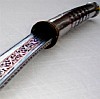
I'm not an expert but the scabbard and tsuba combinations are similar to the ones listed as Cambodian on Mark's website ( they're actually are part of Ian's collection ) . There's a picture of one of them on the History of Steel's website:
http://www.arscives.com/historysteel/images1/263-iag04.jpg The turned wooden grip looks Thai ( Siamese ) and many modern Thai daab share this feature . The knife looks like a Thai priest knife and I would agree that the markings look Thai . I think Ian's subsequent response would give you the definitive answer to your questions. |
|
|
|
|
|
#2 |
|
Member
Join Date: Nov 2004
Location: USA
Posts: 1,725
|
I think Cambodian weapons are ripe for more research. Frankly, I have yet to really get a good appreciation for what, exactly, constitutes a "Cambodian" sword. Ian does have a few that defy easy insertion into the more familiar classification groups, but I think we've all tended to fall back on "Cambodian" as a default in such cases. Not to say the reasoning that gets us there isn't sound, just that it lacks extensive data to support it.
Ariel, I like this group of weapons very much. Thanks for sharing with us. If you ever want to part with that pole-arm/sword catcher, please contact me immediately!
|
|
|
|
|
|
#3 |
|
Member
Join Date: Dec 2004
Posts: 987
|
The second one is very interesting. No opinion about it being a polearm blade, but it sounds plausible.
The features of a Cambodian dha are a sharp change or bend in the overall sweep of the sword between the blade and the handle, something Ian has identified, the presence often of a tsuba, and a scabbard with an upswept tip rather than the square or round ones seen in other dha. I don't think we have enough strongly-provenanced blades to really confirm whether these are consistent, nor indeed even if such swords are "Cambodian" (i.e., Khmer) as opposed to being of a Tai minority. |
|
|
|
|
|
#4 |
|
Member
Join Date: Dec 2006
Posts: 102
|
the first one does seem to have a Japanese appearance to the "tsuba" and basic blade shape. The tsuba has what looks to be an oval marking around the blade indicating it might have originally had a seppa (washer) also the oval hole is for a small utility knife (kozuka/ Kogatana).
I apologise if these are very obvious comments. If you were able to remove the handle to we can see the tang then maybe more info will come to light. My guess is that it is a composite piece using an old japanese blade and tsuba? Cheers Jason |
|
|
|
|
|
#5 |
|
Member
Join Date: Dec 2004
Location: Ann Arbor, MI
Posts: 5,503
|
Jason,
Wish you were right..... No, there is no chance this blade was made my Masamune, Muramasa or even the most undistiguished Japanese smith This is a product of a very primitive village foundry, far, far away from Bizen...No sense disassemmbling it. The tsuba is , as you say, reminescent of a Japanese general geschtalt, but is definitely NOT Japanese either: its core is soft metal ( copper? I seem to see some reddish hue) and is clad on both sides with another metal that even peeled off the base. The decorative motives are pretty basic and technically simple over the weekend I shall gently clean them and see what transpires. Hope to find an inscription " This belongs to Mr. Pol Pot. Pretty please do not touch. Or else...." |
|
|
|
|
|
#6 |
|
Member
Join Date: Dec 2006
Posts: 102
|
Hahahaha
Yes I probably should have worded my thoughts a little better. - Its not going to be the lost heirloom piece missing from the Imperial Castle. However I have never seen any other guard/ tsuba thingy that has a hole exactly in position for a small knife other than Japanese. THe basic shape is Japanese-ish maybe a WW2 tourist GI piece from the islands that found its way to Cambodia? Copper and soft metals are very common on genuine tsuba as are rough and basic designs. I dunno but the tsuba is the bit that had me intrigued? Cheers JAson |
|
|
|
|
|
#7 |
|
Member
Join Date: Dec 2004
Posts: 987
|
I think that it is more likely that the tsuba is an immitation. You see a strong Japanese influence on dha the further east you go in this area.
Maybe Rich Stein will have a comment on whether soft metal was ever used by the Japanese. |
|
|
|
![]() |
|
|