
|
 26th October 2021, 02:27 PM
|
#1 |
|
Member
Join Date: Jun 2005
Posts: 299
|
 Link from pappenheimer to boca-de-caballo hilt
This sword is driving me nuts. I found it a month ago in the Canary Islands. Because it is a dangerous pointy object, it cannot travel by plane. So it had to be embarked. Then, the seller stopped communications for two weeks. Today, she reappeared, confirming me the sword is on a boat, and that she went missing because she had to attend business in La Palma due to the volcano.
Pictures are hers. I do not even know at this point if the blade has an inscription. I would call this a Brescian hilt with a cavalry military blade. Probably from around 1680. I believe Brescian hilts evolved from German shell swords, and these started as a sort of Pappenheimers that were influenced by Swedish cavalry swords, also with two shells (like the one Gustav Adolf was carrying at Lützen). The Brescian hilts in Spain come in two flavours, both have characteristic decorations in one of the shells. There are delicate rapiers and massive cavalry swords. Usually they have long quillons, but in this example they have been cut down and twisted upside and down, just as those from 1728 Spanish cavalry models (boca-de-caballo), probably because they interfered with fencing from horseback. There is another field reparation at the knuclebow. Probably this sword saw 30 or more years of battle use. First against the armies of Louis XIV and then fighting alongside them, or maybe with the Habsburg pretender, in the War of the Spanish Succession. Last edited by midelburgo; 26th October 2021 at 02:42 PM. |

|

|
|
26th October 2021, 04:34 PM
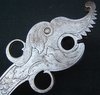
|
#2 |
|
Member
Join Date: Dec 2004
Location: NC, U.S.A.
Posts: 2,236
|
Very nice piece! Not an expert, but I think this would be classified as a 'Spanish colonial' broadsword of provincial manufacture. Very similar to the Spanish colonial Caribbean rapiers and bilbos (sorry, we know this isn't the correct term, but has become so mainstream, it's easier just to use it!) coming out of the Americas. I base this on the the undecorated state of the blade and guard, the relative primativeness of the decoration, the mushroom-shaped plain pommel and most importantly, the shape/assemblage of the knucklebow and quillon, so similar to Central American/Caribbean espadas. Note the snake shaped downward quillon on this espada and the D-shaped flat-sided knuckle bow on this provincial bilbo...
Last edited by M ELEY; 26th October 2021 at 11:06 PM. |
|
|
|
|
26th October 2021, 05:13 PM
|
#3 |
|
Member
Join Date: Mar 2009
Posts: 1,071
|
I believe it is second half of the 18thc spanish bilbo sword for the cavalry.
best, |
|
|
|
|
26th October 2021, 09:46 PM
|
#4 |
|
Member
Join Date: Jun 2005
Posts: 299
|
These are Brescian rapiers from the second half of the XVIIth century. Civilian weapons very common in Spanish museums. Spaecially those eith the dog/lion decoration.
Last edited by midelburgo; 26th October 2021 at 11:11 PM. |
|
|
|
|
26th October 2021, 09:50 PM
|
#5 |
|
Member
Join Date: Jun 2005
Posts: 299
|
And these are military cavalry swords with Brescian hilts from the second half of XVIIth century. The one with the motto has been rehilted with a blade of about 1775. The group of three is from Segovia Alcazar.
Last edited by midelburgo; 26th October 2021 at 11:13 PM. |
|
|
|
|
26th October 2021, 09:58 PM
|
#6 |
|
Member
Join Date: Jun 2005
Posts: 299
|
And this is a sort of German sword from where I believe the Brescian hilt evolved. Possibly c1630.
I believe next one is an early Brescia from 1640-1650. Last edited by midelburgo; 26th October 2021 at 10:58 PM. |
|
|
|
|
26th October 2021, 10:12 PM
|
#7 |
|
Member
Join Date: Jun 2005
Posts: 299
|
And these are munition swords imitating the Brescian style. Possibly used in the navy and now known as colonial swords. They are usually short, for combat on foot. Cheap blades. Probably early to middle XVIIIth century.
Last edited by midelburgo; 26th October 2021 at 10:46 PM. |
|
|
|
|
26th October 2021, 10:28 PM
|
#8 |
|
Member
Join Date: Jun 2005
Posts: 299
|
Boca-de-caballo swords (known often as bilboes) are easier to build. Instead of a single forged piece, something difficult to make and that rarely you see in replicas even today, they have two pieces bound by screws.
Originally two screws, with the result of many hilts broken at the weakened union of the two shells. They were around before the 1728 model was defined. Later 4 screws. Then from 1761 on the pieces with the four screws were made as a frame, much stronger. The 1728 model became completely standardized by a new ordonance that year, about the same time Toledo factory started working Quillons are usually twisted because seated on horseback were easy to entangle in the horse furniture. Many swords have had their quillons straightened in later years by collectors. So my Canary sword precedes the 1728 model, and it is an interesting step in its evolution. Spain lost most of its Italian territories, including Milan in 1706. Possibly Brescia weapons stopped being delivered then. Last edited by midelburgo; 26th October 2021 at 11:35 PM. |
|
|
|
|
27th October 2021, 09:16 AM
|
#9 |
|
Member
Join Date: Mar 2009
Posts: 1,071
|
here is another example of a Spanish 18th century cavalry bilbo, with a lion motif on the hemispherical cup. I think the rapier of post 1 has been modified a bit during its working life, guillons shortened and knuckleguard linked to the pommel.
best, |
|
|
|
|
27th October 2021, 12:32 PM
|
#10 | |
|
Member
Join Date: Jun 2005
Posts: 299
|
Quote:
Those hilts were typical of XVIIth century rapiers, that became obsolete in Spain after Felipe V enthroning in 1701. The sword you show is from last third of the XVIIth century. It will not fit the Spanish 1728 military regulations, not any other after that. The 1762 engraving corresponds to the model 1728 in the last two pictures of my previous post. Notice that quillons are twisted as design. Last edited by midelburgo; 27th October 2021 at 01:44 PM. |
|
|
|
|
|
28th October 2021, 08:09 PM
|
#11 |
|
Arms Historian

Join Date: Dec 2004
Location: Route 66
Posts: 10,867
|
I think Mark and Jasper presented a very viable suggestion thier earlier posts, that this is quite possibly a Spanish colonial version of a 'bilbo' from 18th c.. It seems quite likely that the Brescian designs may have been followed later in more a 'munitions' grade development.
In the Spanish colonies the use of obsolete equipment and the continued favor of much earlier designs was prevalent. This has been constantly noted in many references concerning these colonial times and Spanish contexts. The M1728 was a designation for the style of arming rapier which became colloquially termed 'bilbo' by collectors, and boca de caballo by locals, as previously noted. It should be remembered that these, in variation, were probably in use for years before the regulation. In references on Spain's colonies I recall notes saying that, the administrative aspects of military regulation was notoriously slow, and commonly this type of situation occurred. Midelburgo, thank you for the excellent notes and details in your posts on this and the swords of its type! very informative and helpful in better understanding development of these features. |
|
|
|
|
29th October 2021, 01:51 AM
|
#12 |
|
Member
Join Date: Jun 2005
Posts: 299
|
I have found that obsesion with "colonial" and "caribbean" Spanish swords before. I will copy myself from a previous post:
About the colonial description, we have to think that what makes nowadays differences between Hispanic America and Spain is that they have evolved in different ways since the early XIXth century. Often Hispanic America has kept characteristics from XVI to XVIIIth centuries that were also common in Spain once. Language is full of those. So it is often not easy to say that something is Colonial about a piece from the XVIIth century, because it could have been just the same at both sides of the Atlantic at its proper time. For example the University of Mexico started working in 1551, and soon there were book presses everywhere. Of course we cannot forget the native substrate, but while this was crucial on the arts and the everyday living, it influenced little the military matters. The swords I have shown are mostly from European (Spanish) collections. I have never seen a real Brescia hilt coming from a South America country, although probably they could be found in archeological sites (underwater specially). Officers used to return with their belongings, or they could stay. The fact is that we have plenty of documentary data on the shipments of weapons to America in the XVIIIth century. Remember, Spain was extremely burocratic, and the archives have been kept up today. In the book I include below, some of the contracts for swords have been studied next to letters from the presidios with the opinions on Barcelona or Toledo blades. In XVIIIth century there was precisely an obsesion with uniforms and regulated weaponry. Standardization was cheaper. Most of colonial America could have obsolete material, but irregular material will be found only in extremely backguard and isolated areas (Phillipines, New Mexico). This changed with the napoleonic invasion of the metropoli. That is the starting point for local made hilts and salvaged blades. While I have tried to support my affirmations with similar examples and documentation, I understand there is a shortage of literature in English on this subject. Norman has scarce information on Spanish swords, and Brinckerhoff, who is focused on colonial weapons, when he did not find them in America recurred to the Madrid Army museum to fill the gap. None of them has a single image with these Brescia swords. But they are not rare at all. The metropolitan museum at NY has at least one (Sorry not image here): https://www.metmuseum.org/art/collec...=80&pos=93 I give you now the catalogue of a Spanish collection at Sevilla. From page 128 to 143 and 163, 16 swords belong to this type. All of them are described as from the XVIIth century. http://www.museosdeandalucia.es/docu...9-892f94075587 With that obsession on "colonial" you seem to give a greater relevance to the Apache, pirate or Araucanian guerrilla warfare, than to the continuous warfare going on in Europe between the Nine years War and the War of the Spanish Sucession (the period of use of the subject sword I estimate). Of course, that is what Holywood does. The first group consisted of fights with hundreds of soldiers involved, the second with tens of thousands. The two swords included by M Eley have nothing to do with the one I have shown. The "espada ancha" is difficult to date, could be from the end of XVIIIth century, but the second one is a "chinaco" sword from the 1860s, used by the Mexican revolutionary partidas against emperor Maximilian. Last edited by midelburgo; 29th October 2021 at 02:41 AM. |
|
|
|
|
29th October 2021, 02:55 AM
|
#13 |
|
Member
Join Date: Dec 2004
Location: NC, U.S.A.
Posts: 2,236
|
The two swords I posted were for reference to the figural quillon downfacing from the hilt and of a form found in espadas and colonial broadswords. I made no definite conclusion to this, just a possible clue. Likewise, the second posting shows a cuphilt (albeit later period) with a flattened knucklebow EXACTLY like the one on the specimen being presented. Again, I'm no expert, but wanted tp point out this interesting characterization. The knucklebow near the hilt also bears some evidence of repair, as noted by others here. This type of repair often seen here in the Americas, but of course not exclusive. Most of the examples shown have the long straight quillons of classic Spanish cuphilts, while this example is, as noted, similar to the m1728. I guess what we get into here (and have before) is how to tell a beat-up, field repaired classic Spanish cavalry type with one that was assembled from different parts in provincial/colonial settings? The example shown has a replacement grip of plain wood core? The pommel, unlike almost all of the other examples presented, is devoid of all decoration, The quillons, once again, are like the classic bilbo, but lack grace, so replacements? Repairs?
So.....if this is a European fellow, it has definitely seen some hard times |
|
|
|
|
29th October 2021, 09:06 AM
|
#14 | |
|
Member
Join Date: Jun 2005
Posts: 299
|
Quote:
No brass welding here. It could have being made to continue the military use of the sword, or in XIXth century by a collector. This sort of afterworks have an antique and primitive look, but that can be deceiving. The funny thing is that XVIIIth century bilboes are often mistaken for XVIIth century swords, because of the ricasso and the holding hand posture, with two fingers on the cross. But that these real XVIIth century swords become mistaken for XVIIIth century ones is new to me. The fact is that Spain abandoned the use of rapiers shortly after 1700, with the new Borbon dinasty, and therefore rapiers and their hilts shall be older than that. |
|
|
|
|
|
31st October 2021, 01:01 AM
|
#15 |
|
Arms Historian
Join Date: Dec 2004
Location: Route 66
Posts: 10,867
|
Midelburgo, again I must thank you for adding the detail and supportive material in your posts, it is most informative.
Actually, your astute reference to my obsession with Spanish colonial edged weapons is well placed. Having grown up in the Spanish southwest many years ago, I became fascinated with them in the 60s. I have collected and studied them nominally ever since, and as you also well note, there is precious little reference material on them. The standard reference on them "Spanish Military Weapons in Colonial America 1700-1821" by Brinckerhoff and Chamberlain was pretty much the guide, despite obviously some material since revised in the community. Pierce Chamberlain was a great guy who like Mr. Brinckerhoff noted there were deficiencies admitting that openly, but were always generous in trying to help with my never ending questions. As you note, 'obsolete' and old forms did indeed prevail in frontier regions, but not only in more remote, but metropolitan regions in the colonies, for example Santa Fe, New Mexico. I have spent time there researching early Spanish arms and armor and it is remarkable how much much earlier forms were favored there. As Im sure you know, Spanish expeditions from the outset, were basically private syndicated enterprises though led by military officers. These groups were self equipped (see "Arms of the Conquistadors" Walter Karcheski) so these men would bring any equipment they could secure. The remote situation of these colonial regions continued to carry these circumstances, with a wide array of weaponry being used. Metal workers and artisans in the blacksmith trade became skilled in copying many of the intricate motif in 'Penisular' work and certainly Italian (Brescian) as these arms were well known in Spain. Many "Spanish' cuphilts were made there. The 'Peninsular' elite, especially with noble ancestry, in these metropolitan colonial cities, held to their antiquated weaponry and swordsmanship well through the 18th century into the 19th. This is well described in Aylward (1945), "The Smallsword in England" (p.34), "....while the French and the English kept on altering their swords to suit new and improved methods of defense, the Spaniards remained almost fanatically attached to the quaint metaphysical theories of their school, regarding the now old fashioned long rapier as so sacrosanct that they could not condescend to making blades for any other kind of sword. The extent to which they clung to tradition is typified most amusingly in an illustration to Danet's L'Art des Armes, published in 1766, which shows a Spanish swordsman arrayed in a dress resembling that of the 16th century, and attempting to defend himself with a rapier almost as long as himself". As Toledo had essentially ceased as a blade center by the end of the 17thc, the reliance was on Solingen to make blades for the colonies. I recall one shipwreck off Panama with bundles of rapier blades with 'Toledo' marked spuriously and dating from early 18th c. However for the military, these narrow rapier blades were of course not suitable, and Solingen began accommodating with the type of 'arming' blades that became associated with the so called M1728 'bilbo' swords. These arming blades also were mounted on the 'Caribbean cup hilt' types (as termed by Peterson). All of these forms comingled throughout the America's and well into the 19th c. As pointed out, the second example Mark posted is of a form regarded as a 'round tang espada' (Adams, 1985) and indeed in use in mid to third quarter 19thc. recalling earlier forms of Spanish swords. As he noted, these were posted as exemplars of that penchant for traditional form and design. As you have noted, these 'Brescian' form hilts are not rare, therefore certainly filtered into colonial settings. The various traditional forms and elements were often constructed into unusual hilt forms as you describe as 'chinaco' from the mid 19th c. used by forces in the numerous insurrections, political upheavals, revolutionary actions on 1850s onward probably of these multiple bar guards. These curiously have a crossguard under these almost basket type guards seeming a bit redundant, and clearly vestigial. In my opinion the 'bilbo' hilt shells seem to recall these Brescian and of course Spanish hilts of 17th c. These images of the 'chinaco' style noted as a grouping including caribbean hilt and bilbo of 18th c. and various later colonial forms. There was even a brass 'briquet' hilt with three bar guard and 'dragoon' blade (with Spanish motto) assembled in an almost 'Frankenstein' type sword possibly for some rural soldado. The notable constabulary forces established by Juarez and continued by Diaz into early 1900s also carried swords of various forms as could be personally acquired despite being armed with firearms. In the rural Iberian regions, during the campaigns and conflicts you mentioned, of course the ersatz use of older weapons and field repairs would very much correspond to the often cruder work in colonial arms. Of course without provenance, its anybodys guess, but the fact that all of these types existed contemporarily in colonial settings into the 19th c. in my opinion stands as quite reasonable. Last edited by Jim McDougall; 31st October 2021 at 02:43 AM. |
|
|
|
|
16th February 2022, 01:47 PM
|
#16 |
|
Member
Join Date: Jun 2005
Posts: 299
|
After what I consider the most hazardous shipment of a sword I have suffered, the sword from the opening post arrived. I paid for it at the end of September. The seller, from Tenerife, had to run to the La Palma island because her family properties were coming under the lava, without sending the sword, although she said she did. Problems with weapons in planes. Finally sent in December, later the sword arrived to the peninsula, but at my post office, for unknown reasons (Christmas mess) they sent it back to Tenerife... Just by chance, I paid online custom duties (they exist between the Peninsula and the Canary Islands) thinking they were for entry in the continent, but then they were for returning to the island. If I would not have paid, the sword probably would have remained in the customs warehouses until destroyed.
Anyway. The inscription, same on both sides, I have not been able to decipher, 6 characters, possibly. I V A M E S, but the M could be a W, then B E W - A I ??? I just found there was at Seville a swordsmith JUANES who died in 1596. Pommel is lightly carved and I believe original. Brutalistic knucklebow repair does not use brass welding. I have made some comparisons of a Brescia hilt rapier (with a c1607 blade), in order to show the performed mutilations. And how they bring this (fashion victim) sword in closer looks to two cavalry trooper 1728 models (bilboes) from c1730 and c1760 (Enrique Coel blade). This sword was probably in use from c1670 to c1750. I believe the twisting quillons thing started about the 1728 ordenanzas. Last edited by midelburgo; 17th February 2022 at 09:03 AM. |
|
|
|
 |
|
|


 Linear Mode

