
|
 5th March 2017, 09:48 PM
|
#1 |
|
Member

Join Date: Mar 2005
Posts: 655
|
 Short Sword For Comment
Hi All,
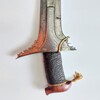
I am posting this short sword for comment. At first glance, it would appear to be a double edge blade but it's not. It is single edge blade about 20.5 inches long with about 9 inch long false back edge. As can be seen in the pictures, the blade is offset from the hilt. The edge is further from the hilt than is the spine. The hilt (including pommel) is 5.5 inches long. The brass cross guard is about 3.5 inches long by 1.125 wide by just over 1/4 inch thick. The ferrule, butt cap, and pommel are all brass. Sincerely, RobT |

|

|
|
5th March 2017, 11:48 PM
|
#2 |
|
Vikingsword Staff

Join Date: Dec 2004
Location: The Aussie Bush
Posts: 4,749
|
The blade form is consistent with a dahong palay from the Philippines, and more specifically from Luzon. The brass guard and brass ferrules with full length, offset tang are most likely Ilocano work, although the screw on the end of a threaded tang is a little unusual (more common to see a peined tang on Ilocano hilts). This appears to be a recently made piece, second half of 20th C.
Ian. |
|
|
|
|
6th March 2017, 01:13 AM
|
#3 |
|
Member
Join Date: Mar 2005
Posts: 655
|
Thanks For the Info
Ian,
Good pick-up on the threaded tang. I forgot to mention it. I also think it is mid to 2nd half of 20th century. I wouldn't have pegged it as dahong palay since the tip is so bilaterally symmetrical. It would appear that the term dahong palay covers a lot of ground. What was really interesting to me was that the seller thought the sword was Chinese and I had a really hard time convincing him that it is Philippine. To be honest, I have to admit that it appears to me also that it has a fair amount of Chinese influence. Sincerely, RobT |
|
|
|
|
6th March 2017, 06:40 AM
|
#4 |
|
Vikingsword Staff
Join Date: Dec 2004
Location: The Aussie Bush
Posts: 4,749
|
Hi Rob:
The dahong palay typically has a symmetrical, spear-shaped tip. The term refers to the similarity of the blade to a rice leaf (dahong palay) or to a venomous snake (dahong palay) that has a similarly shaped head. Ian -------------------Attachments-------------------- Dahong palay (rice leaf) Dahong palay [Trimeresurus flavomaculatus (KU 330049) from mid-elevation, Mt. Cagua - ZooKeys-266-001-g098] Examples of typical dahong palay swords and knives. Most have brass guards and fittings to various Ilocano styles of hilts . Last edited by Ian; 6th March 2017 at 06:51 AM. |
|
|
|
|
6th March 2017, 06:57 AM
|
#5 |
|
Vikingsword Staff
Join Date: Dec 2004
Location: The Aussie Bush
Posts: 4,749
|
Rob:
I would say the examples attached to this post are NOT dahong palay. Ian. --------------------Attachments------------------- Examples of swords and knives that show asymmetric spear-shaped tips. These do not resemble the rice leaf or the snake that are each referred to as dahong palay. . |
|
|
|
|
7th March 2017, 12:59 AM
|
#6 |
|
Member
Join Date: Mar 2005
Posts: 655
|
Got It
Ian,
Thanks for the correction. For some reason, I had it backwards. Sincerely, RobT PS. Really nice collection of dahong palay & non-dahong palay. |
|
|
|
|
8th March 2017, 04:47 AM
|
#7 |
|
Vikingsword Staff
Join Date: Dec 2004
Location: The Aussie Bush
Posts: 4,749
|
Rob:
Here is another Ilocano sword that just finished on eBay and is no longer available for sale. It has a similar style of brass guard and full tang hilt with a threaded brass nut on the end. I would date this one also as post WWII. BTW, I have no idea how the two small holes in the guard may have been used. The brazing of the brass joints is also quite evident on this one. Ian. |
|
|
|
|
12th March 2017, 01:37 AM
|
#8 |
|
Member
Join Date: Mar 2005
Posts: 655
|
Hilt looks Spanish not Chinese
Ian,
Although the cross guards are similar, the hilt on the sword you posted looks more Spanish than Chinese. To me, the blade I have has the look of a jian that has been filtered through Philippine sensibilities (the seller just thought it was flat out Chinese). That's what is so fascinating to me. The Spanish aesthetic influence in the northern Philippine blades is often encountered. What about the Chinese? What was their aesthetic influence (if any) on northern Philippine blades in the late 19th century to post WW II and what were the sociocultural circumstances surrounding any such influence? Sincerely, RobT |
|
|
|
|
22nd February 2020, 01:13 AM
|
#9 |
|
Member
Join Date: Oct 2018
Posts: 715
|
Hi! Just some clarification. While the attribution of dahong palay for Southern Luzon is correct- its tip is at center- the attribution for Ilocos is incorrect.
In Ilocos, there are two 'leaf' blade classifications. The first one is 'bulong pagay' (rice leaf) and 'bulong unas' (sugarcane leaf). It's important to note that unlike Southern Luzon rice leaf blades, the bulong pagay's blade tip is at top, sometimes even slightly arcing up. The bulong unas' tip, on the other hand, corresponds with the Southern Luzon rice leaf blades, as its tip is dead center. To illustrate, please see the following pictures: 1. Sinan-olimaw (dragon hilt) na bulong pagay (left) and sinan-kapitan na bulong unas (right) 2. Trio of sinan-kapitan na bulong unas blades 3. Sinan-olimaw na bulong pagay (solo pic) It's important to classify the Filipino traditional blades according to the native language in the region, as using a general classification (rice leaf) may apply to a certain blade profile in one region of Luzon, but not to the other regions. While the meaning of the translated term is the same, the blade profile attribution may be different. This also happens in Visayas and Mindanao blades. Source of classification is from the panday community of Santa, Ilocos Sur, and the elder panday/artisan Antonio Pader. |
|
|
|
|
22nd February 2020, 11:13 AM
|
#10 |
|
Vikingsword Staff
Join Date: Dec 2004
Location: The Aussie Bush
Posts: 4,749
|
Dear Xas,
Wonderful stuff! Thanks so much for posting these clarifications. I think what you are saying is that dahong palay is used in the Tagalog regions and that bulong unas is used where Ilokano, or a dialect thereof, is spoken. Is that correct? How confusing that "rice leaf" is used to describe two different blade profiles. One question. The hilts described as sinan olimaw in your pictures appear to be the same as sinan sabong that Lorenzo illustrated in an earlier post. The sinan sabong was said to represent a flower. Can you clarify if we are talking about the same thing, just two different names, or are they different hilt styles? Perhaps the same style represents different things in the Ilocos provinces compared with elsewhere. Xas, it might also be helpful to describe the geographic area that you classify as Southern Luzon. For example, you have mentioned Taal, Laguna, Batangas in the context of Southern Luzon. Parts of these areas are now almost "bedroom suburbs" of Manila. Do you extend your definition to include as far down as the Bicol region? Ian |
|
|
|
|
22nd February 2020, 02:35 PM
|
#11 | |
|
Member
Join Date: Oct 2018
Posts: 715
|
Quote:
Regarding the blade profile, the equivalent of rice leaf 'dahongpalay' in the aforementioned provinces is equivalent to Ilocos sugarcane leaf 'bulong unas.' The rice leaf 'bulong pagay' of Ilocos has a different blade profile. I can't comment on Bicol as that's another complication altogether, one I'm not yet thoroughly familiar with. Regarding the sinan sabong, that's the standard labeling, but according to the Ilokano martial artist, healer, and researcher Virgil Apostol (2010) in his book Way of the Ancient Healer, that particular hilt represents olimaw or orimaw. It's one of the monsters in Ilokano mythology, similar to the Visayan bakunawa. |
|
|
|
|
|
22nd February 2020, 09:37 PM
|
#12 | ||
|
Vikingsword Staff
Join Date: Dec 2004
Location: The Aussie Bush
Posts: 4,749
|
Quote:
Quote:
|
||
|
|
|
|
24th February 2020, 04:34 AM
|
#13 | |
|
Member
Join Date: Oct 2018
Posts: 715
|
Quote:
|
|
|
|
|
 |
|
|


 Linear Mode

