
|
 4th January 2016, 11:42 AM
|
#1 |
|
Member

Join Date: Jan 2012
Location: FRANCE
Posts: 1,065
|
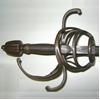
 A GERMAN FIGHTING TWO HAND SWORD LATE 16 TH CENTURY
.
Overall 175 cm and 132 cm in blade . The blade has two bladessmith’s marks ( one crowned dragon and one imperial eagle) also one celestial mask ,a sun in splendour IHS trigram . The Ricasso are engraved with JESU and MARIA and the fullers are with many punches nearly till the tip. The pommel with polygonal sides of type 32 ( AVG NORMAN P254) could be dated from late 16th century early 17th century. Later I will post close pictures from the full blade. Of course any help for identification will be welcome , I already have applied for the support of Jasper who has already decipher some punches . “IN TE DOMES SIE “ ( in your name) Best Cerjak |

|

|
|
4th January 2016, 11:46 AM
|
#2 |
|
Member
Join Date: Jan 2012
Location: FRANCE
Posts: 1,065
|
more pics
more pics
|
|
|
|
|
4th January 2016, 04:06 PM
|
#3 |
|
Member
Join Date: Jan 2012
Location: FRANCE
Posts: 1,065
|
Up close pictures of the blade side one( maria)
Any help from menber's with knowledge in Latin and good eyes for decipher the punches will be welcome.
BETTER RESOLUTIONS PICTURES ARE AVAILABLE AT http://we.tl/J6nmDxOKGj First side : |
|
|
|
|
4th January 2016, 04:11 PM
|
#4 |
|
Member
Join Date: Jan 2012
Location: FRANCE
Posts: 1,065
|
second side
second side
|
|
|
|
|
4th January 2016, 04:13 PM
|
#5 |
|
Member
Join Date: Jan 2012
Location: FRANCE
Posts: 1,065
|
last pics
the last pics
|
|
|
|
|
4th January 2016, 06:03 PM
|
#6 |
|
(deceased)
Join Date: Dec 2004
Location: Portugal
Posts: 9,694
|
Hi Jean-Luc
Great sword, mon ami... with a great problem in deciphering the inscription. I guess that the words being in Latin is less of a problem than discerning the actual letters 'inserted' into the grooves ... at least doing the job from pictures. Maybe having the sword in your hands things are not so complicated. So if you 'burn your eyelashes' for a few hours and manage to read the letters, members versed in Latin will easy translate the wording. Easy to say, isn't it ? 
|
|
|
|
|
5th January 2016, 08:46 AM
|
#7 |
|
Member
Join Date: Jul 2014
Posts: 447
|
Hi Jean Luc,
That is one of the most amazing blades I have ever seen in its kind , the structure of the metal the craftsmanship which forged it typical 16th C,. The craftsmanship of the engravings ... Mind boggling There is no doubt that this is an Original blade, a trained eye can see this immediately. The blade is 16th C , circa 1550 a fine example of a high quality fighting blade. Congratulations Ulfberth |
|
|
|
|
5th January 2016, 11:47 AM
|
#8 | |
|
Member
Join Date: Jan 2012
Location: FRANCE
Posts: 1,065
|
Quote:
Thank you very much for your kind comments. This a fighting sword far more scarce than the frequently encountered processional swords of the late 16th and early 17th.The analysis of this sword highlights serious beatings on the blade , it is symptomatic of numerous fights during its livetime. Best Jean-Luc |
|
|
|
|
|
5th January 2016, 01:47 PM
|
#9 |
|
Member

Join Date: Jun 2013
Location: Netherlands
Posts: 543
|
I tried, but could not find any sentence. If i where you i would try and use some sort of clay and press it in the lettering and get a print. Or use a piece of paper, place it on the symbols and softly go over it with a pencil to get a print.
This is what i read... in te eomine sie hichi es i gucoio it hoc il iusto uowe chx sian ponito amia in te ic ominesie mepius omen ponon il iusto uowe hic sian ponito amia |
|
|
|
|
5th January 2016, 02:20 PM
|
#10 | |
|
Member
Join Date: Jan 2012
Location: FRANCE
Posts: 1,065
|
Quote:
Thank you very much for the time you spend trying to decipher the punches This week end I will try this method with paper and carbon. Best Jean-Luc |
|
|
|
|
|
5th January 2016, 04:04 PM
|
#11 |
|
Member
Join Date: Jun 2013
Location: Netherlands
Posts: 543
|
Hi Jean,
I also got a strange feeling that this is not pure Latin. And the above part of the blade reads the same on both sides: il iusto uowe hic sian ponito amia The N and H are unclear at certain point because they are both 5 "dots" and there are also a few unknown symbols like ic (beeing one symbol instead of two) etc. Good fun to research so i am very curious to see the results of that paper 
|
|
|
|
|
5th January 2016, 04:59 PM
|
#12 | |
|
Member
Join Date: Jan 2012
Location: FRANCE
Posts: 1,065
|
Quote:
In the description when I bought this sword was : 'IL IUSTO VOLE OHA/SIAN PONITO AMIA' 'ASITE DOMINE SIE/NIHIL DES IN NUCOLO/??P?' But may be this text has no meaning... |
|
|
|
|
|
5th January 2016, 05:18 PM
|
#13 | |
|
(deceased)
Join Date: Dec 2004
Location: Portugal
Posts: 9,694
|
Quote:
You are right in assuming that the text might have no full meaning. Some words are an approach to latin, like THE JUST WANTS TO PUT ???. Also Nihil is latin for NOTHING. But this could be one's imagination. |
|
|
|
|
|
5th January 2016, 05:35 PM
|
#14 |
|
Member
Join Date: Jan 2012
Location: FRANCE
Posts: 1,065
|
similar pommel
I found in one old thread from Jasper this two pics from two swords with similar pommels from same period ( because of the resolution I'm not 100 % sure but seems to be same polygonal shape
http://www.vikingsword.com/vb/showth...5&page=1&pp=30 |
|
|
|
|
5th January 2016, 05:49 PM
|
#15 |
|
Member
Join Date: Jun 2013
Location: Netherlands
Posts: 543
|
What i gather the frase is that either it is a mix of different languages, or that the person inscribed something he heared of but did not know the correct grammar.
Like "in te eomine sie" could be "in e nomine sie" which would translate to: In the name of so. EDIT: the word Sie in German means "you" refering to either one or multiple persons (beeing one person, Sie with a capital letter is meant as respect mostly to a person older or above you. Sie can also refer to a group meaning "They"). Or just sie meaning she when written in lowercase. hichi es i gucoio might be "Hi Hi es i **coio" which translates to "these belong to **coio" Atached are two symbols of the second line of the first side of the underside of the sentence, thee last word begins with a G? and than a V (made clear by the extra punctuations, so not a U)? Very difficult to see I also did find this sword at the thomas del mar sale, lot number 88 (forgive me if i overstep a boundry here). They state it to be German or Italian. If this is indeed German, the chance of it beeing correct grammatically is very slim (German and Latin are quit different in al sorts of ways. It is also the main difference between German and Dutch, the latter beeing influenced by Latin). Last edited by Marcus den toom; 6th January 2016 at 09:02 AM. |
|
|
|
|
7th January 2016, 05:40 PM
|
#16 |
|
Member
Join Date: Mar 2009
Posts: 1,071
|
Jean Luc as mailed to you, I believe the sword is from the third quarter of the 16th century, around 1570, that is indeed when this type of pommel came in fashion.
Engravers were mostly illiterate, so wrote the words phoenetisch or/and sometimes exchanged and added characters in a word. U did not exist, U came only in the 17th century, so the V was used as a vowel and consonant. this is what I can make of it, the meaning is not yet entirely clear to me. IN TE DOMENS SIE so in your name NIHI ES IN LUCO(LO) you are nothing in a grove/you have no significance between all people. IL IUSTO VOLE CHE (=HEC) the things wished for. SIAN PONI-TO AMIA sian assigned/connected to amia SEPIUS OMEN JONON. often signs/augury of jonah/jonasis The sword has a rounded point as some landsknecht swords have, perfect for cutting this was probably as it originally was. I will check the two-headed eagle mark and lion c.o.a mark if I can be with my books again. beautiful blade geometry from 3 to 2 fullers along the entire length. best, jasper Last edited by cornelistromp; 7th January 2016 at 05:51 PM. |
|
|
|
|
7th January 2016, 06:16 PM
|
#17 |
|
Member
Join Date: Jan 2012
Location: FRANCE
Posts: 1,065
|
Thank you jasper I was waiting your imput about the punches ,hoping you could find something about the two-headed eagle & lion mark . So after next step : find a place to hang it to the wall !
For sure you already had this problem: How to hang such big sword ? I guess that a vertical stand would be the best solution. Best Jean-Luc |
|
|
|
|
7th January 2016, 09:37 PM
|
#18 |
|
Arms Historian

Join Date: Dec 2004
Location: Route 66
Posts: 10,872
|
This is a most fascinating sword, mostly because it has more complexity in it than being a 16th century zweihander, but because it's blade seems to have begun as noted, a genuine combat blade of the 16th century, but the sword itself appears to have continued much later . Many of these old combat swords became venerated old arms and served on as processional and bearing swords.
This example seems to have been rehilted later with mountings in accord with original form, perhaps later in the 16th or possibly into early 17th. The most interesting thing, aside from the intriguing inscriptions as the linguistics continue evaluation, are the profuse markings and motif that cover the blade. In my opinion, the punzones at the forte adjacent to the parry hooks suggest a German made blade using the typical Spanish type marks. I have not yet found corresponding examples in the compendiums of markings, but the crescent moon on one side suggests the mark often used by the espaderos del rey ( royal smiths in Spain) as shown in Palomares plate. It seems however that the posture is facing reverse to those usually seen in the originals. The double head eagle was apparently to Sebastian Hernandez elder (1599-1637) and continued by son 1634-39 but illustration was not available as yet. The double head eagle also seems to have been used by Solingen maker Andreas Berns c 1580-90 but the form looks different (this was used again far later by descendant). There also is implication that a double head eagle was used in Passau, however form and certainty seem unclear. I have not yet found evidence of a walking lion but Josepe Bustindui in Valencia used a rampant lion, (Boeheim, 1890, p.667) but no date. These findings simply reaffirm to me they must have been applied to the blade originally in the German shop following the usual spurious applications of Spanish and other markings. The remainder of the 'motif' over the blade suggests it was applied later after the veneration of the blade and that these intriguing markings consist considerably of magically oriented sigils and symbolism intended to imbue justification and representation of power in its probable use as a bearing symbol. I think there is compelling possibility this sword may have found use later in the mysterious Westphalian tribunals in Germany known as the courts of the Free Judges. The glyph like nature of the symbolic motif suggests the use of occult and magical themes which are similar to some elements of the motif associated with their regalia and implements. Interestingly these courts often used 'executioner' type swords with rebated or rounded points. These were not actually 'heading' swords, but symbolic of the power they and the courts held...over life and death. The motif is far over embellished for a combat blade and these kinds of markings and embellishments correspond to those known in various occult themes of the 17th and through the 18th centuries. It is believed that the use of scriptural quotations and names would enhance the powers of sigils and magical glyphs and devices. While the theme of most of these inscriptions are not Biblical, the use of Jesus Maria may be aligned with this thought. This particular inscription was typically used by Milanese armourers as well as the Ayala's in Spain. It is interesting to note the astrological type of radiating lines and the characters that circumvent the distinctly cosmological crescent moon. The other Cabbalistically oriented devices as well as the use of the joined arcs seen on the familiar 'anchors' and the asterisk like 'stars' also seem to support this kind of theme. Absolutely fascinating sword !!! with far more history beyond its working life as a combat weapon. |
|
|
|
|
8th January 2016, 09:13 AM
|
#19 |
|
Member
Join Date: Mar 2009
Posts: 1,071
|
@ Jim
Jim thanks you for your Always very valuable commentary, with a good track to potential sword makers of this piece there are always questions often by collectors including myself how with these swords could be fought, more then often two-handed swords are wrongly dismissed as processional swords. here is a good demonstration on youtube of how these two hand techniques must have looked like. http://www.oakeshott.org/Figueiredo_...s_and_Hick.pdf https://www.youtube.com/watch?v=nYNy_drriXs I believe this sword is homogeneous ( all the parts belonging together) from the third quarter of the 16th century. I hope the marks will give more clarity at a later stage. so 3/4 16thC! however with the note that some of the blade decoration can indeed be applied later in the 19th century. The latin inscription seems to me from the 16thC. for an Italian sword with similar fuller Latin inscription see pictures and post #141 http://www.vikingsword.com/vb/showth...ght=katzbalger Last edited by cornelistromp; 8th January 2016 at 09:33 AM. |
|
|
|
|
8th January 2016, 09:32 AM
|
#20 |
|
Member
Join Date: Jul 2014
Posts: 447
|
I believe Jim has revealed the reason for the abundance on decoration on the blade.
Since the original question was mainly about the blade , that was the only part I chose to comment on. Now after the discussion about the pommel and type of guard has begun, I will take the liberty to comment on this to. The blade is clearly 16th C no doubts about that and although the pommel and guard have the correct style for the blade I believe them to be of a later date. Im sorry but the guard is just not 16th C, at best 17th or even 18th C and indeed assembled with the fighting blade for further use as a ceremonial or a sword of justice. If we look at the alloy and metal surface of the cross guard we see it is different than that of the blade, it is also forged in a different manner. The patina and oxidation clearly show a very different pattern, very visible on the blade in all places and absent on all parts of the guard, the guard has just some light orange rust which can be cleaned of with some steel wool 000 were using steel wool on the blade this would have zero effect. One could argue that the guard is cleaned, But this is not the case because all lines of the cross guard are still sharp and as fresh as the day they were made. I hope I have not offended anyone by clearing this up, after all the sword is still a valuable historical piece with a prolonged use for a different function. Kind regards Ulfberth |
|
|
|
|
8th January 2016, 09:55 AM
|
#21 | |
|
Member
Join Date: Mar 2009
Posts: 1,071
|
Quote:
the composition of the steel is never matching between blade and hilt. this is the case with virtually all the 16th century swords. the blade and hilt come from different workshops, Passau and Solingen blades were exported national and to other countries where the hilt was made and mounted by a local blacksmith. This is also the reason why we see beautiful blades in a coarser hilts and vice versa. because the sword was obviously apart. the parts are probably cleaned separately. so I would not worry about it, the type of pommel and guard are as you would expect here. best, Last edited by cornelistromp; 8th January 2016 at 10:07 AM. |
|
|
|
|
|
8th January 2016, 03:27 PM
|
#22 |
|
Member
Join Date: Jul 2014
Posts: 447
|
Hello Jasper,
The blade usually has more hardness than the guard, the blade shows spots of oxidation all over as is to be expected and the guard almost none. I have concerns when a sword that has supposedly been assembled for over 500 years with such a difference in patina, if that was the case the patina would be almost the same, the only exception would be if the guard has been blackened and this is not the case. The style of the pommel and cross guard is indeed correct but that does not prove the are made in the same age. I had many pictures of this sword from the recent auction, and the reason I chose not to bid was exactly that, it seems more people had the same thoughts because the price it sold for was less than half for a sword like this if all parts would belong together. Of course I respect each and everyone's opinion, but lets just look at sword a bit more closer, the sword is the object of study, the books are the tool, have look at the evidence at hand and than form an opinion. Kind regards ulfberth |
|
|
|
|
8th January 2016, 04:55 PM
|
#23 |
|
Member
Join Date: Jan 2012
Location: FRANCE
Posts: 1,065
|
Thank you very much to all of you for your interest and input for this sword.
A special thank to Jim and Jasper, I did not expect so much! Jim as usually you made a rigorous analysis very well documented to highlight a very interesting fact: This sword had two differents lives, I hope if possible that you could post some scans about your literature's Reference (particularly about double head eagle & walking lion) Jasper very interesting link about the practice for such sword and of course all the time spend trying to figure out the words, tracing out the letters and of course the translation you made after. Best Jean-Luc |
|
|
|
|
8th January 2016, 06:28 PM
|
#24 |
|
Member

Join Date: Apr 2014
Posts: 237
|
For what it’s worth, I’ll offer my opinion. First, what an impressive piece with such detail and character. I am jealous for sure and would love to have it in my collection.
In my somewhat uneducated opinion, I think the guard and blade have not spent their entire lives together. I know there can be differences in metals with blades often being made separate but there is just too much variation in wear and patina between the blade and the hilt. There is a good bit of deep pitting in the blade that just doesn’t show at all in the hilt. What a great piece though! |
|
|
|
|
8th January 2016, 08:08 PM
|
#25 |
|
Arms Historian
Join Date: Dec 2004
Location: Route 66
Posts: 10,872
|
Thank you guys for all these responses, and I very much appreciate the kind recognition of the detail I added concerning these most unusual markings.
I will here note that as always my focus is typically toward the historical aspects of the weapons themselves and have always been particularly intrigued by markings as well known here. I must however note that in the relatively limited experience I have had in handing arms physically, in the cases I have seen, the physical character of metals in corrosion and pitting in often markedly varying. While all sources I checked in making my comments revealed that the components and features of this sword do seem of the proper period and seem to suggest a German zweihander of third quarter 16th c. However, I am very much inclined to agree that the nature of aging of the metal in the blade vs. the hilt do not seem commensurate. I would note that this blade certainly does appear to have been a genuine combat blade, but as suggested likely has been refurbished and had some extensive embellishment which would suggest later use in a symbolic sense in the context I also described. This does not dismiss this sword in any way by its later use in such processional or bearing context, but adds most intriguing dimension to it. Rather than being stored away it plausibly continued on as a component of a very unusual and relatively little known organization in Germany. As noted, the sword has certainly been apart at some point, also it is well known that blades were export items and typically the hilts came from other makers. It does seem unusual that the hilt components follow so closely the proper style of this type sword in its period. However, it does seem possible that other hilts of the form existed in static circumstances and would have been chosen for refurbishing. That being the best case scenario, the possibility of later production in the case for reproducing similar components remains possible. As noted the metal in hilts is of course much different than in blades, but still the degree of deterioration must resemble that relative to the blade. As with all metal production, the composition of ingredients in the forging of these metals must vary according to regions and materials used, but still, corrosion and deterioration should be notably comparable to other parts. The deterioration in this hilt shows only staining as opposed to the deep areas of pitting which have existed in the blade. Getting back to the markings, the inscriptions in the fullering do seem commensurate with the blade as it would have been in its original state. The deeper punzones on the blade with crowned lion and double head eagle with the crescent moon of 'espaderos del rey' on the other seem to have existed in place as well. The mystical or magical embellishment seems added some time probably much later in the 17th or even perhaps 18th century, when these kinds of markings flourished. Note that the interesting surround of the crescent moon is added in a cosmological radiating fashion. Also the JESUS MARIA inscription added at the forte seems far from the style of the earlier centuries and was usually placed on the blade...not the forte.. Also, it is noted that religious invocation was often added to that of magical nature to augment or accent the potency of these markings. The blade itself seems likely a German product and as earlier noted, I have not yet found exact sources for these marks. This may be due to the fact that German makers often used spurious stamps or markings to imitate other centers products. The nature of the double headed eagle suggest somewhat Austrian or Italian character as does the lion with the five point crown which seems Italian. As previously noted the crescent moon of Spanish makers was often copied in Germany. In all, a wonderfully fascinating sword! |
|
|
|
|
9th January 2016, 10:17 AM
|
#26 |
|
Member
Join Date: Jan 2012
Location: FRANCE
Posts: 1,065
|
There is a point not debated yet : the leather grip ,there is no doubt that grip it is an early grip and seems commensurate with the age from the blade.
I have well understood the opinion from ulfberth but I would like to remember to all how many swords were wrongly classified as 19 th century because of such details. We have in this case the hilt ,grip & pommel who are correct model and patterns for the period ,so doubts persist . |
|
|
|
|
9th January 2016, 11:52 AM
|
#27 |
|
Member
Join Date: Mar 2009
Posts: 1,071
|
I would not worry about it, the patina and pitting need not necessarilyto be equal.
the hilt of this type was originally blackened with a protective layer or browned, hot in oil. suppose someone in the last 100 years of this 450 year old sword has cleaned the sword "thoroughly". so mechanically removed the rust of the blade and worsed brushed the black coating of the hilt, because he wanted it to be shiny. actually because the guard and pommel have a dull leaden look, I think they have been cleaned with acid ! The hilt is over 350 years been protected against oxidation and looks quite new now. but the blade therein is 450 years exposed to oxygen and shows dark oxidation patches. the style of your hilt is good, so is the rough forging typical for those two-handed swords. Most 19th/20th-century productions hilts are made too perfect and often wrong in type. alongside Thom would certainly have placed a note in the description as he would have doubts about the hilt beeing of a later date. best, Jasper Last edited by cornelistromp; 9th January 2016 at 01:08 PM. |
|
|
|
|
9th January 2016, 01:56 PM
|
#28 |
|
Member
Join Date: Jul 2014
Posts: 447
|
First I think your sword is well worth the money paid for Jean Luc and it is used and re used far longer than most and this ads extra history not less.
I think its better for me to answer only at the questions that are asked, there is no point in giving something ( here being correct information) if they don't actually want it. My opinion is a bit more than just that, its build with arguments and 38 years of experiance, not it could, what ifs and its possible. Because in a conversation grounded on possibilities, everything is possible. For example , it could be cleaned with acid, sure it could ( but the sword of Jean Luc has not been cleaned with acid) , but how are you to judge this Jasper ? How many times have you in your profession used acid for cleaning and saw the results of it first hand ? And if not how are you going to know? From a book ? Or because someone told you.... A few decades ago I , and this is a fact visited a big collection of 16th and 17th C swords and arms and armor in the Netherlands, when I asked the owner why all his swords had such strange landmap swirl like patina on them he honestly stated, oh they were all cleaned with acid long ago thats what they did back than.... This was on august the 31 the year was 1997 aprox. 11 am , and this guy was serious about this, I just shut my mouth. Now about the grip , I would like to pose a question to anyone with knowledge what about this grip it looks old, is it 17 the C or could it be ? Kind regards Ulfberth |
|
|
|
|
9th January 2016, 02:08 PM
|
#29 | |
|
Member
Join Date: Jul 2014
Posts: 447
|
Jasper, could you please show me how a sword cleaned or treated with acid looks ?
Kind regards Ulfberth Quote:
|
|
|
|
|
|
9th January 2016, 04:05 PM
|
#30 | |
|
Member
Join Date: Mar 2009
Posts: 1,071
|
Quote:
it looks dull like lead. in records of the medieval sword by Oakeshott is a sword particularly described which is cleaned with acid. I believe a type X without a crossguard and with important silver inlays.oakshott exuberantly describes the dull look like lead and describes the restoration of this sword, where by polishing the nice dark metal look reappears. best, jasper |
|
|
|
|
 |
|
|


 Linear Mode

