
|
 15th August 2012, 06:43 PM
|
#31 |
|
Member
Join Date: Oct 2008
Location: Manila, Phils.
Posts: 1,042
|

this guy i totally missed when i went to the museum this morning. we will see later.
|

|

|
|
15th August 2012, 06:46 PM
|
#32 |
|
Member
Join Date: Oct 2008
Location: Manila, Phils.
Posts: 1,042
|
another rectangular tang hole, and part of the tang can actually be seen on the specimen.
note: all these pics i'm posting are being cobbled from various sources, but i personally checked out the specimens at the museums, to find out the inferred tang shapes. |
|
|
|
|
15th August 2012, 06:47 PM
|
#33 |
|
Member
Join Date: Oct 2008
Location: Manila, Phils.
Posts: 1,042
|
this hilt is too crumpled and damaged. thus it was impossible to find out what the tang's shape was.
|
|
|
|
|
15th August 2012, 06:49 PM
|
#34 |
|
Member
Join Date: Oct 2008
Location: Manila, Phils.
Posts: 1,042
|
this one has a circular hole where the tang passes.
to summarize, as far as these 10th to 13th century a.d. gold hilts are concerned, the vast majority would have inferred square or rectangular tangs. |
|
|
|
|
15th August 2012, 06:54 PM
|
#35 |
|
Member
Join Date: Oct 2008
Location: Manila, Phils.
Posts: 1,042
|
then a hundred or two hundred years later (given that this specimen is estimated to be from the 10th to the 15th century a.d.), we find the bohol kalis with a square tang.
to recap, it appears that for philippine blades we can trace a progression from a round tang (circa 500 b.c. to 100 b.c.), then to a hexagonal one (circa 0 a.d. to 950 a.d.), then finally to the square or rectangular tang (10th to 15th cent. a.d.), even up to now. i'd just like to qualify that these are anecdotal evidences. and especially for the hexagonal tang (assuming it's really hexagonal -- and i'll try to view the actual specimen the next time i'm in cebu), i think it's too early to say that this tang shape persisted. most probably it's a simple switch from a round tang, and then to the square or rectangular tang. but the thing is the square or rectangular tang appears to have come up even way earlier, as we've seen. |
|
|
|
|
15th August 2012, 08:18 PM
|
#36 |
|
Keris forum moderator
Join Date: Aug 2006
Location: Nova Scotia
Posts: 7,282
|
Miguel, thanks for all these diagrams and research. These gold hilts are indeed quite interesting and beautiful. However, from what i can see in the diagram you presented in post #15, these hilts clearly were not attached to the weapons that we consider to be kris today. Different types of weapons use different types of tangs for different reasons. Indonesian keris still use a round tang because it is a stabbing weapon, not the slashing weapon that the Moro kris developed into, so the stability that the rectangular tang offers along with the a sang-asang is not necessary. So i am not sure that we can use the evidence presented here to make a case for a evolution in these kalis forms from round to hexangular to square or rectangular tangs that we see in Moro kris since we are looking at completely different weapons.
 It's fine to use the general terminology of "kalis" to describe all these weapons, but when you use the term in that way, all "Kris" might be "kalis", but clearly not all "kalis" are "kris". |
|
|
|
|
16th August 2012, 12:20 AM
|
#37 |
|
Member
Join Date: May 2006
Posts: 7,191
|
There are some interesting comments in this thread, but I'm not going to get too involved in it because I do not have the necessary cultural, societal nor historical knowledge specific to the matters being discussed to be able to make valid comments.
However, I will make this one comment:- in the Javanese keris the kembang kacang or sekar kacang, the "elephant's trunk", did have a definite symbolic meaning when it first appeared, which was in the Modern Keris, the form that appeared after the Keris Buda. Its origin was rooted in Hindu belief, nothing at all to do with elephants roaming around Jawa. It should be noted that both kembang kacang and sekar kacang are euphemisms. How the kembang kacang may be interpreted in the societies to which the keris spread from its point of origin, I do not know, but I am reasonably confident that any such interpretations would have been generated within those societies, rather adopted from early Javanese society. The later, although still early in terms of keris development, additions to the Javanese keris of singo barong, naga, or bomha held iconographic meanings which differed from the meaning and purpose of the original kembang kacang. |
|
|
|
|
16th August 2012, 04:24 PM
|
#38 | |
|
Member
Join Date: Oct 2008
Location: Manila, Phils.
Posts: 1,042
|
Quote:
|
|
|
|
|
|
16th August 2012, 05:40 PM
|
#39 | ||
|
Member
Join Date: Oct 2008
Location: Manila, Phils.
Posts: 1,042
|
Quote:
Quote:
Thus it should not come as a surprise that the Bohol kalis (10th to 15th century AD) already sported the rectangular tang. I also understand that all I've said somewhat invalidates a theory on Moro krises that goes like this: 1. all kerises (i.e., the Indonesian kind) have round tangs 2. said Javenese kerises are the ancestors of all kerises and krises 3. krises (i.e., the Moro kind) have rectangular tangs 4. krises came after the kerises 5. thus, the missing link between kerises and krises ought to be krises with round tangs. However, as we've seen, the rectangular tang came about very early on, on kalises -- as early as 10th to 13th century AD. And given that what I regard as the proto-kris (the Bohol kalis) also had the rectangular tang (as can be expected given the trend), then I think we can make an extrapolation, by saying that all krises from Day 1 had the rectangular tang. Which leads us back to Ron's very old kris with a round tang that defied the trend. Well, I'm still scratching my head on that one. Can it be that the smith was Indonesian? Could the prematurely broken 'elephant trunk' be another sign that the smith was not that familiar with the finer points of making a Moro kris? Just thinking out loud ... |
||
|
|
|
|
16th August 2012, 06:21 PM
|
#40 | |
|
Member
Join Date: Oct 2008
Location: Manila, Phils.
Posts: 1,042
|
Quote:
 Actually all of those examples I posted have many many things in common: 1. all of them (except for a few Luzon plates from the Boxer Codex), are from the Visayas -- said region is the encircled portion on the map below; 2. within the Visayas, almost all of the examples I used are clustered on an area I marked with five 'x' in the map - thus, they share a common sub-culture; 3. as to their weapon types, all of them (except for the Bohol kalis) are: (a) very short, i.e., all of them are tiny hilts; (b) their blades appear to be all symmetrical and double-edged; and (c) as such they were all designed more for stabbing. And though all designed for stabbing, the evolution from the round tang to a rectangular tang still happened. As to the impetus or motive for the transition to a rectangular tang, that I'm not sure of. On a related matter, it might also interest others to know that some of those 10th to 13th century AD gold hilts have clay for its core inside, rather than wood. Perhaps as a ceremonial or dress dagger, sturdiness was not an issue, hence the use of clay sometimes. And with regard to the early Iron Age (Argao, Cebu) dagger (500 BC to say 100 BC), there's a piece of cloth found wrapped its hexagonal tang. Would anybody have any idea on why a piece of cloth would be wrapped on the tang? |
|
|
|
|
|
16th August 2012, 10:43 PM
|
#41 | |
|
EAAF Staff
Join Date: Dec 2004
Location: Louisville, KY
Posts: 7,382
|
Quote:
The tang is a square and tapers to a point at the distal end. |
|
|
|
|
|
17th August 2012, 08:12 AM
|
#42 |
|
Member
Join Date: Dec 2004
Location: Witness Protection Program
Posts: 1,730
|
so i reckon this kris is older than dirt then, right? lol, just kidding
 excellent discussion so far guys, please keep it up. lorenz my friend, your research has come a long way since our last conversation on this subject matter! very impressive!!! please keep it up. i really thought we could get together for some sarsi and sisig this coming january for my bro's wedding, but since that was cancelled i will have to wait another year, lol. on the side note, i can't help but notice the similarity of the wirework form the gold handle dagger handle on top of this page to sajen's gunong: http://www.vikingsword.com/vb/showthread.php?t=15927 |
|
|
|
|
17th August 2012, 01:06 PM
|
#43 |
|
Member
Join Date: Jun 2009
Posts: 1,318
|
Spunjer, your kris share some similar features with this one, which perhaps even could be older, becouse it appears to have posessed a straight gonjo once:
http://www.vikingsword.com/vb/showthread.php?t=15256 The tang of this one is disturbed, yet it also seems to be between square and rounded. We will never know, how looks like the tang of this one, also straight gonjo: http://www.vikingsword.com/vb/showthread.php?t=13785 It seems to me also, the two linked kris are older becouse of features of Gandhik.They are close to very close to Javanese keris; the gandhik of your kris is already almost like this strange mixed Maguindanao/Maranao gandhik, which pops up so often in the last time. Perhaps is your kris a very early Mindanao kris? |
|
|
|
|
17th August 2012, 04:42 PM
|
#44 |
|
EAAF Staff
Join Date: Dec 2004
Location: Louisville, KY
Posts: 7,382
|
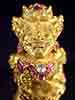
I would say that the top one of your pictures (the one with the early golden hilt) is Sulu, although that early back we are not as sure because there are few examples from that period.
|
|
|
|
|
17th August 2012, 06:04 PM
|
#45 | |
|
Keris forum moderator
Join Date: Aug 2006
Location: Nova Scotia
Posts: 7,282
|
Quote:
I am certainly grateful for all this info on Visayan swords and daggers, but i do wonder just how much connection we can truly draw to Ron's kris that started this post or the Moro kris in general as we know it today. While i am not in a position to debate whether or not there is any real connection between your Visayan examples and the Moro kris, simply from observation the similarities are rather superficial. When we look at at Ron's sword we are able to draw very clear and solid connects to the Javanese and/or Balinese keris. These similarities are rather exacting, down to minute detail of the various features of these blades. We see in these early "archaic" Moro kris both a gonjo and a gandik. But even more we see most of the detailed feature that are contained in the diagram of Javanese keris that you posted in earlier in this thread. Clearly we see a developed kembang kacang (whether or not meant to be an elephant). We see a well developed double sogokan and greneng. So while i would not discount that Visayan swords may have had some influence on the development of the Moro kris, it is clear to my eyes at least that these early "archaic" Moro kris developed directly from the form of Javanese and/or Balinese keris. It's about so much more than the shape of the tang for me and i am afraid that all you have stated here has done little to invalidate the theory that the Moro kris is a direct development of the Javanese form. You have to look at the entire design of the keris/kris, not just the shape of the tang. I am afraid that i remain unconvinced that the Bohol kalis is the proto-type of the Moro Kris. |
|
|
|
|
|
17th August 2012, 10:36 PM
|
#46 | |
|
Member
Join Date: Jun 2009
Posts: 1,318
|
Quote:
One more kris with straight gonjo Gavin sold a time ago: http://www.swordsantiqueweapons.com/s250_full.html Spunjer's kris is really interesting becouse of its very complete early kris features, together with Gandhik area which looks Mindanao to me. Would you agree on it? |
|
|
|
|
|
18th August 2012, 02:30 AM
|
#47 |
|
EAAF Staff
Join Date: Dec 2004
Location: Louisville, KY
Posts: 7,382
|
Oh no question that Spunger's kris is an early kris (with a great blade!).
|
|
|
|
|
18th August 2012, 12:44 PM
|
#48 |
|
Member
Join Date: Dec 2004
Location: Witness Protection Program
Posts: 1,730
|
thx for posting additional pictures, gustav! i noticed as well that on those other examples, the asang2x mark is non-existent. looks as if it never had asang2x. the one with the gold hilt: i'm almost certain the tang on that one is circular or squarish, as oppose to the rectangular ones. again, with a narrow base like that, there's nowhere to attach the stirrup, or should i say the stirrup wasn't part of the plan..
|
|
|
|
|
18th August 2012, 01:31 PM
|
#49 |
|
Member
Join Date: Jun 2009
Posts: 1,318
|
Dear Spunjer,
the Sulu kris with golden hilt had a stirrup for asang-asang, yet although the hilt is very early there of course still is some possibility the hilt is later then blade and blade was intended to be without asang-asang. In Cato's book on page 72 there is a hilt with similar construction of stirrup for asang-asang, which would let us think, this kind to attach asang-asang is also old if not the oldest one. On your kris I also see somethingwhich could be markings from front asang-asang, yet again, it could be attached later and then dissapeared again. |
|
|
|
|
19th August 2012, 02:29 PM
|
#50 |
|
Member
Join Date: Dec 2004
Location: Witness Protection Program
Posts: 1,730
|
i see what you're saying gustav, regarding the stirrup. that's indeed a unique method of attaching an asang2x, something you don't see on later krises. the closest type that i could see with an almost similar type would be this one:
|
|
|
|
|
19th August 2012, 02:31 PM
|
#51 | |
|
Member
Join Date: Jan 2007
Location: The Netherlands
Posts: 1,464
|
Quote:
|
|
|
|
|
|
19th August 2012, 02:35 PM
|
#52 |
|
Member
Join Date: Dec 2004
Location: Witness Protection Program
Posts: 1,730
|
not quite as fancy with the teapot handle style stirrup, but rather the asang2x was attached using a silver wire. i haven't removed the handle on this one (no need to, i guess), but am wondering if the tang is squarish or rectangular. most likely rectangular...
yeah the older archaic does have a very faint asang2x mark but like you said, it must have disappeared early in its life... |
|
|
|
|
19th August 2012, 02:37 PM
|
#53 |
|
Member
Join Date: Dec 2004
Location: Witness Protection Program
Posts: 1,730
|
hello maurice! nice to see you back, bro!!!
yes it is. same kris from the old eewrs forum. the crossguard on the scabbard is solid carabao horn. pretty neat. |
|
|
|
|
19th August 2012, 03:59 PM
|
#54 | |
|
Member
Join Date: Jan 2007
Location: The Netherlands
Posts: 1,464
|
Quote:
I thought it looked familiar.... Now I remember! A lovely kris indeed!!! |
|
|
|
|
|
19th August 2012, 05:50 PM
|
#55 | |
|
Member
Join Date: Oct 2008
Location: Manila, Phils.
Posts: 1,042
|
Quote:
With regard to those two distinctive features of kerises and krises (encircled in the attached pic, which pic I merely hastily snatched from the Internet), what would be the latest views on which century or centuries those first appeared? Being a stranger to Indonesian kerises, I don't have any idea on these matters. Thus hope that you can shed more light on the subject. Thanks in advance. |
|
|
|
|
|
19th August 2012, 06:48 PM
|
#56 | |||
|
Member
Join Date: Oct 2008
Location: Manila, Phils.
Posts: 1,042
|
Quote:
Quote:
Quote:
What was invalidated to my mind via what I presented, is the theory that the 'smoking gun' insofar as the inferred transition from a Javanese keris to a Moro kris must have been a Moro kris with a round tang. That can't be, because as we've seen our square or rectangular tang came about centuries even before our kris was born. I also agree with you on the Javanese influence on the development of what eventually became the Moro kris (and earlier, on the Javanese influence on the development of the Luzon, Visayan, and Mindanao-Sulu kalises). I'm now reading a nice book on numbers and units in Old Tagalog by Dr. Jean-Paul Potet. And in there (see excerpts below), the very close ties between our islands and Java was mentioned several times. We can also see that he also mentioned that there was a period where our forefathers were using Javanese currency, given the far-reaching influence of the Javanese economy. Thus, we can surmise from all these that there must have been a tremendous amount of cross-fertilization going on within our region (which region eventually became Malaysia, Indonesia, and Philippines). And so I think we should always remember that it was and will always be a two-way street. When I had the opportunity to interview the weapons expert of Museo del Ejercito in Toledo, Spain in 2010 (and our subject was antique Phil. blades), he suggested to me that one important area of study is the influence of Filipino sword design on Spanish blades. Because precisely he is emphasizing that the influence of one region to another will always be reciprocal. Thus in my humble opinion the proper perspective is to think in grayscale and not in black and white. Or put another way, the approach is to think in percentages, rather than all or nothing. To put it more concretely and by way of an example, I think the Moro kris' origin is 70% local (with the Visayan kalis, as my personal proof, which kalis form must have also existed in Luzon and in Mindanao-Sulu, and perhaps even before the advent of Islam in our islands) and 30% Javanese. I suppose the alternative view is to think that it's lopsided the other way around -- e.g., the Moro kris' origin is 90% Javanese and only 10% local. I don't have any problem with the two views above, hypothetically. My only issue is for anybody to claim that the influence on the any design is 100% local, or 100% Javanese, or 100% whatever Next, I'll present some more info why I believe that the influence on the development of the Moro kris' design must have been predominantly homegrown. |
|||
|
|
|
|
19th August 2012, 07:07 PM
|
#57 |
|
Member
Join Date: Oct 2008
Location: Manila, Phils.
Posts: 1,042
|
The following are excerpts from the book Philippine Ancestral Gold, which deals mainly with local 10th to 13th century AD artifacts.
We can see that in the area of craftsmanship then, only Philippines was at par with Java in the region. I understand that this is not a direct proof with regard to the subject of this thread. I guess my only point is that the Philippines too must have had influenced Java a lot, in the general area of design of cultural objects, which included weapons. |
|
|
|
|
19th August 2012, 07:50 PM
|
#58 | |
|
Keris forum moderator
Join Date: Aug 2006
Location: Nova Scotia
Posts: 7,282
|
Quote:
I do look forward to the evidence you will soon be presenting that will show why you believe the Moro kris is predominately homegrown. Given that early ("archaic") Moro kris seem to incorporate all the exact same minute details of design that we find on the Javanese keris (gandik, gonjo, sogokan, blumbangan, kembang kacang, greneng w/ rondha, lambe-gajah, etc.) and that none of these features are visible on any of the examples of these ancient kalis that you have posted i have a very difficult time accepting the Moro kris as 70% homegrown as you have suggested. What does seem homegrown is the development of this uniquely Javanese design from a stabbing dagger into a slashing sword, which certainly makes the Moro variety of kris/keris a different beast, a one to be seriously reckoned with. In order to effectively do this the change from a round tang to a rectangular one seems a necessity for the effectiveness of the weapon. Such shaped tangs were not a mystery to the Javanese either. They just were just not a necessity for the stabbing function of the keris. Alan will be able to answer the question you posed to him better than i, but it is my understanding that the features you are questioning about are at least as old as the Mojopahit Empire when all this contact between Jawa and the southern Philippines was taking place. I have attached a map of the Mojopahit Empire for some context. Certainly when you have contact between peoples their is an exchange of ideas. However, one must also keep in mind which was the dominate culture at the time. Vassal states tended to adopt the styles and directions of the keraton in power. |
|
|
|
|
|
19th August 2012, 08:17 PM
|
#59 | |
|
Keris forum moderator
Join Date: Aug 2006
Location: Nova Scotia
Posts: 7,282
|
Quote:
If you can show me a Moro kris that can be legitimately dated to this same period (13th or 14th century) of time that has all the features of the Javanese keris of that same period, that might be a game changer. Frankly i have never seen one that can be dated earlier than the 16th or 17th century at best (Cato is more conservative and calls these 18th century, but i think they must date a little older than that). Getting back to tangs, these really early ("archaic") Moro kris that i have seen have not really developed yet into the slashing weapon they were to become. They are smaller (many not much longer than the blade length of many Bali keris) with much thinner width and a pointiness which infers that stabbing was still the main function. I have not had the opportunity to examine the tangs on these very early kris, but they could probably still be fairly effective as stabbing weapons if they still had a round or even square tang. It is only as the weapon gets larger and more intended for slashing that a rectangular tang becomes more necessary. Ron's kris shows that at least some of these early kris retained the round tang of their Indonesian cousins, though i would image that Moro smiths were probably trying different things at the time to develop a more effective weapon to use against the Spaniards. |
|
|
|
|
|
19th August 2012, 11:11 PM
|
#60 |
|
Member
Join Date: May 2006
Posts: 7,191
|
With regard to those two distinctive features of kerises and krises (encircled in the attached pic, which pic I merely hastily snatched from the Internet), what would be the latest views on which century or centuries those first appeared?
Miguel, the most recent opinions relating to the development of the Modern Keris (ie, the keris form that followed the Keris Buda) have not yet been published. With God's blessing perhaps later this year they may see daylight. |
|
|
|
 |
|
|


 Linear Mode

