![]() |
|
|
|
|
#1 |
|
Member
Join Date: Mar 2010
Location: Olomouc
Posts: 1,719
|
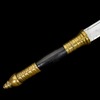
I've seen these referred to as Maasai elders' spears. I don't have a good reference, but if I recall correctly they are apparently intended for cattle guarding duty, rather than the lion spears, which are reserved for the hunt.
Hopefully someone else can chime in. Your example looks to have some age, although the forging quality is a bit rougher than what I would expect in a 19th century example. I seem to recall that in Maasai pieces a decline in quality is often attributed to the British ban on blades in the 1930s (although to be 100% honest I'm not sure if the ban was on semes or spears as well). Best, Iain |
|
|
|
|
|
#2 |
|
EAAF Staff
Join Date: Nov 2004
Location: Upstate New York, USA
Posts: 982
|
Per Spring (1993), this is a spear of the type carried by Maasai elders. An example measuring 200 cm in overall length is pictured on p. 112. (Your example is much nicer than my own.)
|
|
|
|
|
|
#3 |
|
Member
Join Date: Jan 2006
Location: Kent
Posts: 2,658
|
I think they may be Turkana.....
Regards David |
|
|
|
|
|
#4 |
|
EAAF Staff
Join Date: Dec 2004
Location: Louisville, KY
Posts: 7,363
|
What a fascinating scabbard (?).
|
|
|
|
|
|
#5 | |
|
Member
Join Date: Nov 2006
Location: The Netherlands
Posts: 2,238
|
Quote:
I saw a similar one for sale a a belgian trader/collector who collected it in east africa. Can't remember the exact tribe, but i am quite sure that he did not attribute it to Zulu tribe. Nice picture by the way of the running warrior. Nice shield with the ostrich feathers. Best regards, Willem |
|
|
|
|
![]() |
|
|