
| Find place | Unknown, reputedly Sweden |
| Collection | Private |
| Length | Overall: 103 cm. Blade: 88 cm. |
| Date | 900 to 1000 AD |
| Condition | Excavated; broken with two modern welds |
| Literature | Werner, Gunnel. 'Konservering av tre vikingatida svärd med inläggningar', Fornvännen 76 (1981), pp. 16-23. |
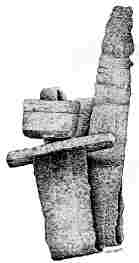 Viking age sword with pommel
and conjoined upper guard adorned by parallel linear silver and
copper inlay, the lower guard is now absent. The blade has been
repaired with two modern welds, one in the mid-tang and the other
just beyond the mid-point of the blade. The degree of corrosion
is different for the two blade fragments. No trace of pattern
welding can be seen underneath the patina, however the texture
within the fuller focally suggests iron inlaid inscriptions which
remain undecipherable without cleaning. The damage suggests that
this sword was deliberately mutilated, presumably prior to interment
in a grave, as is seen in the illustration to the right and above
from Petersen
(1919), figure 93, p. 112.
Viking age sword with pommel
and conjoined upper guard adorned by parallel linear silver and
copper inlay, the lower guard is now absent. The blade has been
repaired with two modern welds, one in the mid-tang and the other
just beyond the mid-point of the blade. The degree of corrosion
is different for the two blade fragments. No trace of pattern
welding can be seen underneath the patina, however the texture
within the fuller focally suggests iron inlaid inscriptions which
remain undecipherable without cleaning. The damage suggests that
this sword was deliberately mutilated, presumably prior to interment
in a grave, as is seen in the illustration to the right and above
from Petersen
(1919), figure 93, p. 112.
As the sagas are replete with tales of grave robbing for venerated ancient swords, the most practical explanation is that such weapons were mutilated so they and their presumed previous owner would be left at rest. Other possibilities include the ritual killing of an object or a superstitious belief that weapons must be disarmed to protect the living from the dead.