
|
 27th January 2009, 03:37 AM
|
#1 |
|
(deceased)
Join Date: Feb 2005
Location: Centerville, Kansas
Posts: 2,196
|
 Victorian Wall Decoration?
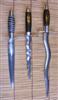
I was ask to post some pictures of this sword in another thread in the ethnographic forum but thought it would be better here. I have posted this once before but did not get any response so now that we have this forum I thought I'd try again. To begin with when I bought this it was covered in layer after layer of old aluminium or silver paint and under that alot of rust. The woman who owned this was in her 80s when I bought it had let her children use in in school plays and grand children carry it around on Halloween. The wooden grip was so dried out that I put a wood preservative on it (I hope this was not a mistake) to help keep it from getting any worse and cleaned off as much rust as I was comfortable with. Her story was that this was brought back from the Philippines after the Spanish American War with other edged weapons (including one with a long wavy blade as she described it) by her uncle but she had already sold the others when I bought this one. There is engraving on the ferrels and the pommel that look a lot like the engraving on the silver hilted Philippine dagger that I posted on the forum awhile back. The blade is what I would describe as hollow ground it 39-5/8 inches long, 3/8 inches thick at its thickest point and 1-13/16 inches wide at its widest point. The blade is not exactly what I would call sharp but not dull either. The hilt is 9-1/2 inches long and the sword weighs in at 3 lbs 5-1/2 ounces. I was told by someone that it could have been made by Ernst Schmidt. If anyone has any thoughts on this piece please post them as I have been trying to identify it for more than a couple of years with little luck. The blade is not as shiny as it looks in the pictures. Thank you for any help offered.
Robert Last edited by Robert Coleman; 27th January 2009 at 06:01 AM. |

|

|
|
27th January 2009, 02:41 PM
|
#2 |
|
Member

Join Date: Jun 2008
Location: The Sharp end
Posts: 2,928
|
Hi Robert,
What a fine piece! I do love these mystery pieces and the detective work that happens when one is posted. I looked at the pictures before I read your history as I wanted a clear first impression. Looking at the pommel, the fine engraved wavy lines reminded me of late 18thC and 19thC items with simple mechanically added decoration. Rather an elaborate pommel, nice and big to hopefully bring the point of balance to the right place. Big steel collar at the top of the handle? Thats a bit 'sudden' Handle seems rather on the long side, plain, wood has an age split, can't see any holes or evidence of previous wire binding? Quillons/guard/counterguards! Hmmm, Rather elaborate and nice! Steel, difficult to work, business like and not overly fancy, but certainly attractive and stylish. Rather good, getting more interesting! Quite heavy and the 'guard' elements almost look like they are soldered to the quillons? Blade. Looks quite heavy, almost like it would be more at home in a basket hilt than swept. By now I'm thinking its a fancy continental (Spanish) piece, Nice and heavy fair quality, possibly for work out in the colonies. Date... omg... I don't know. Late 18th to mid 19th? Post 3 musketeers, pre El Zorro!  But I'm imagining a chap rather like Ricardo Montalban carrying it (from the Zorro film) Then I read your story! So I think that fits. How about some better pics of the blade and close ups of the hilt? I'll be interested when the really knowledgeable members arrive to pin it down conclusively. BTW, I love it! Gene Last edited by Atlantia; 27th January 2009 at 03:55 PM. |
|
|
|
|
27th January 2009, 03:50 PM
|
#3 |
|
Member

Join Date: Sep 2008
Location: PR, USA
Posts: 679
|
I own a 18th C. swedish sword with a blade very similar to this one. Also, the center ridge and the ricasso suggest a good blade, perhaps rehilted for decoration purposes?
M |
|
|
|
|
27th January 2009, 04:29 PM
|
#4 |
|
(deceased)
Join Date: Feb 2005
Location: Centerville, Kansas
Posts: 2,196
|
Hello Gene, I'm glad you had a chance to take a look at this. I'll start with the wooden grip. If you look closely at the sixth picture down right above the steel collar you can just see where wire was once wound around the wood. When I originally removed the friction tape that had been wrapped around the grip (only to find the wood had also been given the paint treatment too) a few broken coils of rusty braided wire fell out from between the collar and wood. The wood has been roughly sanded before they painted it
 probably after the wire had started falling off. After stripping the paint off of the wood I put a preservative on it to try to keep it from further damage. The parts of the guard that look like knots do look to be soldered in place while the rest of the guard is one piece of worked steel. Where would the POB on a sword like this be? Right now it is 4-3/4 inches from the cross guard. If you would please tell me what parts of the blade you would like to have pictures of and I will post them as soon as it quits snowing. Thank you again for your interest. probably after the wire had started falling off. After stripping the paint off of the wood I put a preservative on it to try to keep it from further damage. The parts of the guard that look like knots do look to be soldered in place while the rest of the guard is one piece of worked steel. Where would the POB on a sword like this be? Right now it is 4-3/4 inches from the cross guard. If you would please tell me what parts of the blade you would like to have pictures of and I will post them as soon as it quits snowing. Thank you again for your interest.Robert |
|
|
|
|
27th January 2009, 05:21 PM
|
#5 | |
|
Member
Join Date: Jun 2008
Location: The Sharp end
Posts: 2,928
|
Quote:
4 3/4" off of the actual crossbar quillons? Or from the bottom of the curling bars attached to them? Does the blade look like its shortered? The tip is unusual (from swords I've had) having the central ridge so pronounced right to the end. Um, pictures of the blade.... Well any marks at all, either side, top and bottom? Perhaps Manuel can post some pics of his if it looks similar for a comparison? So, those bars. A close up of a couple of the joins might be a good idea. Have you had a good look to see if it is solder? In fairness you don't really want solder on a hilt as lead is fairly soft. But there does look like quite a lot of it! Couldn't be remains of some silvering or paint caught in the recesses that someone has put on it could it? Gene |
|
|
|
|
|
27th January 2009, 05:45 PM
|
#6 |
|
(deceased)
Join Date: Feb 2005
Location: Centerville, Kansas
Posts: 2,196
|
Hi Gene, The POB is in front of the actual crossbar quillons. I don't think that the blade has been shortened BWDIK. I will post a picture of the tip of the blade but I will have to do it inside with a flash. As far as the solder goes I don't think it is lead solder (it is way to hard) but it could be the remains of some kind of silvering. Could this be some kind of silver solder, or was silver solder even used then? Like I said it is only where the knotted sections are. The main part of the curling bars and the actual crossbar quillons and the rest are all one piece. Could the knots have been added later as decoration? I too was hoping that Manuel would post some pictures and measurements of his sword for comparison. Thanks again and I will post pictures shortly.
Robert |
|
|
|
|
27th January 2009, 05:53 PM
|
#7 | |
|
Member
Join Date: Jun 2008
Location: The Sharp end
Posts: 2,928
|
Quote:
Well, from what is visible in the pictures, there is considerable work in those bars, and the main ones seem to be 'forged' and shaped, so it might just be that the secondary elements were attached with some kind of silver coloured braze or hard solder as the maker thought that adequate for their level of stress. Take a couple of close ups of the bars if your can too mate. |
|
|
|
|
|
27th January 2009, 06:55 PM
|
#8 |
|
(deceased)
Join Date: Feb 2005
Location: Centerville, Kansas
Posts: 2,196
|
Gene, Here are the best ones I could get inside. A little picture intensive so if this is to many mods please let me know and I will delete as many as needed. These give a good idea of how the guard is put together. As I mentioned earlier the only parts that are not forged together are the knotted pieces. I made a typing error on the POB, it was supposed to be 5-3/4 inches so I double checked it and it is actually 6 inches.
 Robert |
|
|
|
|
27th January 2009, 09:57 PM
|
#9 |
|
Member

Join Date: Jul 2008
Location: Stockholm
Posts: 182
|
Expanding on what Manuel said, this type of blade is seen on a number of Swedish heavy cavalry swords from the 18th century (and a few cavalry swords from the early parts of said century as well). To provide some examples I'm attaching a close-up of an m/1773 (colour), and a scanned full-length shot of an m/1775 for Småland's cavalry regiment (b&w).
These two would have slightly shorter blades than Coleman's, but there are other, similar models with blades matching very well (m/1761 and m/1778 for Västgöta' cavalry regiment, and then of course there's the possibility of an officer custom-ordering something). I have pretty much no idea at all if, and then to what extent, this blade shape saw use outside of Sweden. As for the overall package, it looks very much to me like assembled in the 19th century as a decorative. |
|
|
|
|
28th January 2009, 12:03 AM
|
#10 |
|
(deceased)
Join Date: Feb 2005
Location: Centerville, Kansas
Posts: 2,196
|
Kisak, Thank you very much for posting the pictures of the two swords. I do agree that the blades do look strikingly similar and this could very possible be a Swedish blade . Could you please tell me where the stampings on their blades are as I have been over and over this blade with no luck finding any markings at all. If most blades of this age were marked (I supposed they were ?) maybe if I knew were to look and with better light and a magnifying glass I might be able to find something. The other thing that I'm wondering about is the length of the hilt on my sword. The sword handles very well one handed but with the length of the hilt a two handed grip is very comfortable and greatly improves how it handles. I know absolutely nothing about this type of sword so everything I say is pure speculation on my part. Another question is would they have gone to all the trouble of putting the engraving on the pommel and collars if this was just to hang on a wall? I am only asking questions to learn, I am not disputing anything that has been offered in reference to this sword as I know things were done quite differently even 50 years ago. Again I thank you for your interest and help in trying to identifying this .
Robert |
|
|
|
|
28th January 2009, 01:53 AM
|
#11 | |
|
Member
Join Date: Jun 2008
Location: The Sharp end
Posts: 2,928
|
Quote:
Hi Robert. Its difficult to judge these swords. Manuel and Kisak certainly seem to have found the type of blade. I would be very interested to see if someone can provide some exact measurements for comparison. Its certainly an unusual combination, as the handle is unusually long but is swept hilt style and the blade is unusually heavy and of course the swept hilt was long out of favour by the 18th/19THc. I'd be tempted to take the story you were told at face value and think its a rather strange colonial hybrid. Its a strange one to label. I just noticed you mention silver/aluminium paint on the hilt when you got it? Is that whats in the crevases of the hilt bars? One thought. If the blade is a reuse from one of these military swords then the tang must have been extended or it doesn't go to the end of the long handle. No movement on the pommel is there? |
|
|
|
|
|
28th January 2009, 01:59 AM
|
#12 |
|
Member
Join Date: Jul 2008
Location: Stockholm
Posts: 182
|
From what I can recall it wouldn't be very rare for these blades to be without stamps actually, though I've never really though about looking for stamps and such when I've seen such swords at auctions, etc, so I'm not too sure.
The length of the hilt is indeed quite a bit, if the blade comes from one of these Swedish swords, then the tang would have been lengthened as well in the process. Regarding the handling, these heavy cavalry swords are big, sturdy things, so their blades wouldn't be entierly out of place with a two-handed grip (as we can see here). As a curiosity I'm also reminded of George Silver recommending the same blade length for one handed and two handed swords. And as for the engravings, they could simply be there to make it sell better (decorative work on a decorative thing). If we look at "tourist" versions of the various ethnographic weapons, they are often very heavily decorated (though I assume generally decorated in ways which won't take too much time or skill to produce), to make the customers open their wallets. The same could be the case here. |
|
|
|
|
28th January 2009, 02:24 AM
|
#13 | |
|
Member
Join Date: Jul 2008
Location: Stockholm
Posts: 182
|
Quote:
m/1761: Blade length 100.2 cm, width at the base 4.5cm m/1775: 94.8/5 cm m/1775: 92.5/4.4 cm m/1778: 101.3/4.5 cm m/1778: 100/4.4 cm, 1350g (No weight given for the others.) The m/1778 is supposed to be an m/1775 with part of the basket cut off, which is why I included it here. |
|
|
|
|
|
28th January 2009, 02:47 AM
|
#14 |
|
Member
Join Date: Sep 2008
Location: PR, USA
Posts: 679
|
Mine has a 35.5" blade. (~ 90 cm).
  BTW, Robert. I owe you the data for the POB of my Spanish Ropera/Rapiere. It is 3.25" apically from the xguard. Best Man |
|
|
|
|
28th January 2009, 03:42 AM
|
#15 |
|
Member
Join Date: Jun 2008
Location: The Sharp end
Posts: 2,928
|
Robert,
The POB seems a little forward on your sword, which is clearly due to the rather long and heavy blade. You can see from Manuels small-sword, and its much narrower lighter blade, it can be offset by a much smaller handle (and shorter). Small-swords with that type of blade were used throughout Europe, and many look very similar. I assume the heavier blade might also have become quite far-flung in its useage. The very long handle would seem to me to have two obvious advantages: grip and offsetting that long heavy blade. If the sword was just a rehilted older blade for decorative purposes then why worry about either factor? Why not just make it look as much like a Rapier as you can and give it a standard size handle which would look more in keeping? But the distinctive blade and its unusual point is exactly the same as the one in Kisaks picture? I would think that although a little point heavy still, it WAS made to use. Just my thoughts, and let me remind you, I'm often wrong! lol |
|
|
|
|
28th January 2009, 03:50 AM
|
#16 | |
|
Member
Join Date: Jun 2008
Location: The Sharp end
Posts: 2,928
|
Quote:
wow! Great research Kisak. Robert? How does that compare? Just been looking through some books. Nothing the same, but there are some great examples of 'unusual' rapier-esq swords with similarities. Here's a 'basket hilt' with an eccentric guard and medium weightcentrally ridged blade:  
|
|
|
|
|
|
28th January 2009, 03:56 AM
|
#17 |
|
(deceased)
Join Date: Feb 2005
Location: Centerville, Kansas
Posts: 2,196
|
Gene, Manuel and Kisak, I can't thank you enough for all your help in identifying this sword. To answer Genes questions, the pommel is rock solid tight so I would guess that the tang had been extended and yes there are still traces of silver paint on the guard. I got out my trusty steel measure and the measurements are, Length = 100.4 cm and Width = 4.6 cm. These do not match exactly but I think are definitely close enough to the ones listed by Kisak to figure out what the blade was from originally. As to the POB I'm sure it would change if the wire wrap was restored to the grip. And to the story I was given when I purchased this, with the description she gave on the other swords her Uncle was supposed to have brought back and the story about her children and grand children's use of the sword I found it quite believable. Who doesn't like a good story?
 Gene, I must have been typing this at the same time you were posting your reply. Thank you for posting another example of a sword similar in its none standard appearance. Gene, I must have been typing this at the same time you were posting your reply. Thank you for posting another example of a sword similar in its none standard appearance.Robert Last edited by Robert Coleman; 28th January 2009 at 04:27 AM. |
|
|
|
|
29th January 2009, 01:43 AM
|
#18 |
|
(deceased)
Join Date: Feb 2005
Location: Centerville, Kansas
Posts: 2,196
|
OK I have a few more questions about this sword.
#1 Should I try to clean it anymore than I already have and if so what would be the best way to do it and what would be the best things to use? After stripping off the paint I used 0000 steel wool and machine oil to get it where it is now. #2 Should I try to re-wrap the wire on the grip? I do have a couple of small pieces of the original wrap, a small piece of twisted or braided wire and a piece of solid wire. #3 Where should the POB be on this? Thank you all for any answers that you can offer to my questions. Robert |
|
|
|
|
29th January 2009, 01:37 PM
|
#19 | |
|
Member
Join Date: Jun 2008
Location: The Sharp end
Posts: 2,928
|
Quote:
Hi Robert. 1. Cleaning. I think it loks fine already, a few areas look like they need a little more but it seems generally fine. Soooo, a little more of what you've done on the darker metal of the hilt/guard probobly wont hurt. Stick with the w-wool and machine oil, Its a fairly gently way to do it. I'd say if you are going to do it, then identify the 'solder' or whatever it is first. If its the remains of the aluminium paint you mentioned then it can come off, if its a hard solder then you'll want to be careful if you continue the cleaning so you don't flex any of the joins and crack the solder. Whatever you decide, I would say do it by hand. Don't be tempted to have a bash with your Dremel or anything powered. With cleaning, you can always do a little bit more if you need to, but once you clean too harshly or leave grinding marks etc it can be difficult to disguise. 2. Re-wrapping. This is a question of personal tastes. Can you p[ost a pic of the bits of wire you removed? Many very fine old swords have lost their wire wrap. Yours looks fine the way it is. If you re-wrap it, then it needs to be done completely in keeping or it could make the sword look more like a repro/mix-n-match. If you want to do it, then I would be happy to search my books for pictures of wired hilts that might help. Is the tang visible in that split BTW? 3. POB. OK, well I guess we have to decide if it was intended for 'fencing' on foot or its heavy construction was more for thrusting from horseback. I tend to think the heavy blade and long handle mean it would be best for thrusting from horseback. The POB on your sword is a little far forward (towards the point) for a rapier, (I would expect it to be more around 4 inches from the quillon block), and the handle and size would make is a little clumsy. From horseback I can see it being fine for it to be a little further forward 5-6 inches. So, my 'bottom line' views. I love it. A little more cleaning, but dont rush it. Handle, fine as it is, so perhaps re-wrap if you can find the perfect wire to do it but it really doesn't matter. POB, fine. Just my opinons |
|
|
|
|
|
29th January 2009, 02:21 PM
|
#20 |
|
(deceased)
Join Date: Feb 2005
Location: Centerville, Kansas
Posts: 2,196
|
Hi Gene, thank you for your advice on the cleaning of this piece. You can rest assured that I would NEVER under any circumstances use any motorized tool in the cleaning of any of my pieces.
To answer your question, yes the tang can be seen where the hilt is cracked.After thinking about it I have decided to leave the hilt wrapping as is. I don't think that it could be done properly with out removing the fittings which would require grinding the riveted end of the tang to remove of the pommel. I will try to clean the remaining paint and some of the rust from the joints and crevasses of the hilt. Thank you again for all your help. Robert |
|
|
|
|
30th January 2009, 07:08 PM
|
#21 | |
|
Member
Join Date: Jun 2008
Location: The Sharp end
Posts: 2,928
|
Quote:
Does the glimpse of tang give any more clues? |
|
|
|
|
|
30th January 2009, 07:46 PM
|
#22 |
|
(deceased)
Join Date: Feb 2005
Location: Centerville, Kansas
Posts: 2,196
|
Unfortunately no, only about 2 inches of the tang can be seen in the split. It is well patinated (rusted
) but I can see no forging seam from being extended. Not sure if that is good or bad.  Robert |
|
|
|
|
30th January 2009, 07:55 PM
|
#23 | |
|
Member
Join Date: Jun 2008
Location: The Sharp end
Posts: 2,928
|
Quote:
Well its better than seeing a big weld I think its a great piece! Please post more pictures if you do any cleaning or work on it. All the Best Gene |
|
|
|
|
|
30th January 2009, 09:48 PM
|
#24 |
|
(deceased)
Join Date: Feb 2005
Location: Centerville, Kansas
Posts: 2,196
|
Gene, I would like to thank you, Kisak and Celtan once again for all of your help and time with this sword. With quite a bit of winter left ahead and to help keep myself from getting a bad case of cabin fever I will probably do a little more cleaning on this and try to remove the last of the paint and a little more of the rust from the hilt. I'll also clean the blade a little better while I'm at it. When done I will be more than happy to post more pictures.
With My Best Regards Robert |
|
|
|
|
31st January 2009, 06:30 PM
|
#25 |
|
Arms Historian

Join Date: Dec 2004
Location: Route 66
Posts: 10,872
|
I have been glancing at this thread occasionally and noting the outstanding observations and assessments on this very attractive and interesting piece. I agree that there is a wonderful warmth to a good story that often accompanies items that are passed on through families in estates and as heirlooms. In many cases, however, the stories have been misconstrued or embellished, which sometimes disappointing, though I personally consider all aspects part of the story, from the original version to the revised.
The idea of this piece being from the Philippines does not seem likely, though it would be wonderful to think of it as a Spanish colonial rapier carried by a Spanish officer there. I would think this piece was likely comingled with what sounds like a number of weapons, some of which were no doubt examples which may have been obtained there. Perhaps the 'wavy' bladed one was a Moro kris. It is quite common to have this occur, even in museums, as sometimes the groupings contain incongruent items and are all assumed from the same location. I think the assessment of this blade being probably 18th century military is, as shown, correct, and though I do not think this fabrication is the work of Ernst Schmidt's atelier, I do agree it is likely the work of one of his contemporaries to represent an early rapier. It is a charming piece, and the hilt shows considerable skill in ironwork, and though not an authentic early example, has become a distinct antique in its own right, much as Schmidts work has. Often when I see swords that are reconstructions of the period this piece, and of earlier periods recalling the colorful and chivalrous times of the past, I think of swords that often found use in Masonic lodges as Tylers swords.While it is well known that there were companies that produced regalia swords for the membership and officers, the sword used by the Tyler was profoundly considered more revered in its station. For this reason, I believe that many composite and skillfully fashioned examples became used in this capacity. In earlier research that concerned Masonic symbolism, I have come across numbers of instances of various swords with many degrees of fascinating history in thier eventual arrival in thier use by Tyler's. While obviously I cannot say that is the case with this sword, it does seem worthy of note for consideration. All best regards, Jim |
|
|
|
|
1st February 2009, 05:25 AM
|
#26 |
|
(deceased)
Join Date: Feb 2005
Location: Centerville, Kansas
Posts: 2,196
|
[QUOTE=Jim McDougall]
I would think this piece was likely comingled with what sounds like a number of weapons, some of which were no doubt examples which may have been obtained there. Perhaps the 'wavy' bladed one was a Moro kris. Hello Jim, I cannot thank you enough for joining in on this discussion. At one time in this post I said "Who doesn't like a good story?". The main reason that I left out the following is the fact that it sounds to much like someone grasping at straws trying to make a point. The woman I bought this from did have and did show me an early photograph of her Uncle in uniform with his "war booty" that did show this sword and what looked to be a very nice kris, a couple of bolo's and a talibon as well as other pieces quite clearly. Now as to the age of the photograph I cannot with all honesty say how old it was but it did in my eyes look to be turn of the century or there about. As like other excuses that I'm sure you've already heard she flatly refused to let me have the photo long enough to have it copied no matter what I offered her. She seemed more concerned about the value of the picture than that of the sword which I paid a grand total of $15.00 for, and offered up to $25.00 for the picture itself. I have not mentioned this before because of how how stupid and ridiculous it sounds to me and I'm sure to anyone else when put in printed form. I'm not saying this to try to prove that this sword is from the Philippines because it has already been shown in this thread that this is not the case, but only to try to show how convincing the story was for me to believe. My only question to you is this, do you think that there is no chance that this piece was made to be used as an authentic weapon and was not just made to decorate a wall ? Robert |
|
|
|
|
1st February 2009, 06:20 AM
|
#27 |
|
Arms Historian
Join Date: Dec 2004
Location: Route 66
Posts: 10,872
|
Hi Robert,
I think you did fantastic getting this piece for 15 bucks!! It really is an intriguing piece, and it is reflective of some pretty good ironwork. I cannot imagine any way this sword would have been in the Philippines, though it does seem that the Spanish American War period might be right for its fashioning and assembly. Something that has come to mind is the amazing war surplus world of the Bannerman Company of New York, who were in business from just after the Civil War up to the 1960's, purveyors of all manner of surplus and war relics. One of thier greatest booms was just after the Spanish American War, when they obtained tons of material from both sides. It is nearly unfathomable how many 'bring backs' made the pages of these catalogs, and still circulate as war souveniers. Many veterans even saw items they had seen on campaign and regretted not having 'brought one home' , and now had a second chance to obtain them as examples of the weapons used by the'enemy'. Whether they intended to pass them off as actual souveniers or not is anyones guess as often it was just assumed as they were handed down. I dont think this in any way discredits the items themselves, they were in most cases brought back by somebody, unless part of the stockpiles obtained in the Bannerman conquest. Bannerman also took in just about anything remotely associated with militaria, including fabricated pieces, regalia items, stage props etc. While I do not believe this sword was put together in any way for combat, as rapiers were history nearly 200 years before this was made, I do believe it was intently constructed, whether for use on stage or possibly even as I suggested, as a Tylers sword, rather than a wall decoration. The blade, as we have agreed, certainly had a history of its own, in an undetermined European military sword. Perhaps, that blade had its own story to tell, before the plot thickened and it was given a new life.  All best regards, Jim |
|
|
|
|
6th February 2009, 04:03 AM
|
#28 |
|
(deceased)
Join Date: Feb 2005
Location: Centerville, Kansas
Posts: 2,196
|
Hi Jim,
Sorry it has taken me so long to reply to your last post but after reading it I was to busy crying in my beer.  Just kidding. I can't say that I was not just a little disappointed hearing that it was not made for combat but such is life. Still to me it is a great looking sword and conversation piece and well worthy of hanging out with the rest of my swords. Again many thanks. Just kidding. I can't say that I was not just a little disappointed hearing that it was not made for combat but such is life. Still to me it is a great looking sword and conversation piece and well worthy of hanging out with the rest of my swords. Again many thanks.Robert |
|
|
|
|
6th February 2009, 04:18 PM
|
#29 | |
|
Arms Historian
Join Date: Dec 2004
Location: Route 66
Posts: 10,872
|
Quote:
You're very welcome Robert While I regret that my opinion could not find a way to think of this as a combat weapon in its present incarnation, as I noted, it appears that its blade was, at one time. In actuality, a great deal of the edged weapons collected have not seen actual combat, and the ones which did quickly evidenced it, often taking its toll on them. It seems like far more collectors look for pristine condition, in the manner of collectors in general, and worn or combated weapons are typically downgraded accordingly. I think this is one of the most attractive examples of a reproduced rapier I have seen, mostly because it does appear servicable, and its age shows well on it. I would use as much restraint as possible to retain any patina you can, and for my preference I'd leave the grip alone. To me it would just detract from the antiquity of the piece that gives it special appeal. Again, my preference alone...when I collected, I was fortunate that the dark old, worn pieces were what I liked....as that was all I could really afford It worked out pretty well !All the best, Jim |
|
|
|
|
|
11th February 2009, 11:06 PM
|
#30 |
|
(deceased)
Join Date: Feb 2005
Location: Centerville, Kansas
Posts: 2,196
|
Hi Jim
Just wondering, were all the elements of the guards on original rapiers forged in one piece? Did they ever braze any of the pieces into place, or were they only forge welded or riveted? After looking at some of the more elaborate examples and how complicated they were it makes me wonder how they were made. Thanks.Robert Last edited by Robert Coleman; 12th February 2009 at 04:42 AM. |
|
|
|
 |
| Thread Tools | Search this Thread |
| Display Modes | |
|
|


 Linear Mode

