Ethnographic Arms & Armour
 

Go Back   Ethnographic Arms & Armour > Discussion Forums > Ethnographic Weapons

Closed Thread
 
Thread Tools Search this Thread Display Modes
Old 27th June 2008, 09:57 PM   #1
baganing_balyan
Member
 
Join Date: Jun 2008
Posts: 89
Default

Quote:
Originally Posted by Spunjer
hi guys,

sorry, been on vacation


as a matter of fact, they do. magical symbols, jawi, Qur'anic verses and okir are every now and then can be found in Moro weapons.
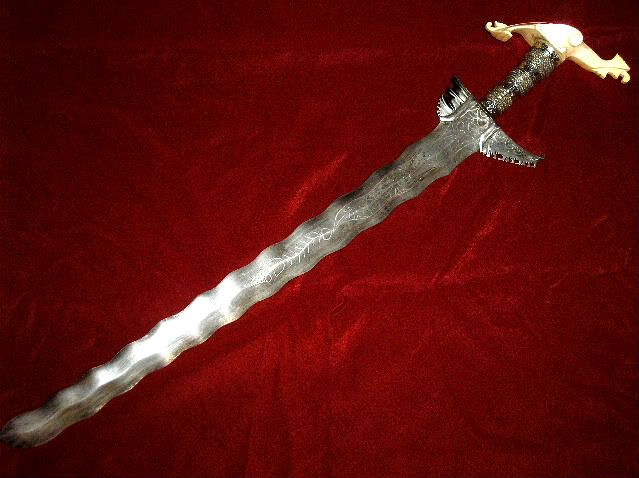


i'm not following the timeline here. if you're referring to the writings on the weapons, etc. during the 14th c. i'm sure a lot of us here would love to see a moro weapon from that era, writings or no writings.


i'm sure it's the same way the word "Moro" (moors) got introduced.
Spain.
Find krises that are earlier than the one you showed. Sulu and Maguindanao muslims have their own dialects. Arabic was not widely-used and written then. Madrassas are recent development.

If the Spanish introduced "turko," don't you think they would have also introduced "vikingo" (viking) since the viking culture and history also reached spain like the Ottomans'? Unfortunately, we don't have vikingo in our language.

Filipinos have names for the people their forefathers encountered in ancient times. For chinese, we have tsino and intsik, Dutch, Olandes, africans, negro not africano.

baganing_balyan is offline  
Old 27th June 2008, 11:22 PM   #2
David
Keris forum moderator
 
David's Avatar
 
Join Date: Aug 2006
Location: Nova Scotia
Posts: 7,261
Default

Quote:
Originally Posted by baganing_balyan
Find krises that are earlier than the one you showed.
That is part of the problem. As i mentioned before, the earliest Moro kris that i have ever seen tend to date to the 18th century. It might be possible that these have been misdated and are closer to 17th century, but earlier than that is doubtful. The one that Spunjer shows here is most probably late 19th century. If anyone can show me a Moro kris from the 14th century i would sure like to see it.
There are many threads on this forum that show these so-called "archaic" kris and we have had quite a bit of discussion on them. There are also many Moro kris threads that deal with blades that have inscriptions, okir and/or magickal symbols on them. As Spunjer has pointed out, these inscriptions are sometimes written in Jawi. I would suggest that you try the search function and check some of these threads out. They will definitely help you with your research.
BTW, can you actually pinpoint when the word "turko" came into the language?
David is offline  
Old 28th June 2008, 01:21 AM   #3
Battara
EAAF Staff
 
Battara's Avatar
 
Join Date: Dec 2004
Location: Louisville, KY
Posts: 7,363
Default

Great to have you back Spunger

You are right David - his kris is late 19thc (I did the silver bands ). A great piece!
Battara is offline  
Old 28th June 2008, 01:42 AM   #4
baganing_balyan
Member
 
Join Date: Jun 2008
Posts: 89
Default

Quote:
Originally Posted by David
That is part of the problem. As i mentioned before, the earliest Moro kris that i have ever seen tend to date to the 18th century. It might be possible that these have been misdated and are closer to 17th century, but earlier than that is doubtful. The one that Spunjer shows here is most probably late 19th century. If anyone can show me a Moro kris from the 14th century i would sure like to see it.
There are many threads on this forum that show these so-called "archaic" kris and we have had quite a bit of discussion on them. There are also many Moro kris threads that deal with blades that have inscriptions, okir and/or magickal symbols on them. As Spunjer has pointed out, these inscriptions are sometimes written in Jawi. I would suggest that you try the search function and check some of these threads out. They will definitely help you with your research.
BTW, can you actually pinpoint when the word "turko" came into the language?
I think the krises collected or photographed by the smithsonian institution in 1900's were actually older. Moros then and muslims now have a tradition of treating weapons as heirlooms.

Spunjer's kris is a suspect because of the ivory head of the handle-- that is if it's really an ivory. Philippines has no source of Ivory. There are lumads who still wear ivory bracelets but they don't know the source. Upon inspections, I believe it could be traced back to India. It could not be borneo because ivory bracelets are only common among the lumads in caraga and davao region. I haven't seen Muslim women in muslim mindanao wear old ivory bracelets.

It is hard to date folklore. As far as I know, my grandparents had been using the words turko, bombay, and negro even without meeting a turk, an indian, and an african. They are just part of our lexicon and consciousness. bombay has a proven history in the Philippines, so is the negro (slaves) during the spanish galleon trade, but the story about the turko is still not clear.

I have been researching about the origin of sulu, its meaning, and what language it came from. I could not find it in early Malay words, in Spanish, but i have found it in turkish language and it means "water." It perfectly suits to the geography of sulu, the philippine province.

Sanskrit also has sulu. it means "one who cuts well" and it is a term use in Indian classical dance, but Mandakranta Bose wrote in her book, Movement and Mimesis: The Idea of Dance in the Sanskritic, that the use of sulu only began in 16th century.

I believe Indian's sulu is an influence of the muslim's temple dance pangalay in sulu, the Philippine province, where krises are sometimes used-- hence, the meaning, "one who cuts well."

I still believe that sulu became a name of the place when the arab missionaries reached the island bringing Islam and the Ottomans were with them. The spread of Islam that time was synonymous to the expansion of the ottoman empire.
baganing_balyan is offline  
Old 28th June 2008, 02:02 AM   #5
Battara
EAAF Staff
 
Battara's Avatar
 
Join Date: Dec 2004
Location: Louisville, KY
Posts: 7,363
Default

I would disagree with you on Spunger's kris - I had it in hand and the pommel is elephant ivory with grain structure indicative of elephant ivory. Also, ivory from India and Sumatra was traded in the reaching, including reaching the Philippines,China, and Japan.
Battara is offline  
Old 28th June 2008, 02:53 AM   #6
baganing_balyan
Member
 
Join Date: Jun 2008
Posts: 89
Default

Quote:
Originally Posted by Battara
I would disagree with you on Spunger's kris - I had it in hand and the pommel is elephant ivory with grain structure indicative of elephant ivory. Also, ivory from India and Sumatra was traded in the reaching, including reaching the Philippines,China, and Japan.
the use of ivory in mindanaoan weaponry is recent not ancient-- probably when the Europeans occupied Borneo in late 1800's.

Smithsonian photographs do not even show krises with ivory handles.

I also have a copy of thirteenth century text written by a chinese trader involved in ivory trading not with the people of sulu but with the lumads (natives) of palawan.
baganing_balyan is offline  
Old 28th June 2008, 06:12 AM   #7
fearn
Member
 
Join Date: Dec 2004
Posts: 1,247
Default

Hi Baganing,

This is a more general comment, rather than a specific response. I happen to work in the sciences, and there's this idea that some have called "scientific sexiness." It's when you fall head over heels in love with this wonderful idea, and then go out chasing it and trying to prove it's true. The problem with great ideas is that not all of them turn out to be so great once you get to know them. Yes, there are parallels between science and dating.

In any case, what separates the good scientists from the bad ones isn't the sexiness of their ideas, it's that their sexy ideas stand up to cold, hard, often brutal scrutiny, primarily because they're testable, and withstand all attempts to refute them with the best evidence available.

While I agree that you have to be a strong advocate for your ideas (and they are interesting), if you want to do truly good scholarship, you also need to find ways to test your ideas. If your ideas cannot be tested in a way that would disprove them, then they really aren't great.

That's okay. I've got a closetful of sexy ideas. Most researchers do. My favorite unfulfilled sexy idea is waiting for someone discover 70 million year old fossil roots of a proto-oak from Burma--if such roots exist. Once someone finds those roots, I can write a paper that will change everyone's ideas about how plants evolved. But only if I'm right about what how those roots are constructed, and only if they exist. There may or may not be parallels between this story and trying to find a 600 year old kris to support your ideas.

My 0.00002 cents. Back to lurking. Interesting thread!

F
fearn is offline  
Old 28th June 2008, 07:48 AM   #8
Spunjer
Member
 
Spunjer's Avatar
 
Join Date: Dec 2004
Location: Witness Protection Program
Posts: 1,730
Default

Quote:
Smithsonian photographs do not even show krises with ivory handles.
do you have a copy of this smithsonian photographs you're talking about?


Quote:
If the Spanish introduced "turko," don't you think they would have also introduced "vikingo" (viking) since the viking culture and history also reached spain like the Ottomans'? Unfortunately, we don't have vikingo in our language.

huh? how did you connect vikings and turks? i wish you could explain this further as this is very interesting.


Quote:
I think the krises collected or photographed by the smithsonian institution in 1900's were actually older.
i'm interested in finding out why you think these krises were older. surely there are tell tale signs, no?
Spunjer is offline  
Old 28th June 2008, 10:37 AM   #9
baganing_balyan
Member
 
Join Date: Jun 2008
Posts: 89
Default

Quote:
Originally Posted by Spunjer
do you have a copy of this smithsonian photographs you're talking about?


huh? how did you connect vikings and turks? i wish you could explain this further as this is very interesting.


i'm interested in finding out why you think these krises were older. surely there are tell tale signs, no?
I meant to say photographs of old krises. Ivory handles are mostly 19th century. in archaeology, the more intricate a tool looks, the more recent it is.

You said the spanish introduced the "turko" to the philippines. Granting they did since Spain was not spared by the ottomans, they would have also introduced "vikingo" since vikings also invaded/raded spain. Why would they be selective about their history, if indeed they introduced the image or the word turko to the filipinos?

anyway, I checked and compared the Y-Chromosome haplogroups of sumatra, borneo, and philippines. They all share the same haplogroups C,O,D, and K, but the only difference is that philippines has haplogroup R1B. Guess what... Turkey has R1b.

I am not sure though if the haplogroup i thought to be R1B is right (the color is just too tiny and vague. Maybe it is RxR1. If it is the case, still there is a turkish connection, turkey has K (western asia or eurasia haplogroup) too, and that would mean, there are also turkish genes in sumatra and borneo like philippines.

I need to go back home and ask my tausug friends for DNA testing. I have always believed that their ancestry can be traced back to turkey since I got a turkish boyfriend years ago who just looked like my tausug cousin. hehehehe

y-chromosome haplogroups

Last edited by baganing_balyan; 28th June 2008 at 12:00 PM.
baganing_balyan is offline  
Closed Thread

Thread Tools Search this Thread
Search this Thread:

Advanced Search
Display Modes

Posting Rules
You may not post new threads
You may not post replies
You may not post attachments
You may not edit your posts

BB code is On
Smilies are On
[IMG] code is On
HTML code is Off

Forum Jump


All times are GMT +1. The time now is 11:45 PM.


Powered by vBulletin® Version 3.8.11
Copyright ©2000 - 2025, vBulletin Solutions Inc.
Posts are regarded as being copyrighted by their authors and the act of posting material is deemed to be a granting of an irrevocable nonexclusive license for display here.