
|
|
|
 1st March 2005, 02:03 PM
|
#1 |
|
Member
Join Date: Dec 2004
Location: Singapore
Posts: 1,180
|

Ok, here's the close-up. The keris is a lot sturdier than typical Javanese blades and is tempered half-way through. The metal feels more typical of S. Sumatran kerises too.
|

|

|
|
1st March 2005, 04:10 PM
|
#2 |
|
Member

Join Date: Dec 2004
Posts: 184
|
Im far from a keris expert but my general impression is that it is peninsular or possibly Balinese.The overall design of the blade just doesnt look Javanese to me.
|
|
|
|
|
1st March 2005, 05:05 PM
|
#3 |
|
Member

Join Date: Jan 2005
Location: Singapore
Posts: 1,248
|
Opinion...
I don't think it's a Megantara or dapur Panji Pengantin.
The nearest match is Dapur Anoman Luk 5 (Ensiklopedi Keris p:73) minus the kembang kacang. This does not explain the 'c' shape, however. I noticed that your pendokok is fitted with a Pattani style, pierced Malacca cup (in silver). Very nice... |
|
|
|
|
1st March 2005, 07:09 PM
|
#4 |
|
Member
Join Date: Jan 2005
Location: East Java
Posts: 137
|
hi all,
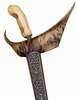
.... Just try to compare type of "Gonjo", "Greneng", "Tikel Alis" and Metal between my Megantara and BluErf. The shape of gonjo called Gonjo Kelap Lintah. Many gonjo like this made from Majapahit to Mataram Senopaten period (for an old keris). > Style of Tikel Alis and Sogokan similiar with Majapahit or Sedayu keris; > Style of Greneng looks like a Majapahit keris; > Style of Gonjo took a characteristic from Majapahit keris; > The metal looks like a Javanese keris with wos wutah pamored, but because BluErf posted keris which no warangan, so that it looks like different with Javanese keris. Similiar like a Sumateran keris. But, I don't think so; > If I look closer, the "C" is too sharp, diffrent with the Greneng which look threadbare. But, I think it is an original. So, without C, both of these keris looks like similiar. I think it is a Javanese keris  But who knows, because I just try to give more opinion by comparing with another same piece and still try to learn more about Javanese keris. Same with what I said previously, your keris is an exotic, BluErf. ------------- To Alam Shah, If you think that BluErf keris nearest match with Dapur Anoman Luk 5, I don't think so. The Anoman (Hanuman) keris have Sogokan from bottom (Sorsoran) to top of the blade and it has a Kembang Kacang. It have a different style Luks with Megantara or BluErf keris  . .Warmest Regards, Mans. Last edited by Mans; 1st March 2005 at 07:23 PM. |
|
|
|
|
1st March 2005, 07:12 PM
|
#5 |
|
Member
Join Date: Jan 2005
Location: East Java
Posts: 137
|
Megantara Pudhak Sategal tangguh Pajang
Any Idea ? |
|
|
|
|
1st March 2005, 07:19 PM
|
#6 |
|
Member
Join Date: Jan 2005
Location: East Java
Posts: 137
|
Anoman (Hanuman) Luk 5 Pamor Wos Wutah Tangguh Mataram Sultan Agung.
(Keris BW Collection) |
|
|
|
|
2nd March 2005, 03:02 AM
|
#7 |
|
Member
Join Date: Jan 2005
Location: Singapore
Posts: 1,248
|
Mans,
I'm still a learner with an 'L' plate  . Having seen your pieces, I tend to agree with your opinion on the similarities with your Megantara. My comparison was based on the megantara piece featured in Ensiklopedi Keris. I presumed that megantara is associated with a luk 7. However, as mentioned by your goodself it may vary (based on your earlier post). . Having seen your pieces, I tend to agree with your opinion on the similarities with your Megantara. My comparison was based on the megantara piece featured in Ensiklopedi Keris. I presumed that megantara is associated with a luk 7. However, as mentioned by your goodself it may vary (based on your earlier post).I've looked through Ensiklopedi Keris, Tammens vol.2, 3 and some other keris books and still cannot find any resemblance to the elusive 'c' shape. BlueErf, I guess it's something exotic and unique to your piece. Have you asked Dave, Paul or Adni's opinion? They should be able to assist... Good day. 
Last edited by Alam Shah; 2nd March 2005 at 03:15 AM. |
|
|
|
|
2nd March 2005, 02:59 PM
|
#8 |
|
Member
Join Date: Dec 2004
Location: Singapore
Posts: 1,180
|
Thanks all for the comments, especially Mans for the pictures. The visual comparison is definitely useful. I now have half a mind that this keris is really Javanese in origins, but the other half was looking at the feel and sturdiness of the blade and going "hmmm... maybe not...".
Actually, the pamor plays a part in the opinion-forming process too. (it actually has warangan, just that pamor is not very contrasting). Though its wos utah, it just doesn't look like the type usually seen on Javanese pieces. But then again, it could be because this is an older blade. When I got this keris, I was really stumped. I guess we always have to keep in mind that kerises move and Empus move. This keris was found in an old East Sumatran/Malay sheath which was made for it. I commissioned the silver works because the sheath was looking really sad in its original state. Its Malay motifs, but I guess still generally "in the same family" given the E Sumatran/Malay connection. |
|
|
|
 |
| Thread Tools | Search this Thread |
| Display Modes | |
|
|


 Hybrid Mode
