
|
 10th August 2025, 11:43 PM
|
#1 |
|
Member
Join Date: Dec 2004
Location: Bay Area
Posts: 1,759
|
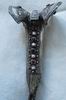
 Interesting Kaskara from the Askeri Museum
When visiting the Askeri Museum a few weeks ago, I found this sword. The museum claims that it is a Byzantine 15th century sword, which it most definitely is not. As a rule, the curators in the Askeri never really cared about proper attribution, so the misattribution is not surprising.
To me, it looks like a kaskara, potentially an earlier one and with an interesting silver hilt. I wonder of anyone is familiar with the markings in the base of the blade. |

|

|
|
11th August 2025, 03:11 PM
|
#2 |
|
Member
Join Date: Oct 2010
Posts: 448
|
To me this sword is not a Kaskara, likely "invented" in mid-19th C. The handle has none of the design elements of a kaskara. The cross guard is close and looks like those cast brass elements from Egypt most common on acid etched blades during the late Mahdist era. (I can't recall just now the name).
Don't know about the mark on the blade. Design elements of the hilt are similar to ancient Islamic swords like the one in Askari Museum attached. (Sorry I can't extract an image of the grip to show. Maybe Tim can give me a hand.) http://i1337.photobucket.com/albums/...ps489036f4.jpg Regards, Ed |
|
|
|
|
11th August 2025, 04:20 PM
|
#3 |
|
Member
Join Date: Dec 2004
Location: Bay Area
Posts: 1,759
|
Thank you for responding Ed. The sword you linked to is an Omani sword with a hilt, which is quite acrhaic in form, inspired (or unchanged for centuries) from early Islamic forms.
Here is a link to a sword posted by Kubur some time ago, with a brass hilt and a crossguard similar in style: http://vikingsword.com/vb/showpost.p...3&postcount=20 Teodor |
|
|
|
|
11th August 2025, 06:23 PM
|
#4 |
|
Arms Historian

Join Date: Dec 2004
Location: Route 66
Posts: 10,834
|
It seems to me that there numbers of 'Sudanic' swords which while not in the traditional kaskara form entirely, were comprised on some elements and often using the kinds of blades produced during the Anglo-Egyptian condominium or somewhat before.
These were often reflecting the Ottoman influences which had been established in Mamluk Egypt into 19th century and these conventions and stylistic tendencies prevailed. In my opinion, the acid etched thuluth calligraphy on weapons during the Khalifa period derived from Mamluk metalwork conventions situated in Sudan earlier in the century. It seems reasonable the same type of followings would apply to various swords in degree, especially those for any sort of prestigious use. Attached is the sword Teodor noted from previous post from Kubur. My example of 'Sudanese'(?) shamshir, seemingly following these traditions. The blade is the Turkish 'beyez'? I dont recall the term used. Ed, I recall those same types of swords you mention, and the cast twirled grips but cannot place where the references are either. As noted they seem Anglo-Egyptian period, and that mark looks like the steel stock type trademarks seen on some kaskaras made with this material early 20th during the Condominium. It does seem in these Turkish museums there is a degree of innovation in exhibits. Last edited by Jim McDougall; 11th August 2025 at 06:52 PM. |
|
|
|
|
11th August 2025, 10:51 PM
|
#5 |
|
Member
Join Date: Oct 2010
Posts: 448
|
Jim,
I agree. From the Egyptian "conquest" of Sudan in 1821 until the Mahdiya beginning in 1885 there was a considerable different kinds of swords deployed in Sudan. The Funj mounted guards used imported Arabic-style sabers for 300 years until defeated in 1821. The Mamluks of Muhammad Ali's army was manned by 4,000 Albanians and other nationalities plus various mercenaries who passed through. They had their own styles of weapons. Likely like your fine saber example posted. During the 64 year period there was ample opportunities for captured swords to be adapted and styles to be to be shared and hybrids to develop and survive among the hated Turkiyah occupation soldiers and the native Arabized Sudanese tribes. Within this period it seems that the native Sudanese tribes had the stronger culture and developed the straight bladed kaskara, grip and cross guard style, and it became more or less fixed. I am nor aware of trophy swords from the Mahdiya Era to be anything other than the kaskara as we know it today. Best regards, Ed |
|
|
|
|
12th August 2025, 01:03 PM
|
#6 |
|
Arms Historian
Join Date: Dec 2004
Location: Route 66
Posts: 10,834
|
Thanks very much Ed, especially for the kind words on my anomaly saber, which I do believe was a creation in the Turkiyah period and mid 19thc. probably in regions of Khartoum to Sennar.
Most notable is the characteristic flare of scabbard tip. This some years ago was surmised by a friend who was an archeologist in Sudan to likely be an affectation from the ancient Meroe kingdom apparently adopted from iconography by Funj rulers. I hope I might add some thoughts from my research of years ago, and run them by you, in hopes that they are at least somewhat correct, and that you might edit with your extensive knowledge on this history. The Mamluk influences remained key through these regions, and it seems their metalworking traditions prevailed in these areas from Dongola to Sennar. I believe there was considerable trade in from the port of Suakin on the Red Sea, including trade blades etc. There was mention of the Shendi market as a central trade entrepot handling much of this activity. The nominal evolution of the kaskara form in the scattered 'bush empires' of predominantly Baggara tribes is apparently the source of the term kaskara loaned from thier language. Naturally the typical term used is simply sa'if. The Egyptian and Turk presence in Khartoum were part of the slave oriented commerce in Sudan which was part of the impetus of the Mahdiyya in 1881. If not mistaken, it seems there was only nominal presence of the sword with tribal forces in the initial campaigns with tribal warriors until they had captured numbers of arms, mostly guns. Apparently at this point there was a profound development of more swords of munitions grade in the manner of the established broadswords of the upper classes in the Funj Sultanate traditions. After the fall of Khartoum, and the subsequent death of the Mahdi, the Khaliph faced issues with maintaining the impetus of the jihad, and needed to create regalia which perpetuated the 'magic' of the Mahdi. Therefore, using the immense stores of industrial equipment and supply left at Khartoum by Gordon, he created an arsenal at Omdurman. In these shops there were many artisans, foreign and others skilled with the Mamluk metalworking tradition. In my opinion, this is where the creation of the profusely acid etched decoration of kaskaras as well as sundry other weapon forms began in large scale, though it seems there had been some degree of this earlier outside this motivation. As many of the Ansar warriors in the forces were conscripted from other tribal regions, numerous weapon forms were included in the types used, and many of these were also covered in the Thuluth calligraphy motif. This was actually comprised of various passages from the Quran, but in repetitive fashion, augmented by interspersed invocations and exhortations toward the Mahdi. In essence, each weapon was imbued by the magic of the Mahdi, and assurances of angelic support to the warriors for their flights to paradise. These types of weapons were among the many that became trophies and sounvenirs after Omdurman and the other residual actions at the fall of the Caliphate 1898. The ubiquitous kaskara swords were of course the primary weapon forms brought back from the Sudanese campaigns, as with this example, as noted, c. late 1880s and likely from Omdurman shops. Note the Hausa moons (dukari) indicating this was likely blade from that source as it seems most of these were. I hope this perspective of the kaskara context is somewhat viable, and adding it here is as much trying to regain my own understanding from memory as sharing it for context in this discussion. All best regards Jim |
|
|
|
|
12th August 2025, 09:58 PM
|
#7 |
|
Member
Join Date: Oct 2010
Posts: 448
|
Jim,
A complex list of queries. I'll try to respond after a fashion. A group of Mamluk "refugees" fled to the Dongola region of N. Sudan in 1812 and influenced the area until 1820 when the Egyptian drove them out. One source says only 300 remained and fled to the South. The refugees were soldiers and I doubt they instituted metal working traditions. It seems that only superficial accounts of the Mamluk-in-Sudan and what happened to them after Dongola exist, no scholarly works I am aware of. Seems a fertile area for some serious research. Dongola and areas south down to Khartoum was inhabited by three Christian kingdoms from after Meroe until the advent of the Funj. They likely inherited and preserved Meroitic metal working traditions. The last kingdom was the Alodia with capital at Soba near today's Khartoun. It fell to the Funj c.1504. Remnants moved south to near the Sudan-Ethiopia border and founded the Fazaghali Kingdom. They lasted until taken over by the Funj in about 1685. A the bottom of the attached Wiki file is a 1821 pic of a Fazaghali man with a sword scabbard with a bulbus tip and a cross guard like the kaskara. This suggests that the kaskara originated in the East rather than the West/Darfur area. https://en.wikipedia.org/wiki/Kingdom_of_Fazughli Apparently, the native sword making era was late in coming to Sudan. Traveller's narratives from as early of c.1700 states that the Funj used Schiavonesca broadswords favored by Hungarian & Venice during the 15-16 C. perhaps made in Serbia. Interesting trade connections. Others report large number of European blades imported from Cairo. See pp. 17-20 in my paper on Kaskara Cross Guards attached. Osman Digna supposedly told the Hadendawa of Kassala area to make swords for the Mahdiya. http://www.vikingsword.com/ethsword/...ara_guards.pdf Yes, Gordon had a first class machine shop in Khartoum that was moved to Omdurman. The Khalifa had Greek and other artisans keep the river steamers running and even tried to reload rifle ammo. No doubt that spear heads and knives were made there as well. Maybe some sword smiths were recruited as well, but since spears and javelins were the main weapons, most elite warriors likely already had a sword from the zillions of imported blades already in-country. Also, the village blacksmith made tool & simple weapons, but likely didn't have the necessary skills to make a proper forged and heat treated sword. Thuluth decorated swords were made in Omdurman. While the thuluth etching was on some proper imported blades as is yours, most blades look to me to be from sheet steel with imported cast brass cross guards. For the most part they were for religious purposes not a fighting weapon. I think I've read that after the Battle of Omdurman the Brits buried piles of Mahdist weapons outside of town. Would be great to find and excavate the spots. Some times I feel like we are like blind men attempting to describe an elephant as we try to understand the Kaskara and swords in Sudanic history. Best regards, Ed Last edited by Edster; 13th August 2025 at 12:19 AM. Reason: Revised Funj swords to have been Schiavonian |
|
|
|
|
12th August 2025, 10:51 PM
|
#8 |
|
Member
Join Date: Jan 2023
Location: Spain
Posts: 57
|
When reviewing the history of the kaskara and swords in Sudan, one must also turn towards Ethiopia. In Gondarine era paintings one can see relatively frequently swords that do look quite similar to kaskaras, except with somewhat different pommels (that do look bulbous).
There is also a direct connection to Sudan, as we are told by a witness report from 1647-1649 that: When we reached the king (Emperor Fasiladas/Fasilides), his court had already lined up in that building, and the courtiers, i.e. the ministers and others, had dressed up in the most splendid attire and the most stately splendour, being dressed in gowns of silk brocade embroidered with gold, and silk gowns which fill the onlooker with amazement at the unusual art and extreme remarkableness. Around their waists they had put golden girdles, set with marvelous stones and precious gems, which they possess in this world, and we - if God permits - shall possess in the next. They had also in their hands swords from Sunnar, inlaid in the same way with the choicest pure gold. They rush after these splendours, which are quicker to disappear than the receding shadow. They had thus lined up in that assembly, standing in the most beautiful arrangement with their perfect forms according to the lenght of their bodies as God had created them |
|
|
|
|
13th August 2025, 12:14 AM
|
#9 |
|
Arms Historian
Join Date: Dec 2004
Location: Route 66
Posts: 10,834
|
Ed,
I cannot say enough on how powerfully elucidating your synopsis' on this history is, and regardless how many decades I have tried to grasp the true history of the kaskara.......I remain completely and relatively a novice  Truly, it is breathtaking, and its as if lights are being turned on all over the place. Your simile on the blind men and elephants hardly includes you Changdao, thank you for this valuable insight as well. Blades and swords were coming into Ethiopian regions, via Harar and of course other entrepots. The conflicts up to and including the Mahdiyya involving Ethiopia (then Abyssinia) are often overlooked in the comprehensive study of these times. The Battle of Gallabat in 1889 resulted in the death of their king Yohannes IV and the uneasy relationship between Menelik who took power and the Khalifa. The presence and use of the kaskara was already well established in Ethiopia by then, and many examples have Ge'ez script on the blades. I remember many years back, a friend who was Eritrean shared with me videos of ceremonies involving native warriors dancing with kaskaras and the familiar hooked daggers of Mahdist times. He was Beja, and noted the ancestry of his people while being in Eritrea, extended of course well into Sudanese regions. Thank you again for these entries guys!!! ED would you pulleeese write a book! Your research is the most comprehensive and revealing ever.
|
|
|
|
|
13th August 2025, 12:26 AM
|
#10 |
|
Member
Join Date: Oct 2010
Posts: 448
|
Changdao,
Good observation!! The Kingdom of Fazughli was a connection between the Funj and Ethiopia. The possible Ethiopian influence on the kaskara are shown on p. 10-11, Figs. 10, 11 & 12 of my Kaskara Cross guard paper linked in the above post. Best, Ed |
|
|
|
|
13th August 2025, 01:27 AM
|
#11 |
|
Member
Join Date: Oct 2010
Posts: 448
|
Thanks, Jim. I do love journeys down the Kaskara internet rabbit hole. It's a fun place to roam about for an ASD.
Keep ahead of the hounds, Ed |
|
|
|
|
13th August 2025, 03:30 AM
|
#12 |
|
Member
Join Date: Oct 2010
Posts: 448
|
Jim,
I went back down the Rabbit Hole. Here's an article on the fate of the Mamluks in Sudan. Pretty well got whittled away over the years. Fought local tribes. Apparently didn't develop a polity. Some returned to Egypt for pardons, some were killed and others pardoned. A. E. Robinson, 'The Mamelukes In The Sudan', Sudan Notes and Records, Vol. 5 No. 2 1922, pp.88-94 Link: https://www.sudanmemory.org/image/SN.../#topDocAnchor Best, Ed Last edited by Edster; 13th August 2025 at 03:31 AM. Reason: Added rabbit hole. |
|
|
|
|
13th August 2025, 05:28 PM
|
#13 |
|
Arms Historian
Join Date: Dec 2004
Location: Route 66
Posts: 10,834
|
It is a heck of a rabbit hole Ed!!! and it seems the deeper we go, the more intriguing and exciting, and more and more perplexing.....curiouser and curiouser !!!
However intrepid researchers like you specializing find the path.......this article is with brilliant insights into the Mamluk mystery. I seem to have had long held notions that due to the clear influences in aspects of Sudanese arms and material culture from Mamluk culture, that they had perhaps artisans in these areas in Dongola etc producing items. I had felt that the acid etched thuluth conventions found in Mamluk metalwork led to the profuse covering of weapon surfaces with this was with Mamluk influence. The numbers of foreign blades and weapons coming into the Shendi markets probably through Suakin seemed to me likely blades and other items which would receive this treatment. While my thoughts toward the kaskara (and other weapons) covered in thuluth at Omdurman were later, after the death of the Mahdi, I thought that perhaps the Caliph had seized on the notion as a means of effectively reinforcing his power and magic in these kinds of regalia. As has been noted, these were not intended necessarily as combative weapons, but votive elements carried by the religious figures who inspired and directed warriors while there to tend to the required attentions to the fallen. Also, these items reflected ecclesiastical authority. This was of course a jihad, and these warriors were the 'Ansar'. So it appears the processing and production of these weapons in the shops at Omdurman were from workers already established there, many were foreign, including numbers of Greeks who had been situated in Khartoum before its fall. So the production of these thuluth covered arms was not by Mamluks, though likely with influence from Mamluk metalworking traditions. The volume of materials held in the shops at Khartoum was enormous, as Gordon had profound designs in building and the upkeep of infrastructure in Sudan. It seems the arsenal and affiliated shops were spared in the destruction of the city, with most materials and machines moved across to Omdurman. There must have been some degree of sheet steel on hand, as many of the weapons known to other tribes who had conscripts and slaves in the Ansar forces seem to have been duplicated and decorated in thuluth are known, many of such commercial material. This article that you attached is remarkable, and prompted a distant memory of a poem I saw many decades ago, and made an impression. I think it was called 'leap of the Mamluk' and I can still see the illustration of a Mamluk horseman in that action. In this article, it describes this supposed event, and the kind of hyperbole that becomes lore from an article in 'The Spectator' (16 Nov 1907) titled 'The Mamelukes Leap'. It is complex history through this rabbit hole! but fascinating, and for those of us ever intrigued by the iconic and mysterious KASKARA! All the best Jim |
|
|
|
|
13th August 2025, 08:37 PM
|
#14 |
|
Member
Join Date: Oct 2010
Posts: 448
|
Jim,
I just now reading "Travels in Nubia" 1819 by Burckhardt. having wadded through the intro. I think Nubia part starts on p.113 after a long intro in Roman numerals. His accounts are the main reference in Robinson's article and maybe there are a few gems therein that he neglected to mention. https://ia800602.us.archive.org/6/it...ubia00burc.pdf Ed |
|
|
|
|
14th August 2025, 02:14 PM
|
#15 |
|
Arms Historian
Join Date: Dec 2004
Location: Route 66
Posts: 10,834
|
Fantastic Ed!!! off we go!!!
Thank you so much!Jim |
|
|
|
|
16th August 2025, 01:35 AM
|
#16 |
|
Member
Join Date: Oct 2010
Posts: 448
|
Information on the arm of Nubians from Burckhardt "Travels in Nubia" 1819. P.254 total or p.142 of narrative.
His trip was made about 1814. Quote" The Nubians seldom go unarmed ; as soon as a boy grows up, his first endeavour is to purchase a short, crooked knife, which the men wear tied over the left elbow, imder their shirt, and which they draw upon each other on the shghtest quarrel. When a Nubian goes from one village to another, he either carries a long heavy stick (c^jj) covered with iron at one of its extremities, or his lance and target. The lance is about five feet in length, including the iron point ; the targets are of various sizes ; some are round, with a boss in the centre; others resemble the ancient Macedonian shield, being of an oblong form, four feet in length, with and curved edges, covering almost the whole body. These targets, which are sold by the Sheygya Arabs, are made of the skin of the hippopotamus, and are proof against the thrust of a lance, or the blow of a sabre. Those who can afford it, possess also a sword, resembling in shape the swords worn by the knights of the middle ages, a long straight blade, about two inches in breadth, with a handle in the form of a cross; the scabbard, for fashion sake, is broader near the point, than at the top. These swords are of German manufacture, and are sold to the Nubians by the merchants of Egypt, at from four to eight dollars apiece. Fire-arms are not common ; the richer classes possess match-locks. End Quote. This suggests that the swords were ready-made and not just imported blades with locally affixed handles. Ed Last edited by Edster; 16th August 2025 at 01:53 AM. Reason: Added date of trip. |
|
|
|
|
16th August 2025, 07:11 PM
|
#17 |
|
Arms Historian
Join Date: Dec 2004
Location: Route 66
Posts: 10,834
|
Outstanding Ed! super slueth.........Ive been distracted and not yet well into the rabbit hole. So it appears that the swords, clearly imported , were coming into the North African trade centers as early as 1814 (suggesting of course that the situation was extant likely for some time.
I had read it seems somewhere that old swords in considerable numbers had been circulated through various channels into Malta, where many ended up with trade networks and into North African entrepots, most notably Egypt. From here it seems that the simple cross guard broadsword was established in these regions long before the 'kaskara' form as we know it had become a recognized indiginous form in the Sudan. Very important is the note of the broadened scabbard tip which appears to be of course a fashion or symbolic element. This begs the question, what does this significant 'flare' mean? did it indeed come from some iconographuc source with origins in Meroe, as has been suggested? must find my old notes. While the Mamluks in Egypt certainly maintained the use of these kinds of simple guard broadswords in their conservative manner, how would this correspond more generally with fully mounted broadswords of mostly German make? There are of course the swords of much earlier, and the Crusades which were in Alexandria, and removed to Istanbul, I think in 16th c. Now well into the rabbit hole............I think I see your light ahead....its dark in here!
|
|
|
|
|
20th August 2025, 05:30 PM
|
#18 |
|
Member
Join Date: Oct 2010
Posts: 448
|
More info from Burkhardt's Travels in Nubia. as referenced by post #16 above.This time it's p.407 of book & p. 303 of narritive. He is discribing items sold at the market in Shendy, one of the largest towns and markets on the Nile. He says, Quote"Sword-blades, of the kind, which I have already
described, and which are in common use all over the Black countries to the east of the Fezzan trade. They come from Sohlingen in Germany ; about three thousand of them are annually sold at Cairo to the southern traders." end of quote. This suggests that just the blades are imported and sold in Shendy unlike the complete swords suggested as trafficed also from Cairo in Dongola as referenced in Post #16 above. "Curiouser and curiouser!" Best, Ed |
|
|
|
|
20th August 2025, 06:10 PM
|
#19 |
|
Member
Join Date: Dec 2004
Location: Bay Area
Posts: 1,759
|
I am almost certain that the swords were not produced fully assembled in Germany, but only blank blades which were exported all over the place, from the Sahel through Sudan to Oman and even further. If there were completed swords produced in Germany, we would be seeing much more uniformity in hilt design and materials.
Instead, given the diversity in hilt styles and coverings, it appears that this was done more locally. I guess the question really is how much of it was done in Sudan and how much of it was done in workshops in Cairo. I know in the Balkans manufacturing activity was organized in esnafs, with division of labor and meticulous records for taxation purposes. While there are probably no written records for Sudan proper, there could be historic records on the workshops in Cairo and Alexandria such as the names and ages of the craftsmen at various times and the levels of their production. This would require a deep dive into archives from Ottoman times and from Muhammad Ali's reign, and that can probably only be accomplished by an Egyptian academician. |
|
|
|
|
20th August 2025, 08:03 PM
|
#20 |
|
Arms Historian
Join Date: Dec 2004
Location: Route 66
Posts: 10,834
|
I agree Teodor, it was the blades that were arriving in volume through the various centers at the ports, then into the trade networks. While there may have been incidental arrival of fully assembled swords from Europe, typically it was the blades which were in demand and for local hilting.
The fully assembled swords were those circulating among the Mamluks during their rule in Egypt, and the subsequent upheavals and relocation which were the strongest influence on the development of Sudanese kaskara hilts, as well described in Ed's excellent work. As noted, only a VERY tenacious researcher in Egypt and other Ottoman resources would be able to find records of these matters. Kinda wonder where Burckhardt got those statistical numbers. WAY curiouser and curiouser!! |
|
|
|
|
21st August 2025, 05:28 PM
|
#21 |
|
Member
Join Date: Oct 2010
Posts: 448
|
TVV, Jim, Good observations.
It could be that the "kaskara" began to get its distinctive style via the relative flat ends of the Sennariya cross guard. Likely made in Sennar by local blacksmiths and distributed to the markets and fitted say at Shendy market to the imported blades. Then distributed throughout the area as complete swords as many caravans, including to Dongola, came through Shendy. It's not as complex to forge as the perhaps later developed lozenge style Sammaniya we normally recognise. See discussion of the Sennariya guard from Page 9 of my Kaskara Crossguards paper and Figs. 8 & 9. (I can't extract the figures to illustrate.) Best, Ed Last edited by Edster; 21st August 2025 at 05:44 PM. |
|
|
|
|
21st August 2025, 07:17 PM
|
#22 |
|
Member

Join Date: Dec 2023
Location: City by the Black Sea
Posts: 341
|
A very interesting and confusing topic about the import of blades from Europe to Africa.
The funniest thing is that I am currently studying and trying to figure out the import of blades to Central Africa, I will not “clutter” this topic, if I achieve any results I will create a new publication. The question arises, can old sources be trusted unconditionally? Burckhardt reports: - blades are brought from Solingen in Germany; about three thousand of them are sold annually in Cairo to southern traders. Jim reasonably asks the question - where do these statistics come from? Further in the text - these swords are of German manufacture and are sold to the Nubians by Egyptian merchants at a price of four to eight dollars apiece. Probably, he meant some “Spanish dollars”, in any case, be it Spanish, English, French or other European currency, this is a very serious amount even for Europe at that time, not to mention Africa. For example, when H. Barth received 2 Spanish dollars in a letter in 1851 while in Gummel, it was a very significant sum for him. That is why Burckhardt writes that those who can afford it own a sword. The question arises - how many remained in Sudan? Most travelers of that time in Africa write about blades from Solingen. In my opinion, this is a generalized concept of blades from Europe. Directly for Solingen, we managed to find out: 1846 - Population census, 6,127 people live in Solingen. 1853 - The "first" industrial steam engine in Solingen was installed at the Henckels plant. I was unable to find out how many blades Solingen manufactories could produce in the first half of the 19th century. But not all products were sold to Africa, there were large orders from Europe. In general, questions, questions, questions. |
|
|
|
|
22nd August 2025, 12:34 AM
|
#23 |
|
Arms Historian
Join Date: Dec 2004
Location: Route 66
Posts: 10,834
|
Yuri, thank you for coming in, and these are most valid questions. What comes to mind right away is in reading on the Mahdist uprisings years ago, it is noted that in the very beginnings of the jihad, the native forces of the Mahdi were poorly armed, and very few had swords. In the initial conflicts, many only had sticks instead of swords, and they would either pick up the swords of the fallen who had them, or of course capture weapons from 'enemy' forces. It was not for some time that the Mahdi ordered swords to be made, though the emphasis was of course on rifles, ammunition and powder.
Though most native tribes relied primarily on spears and various knife forms, it is true that despite numbers of swords in circulation in degree, the larger numbers of tribesmen did not have them in Sudan. It seems that to the west, in the Sahara and Sahel and into West Africa swords were more common to tribesmen, with Tuareg warriors in particular, commonly had broadswords, though mpst commonly preferred the spear. Dragging out my well worn copy of Burton ("Book of the Sword" 1884), on p.162: "...Denham and Clapperton inform us that the Knights of Malta exported great numbers of the straight double edged blades which they affected to Benghazi, in North Africa, where they were exchanged for bullocks. From the Tripolitan they were borne across the Sahara to Bornu, to Hausaland and to Kano , where they were remounted for the use of the population. Modern travellers note that the trade still continues at Kano, where some FIFTY THOUSAND blades were annually imported across the Meditteranean. Hence they are passed on to the Pule(Fulah) and Fulbe tribes. the Hausas, the Bornuese, and others traveling in the north western interior". From "Travels in Northern and Central Africa in 1822-24" Denham, Clapperton and Oudney, London, 1826. These accounts from this early in the 19th century would indicate that in this period, the import of blades into Africa was more a case of probably the tons of surplus that had been piled up in the stores of the Knights of Malta, which indeed probably had swords from the times of the crusades. The nature of these stockpiles may have more to do with Masonic lore than any sort of commercial venture, and with the obvious changes in weaponry, these were regarded as 'old junk'. That they were simply traded for necessities in these early advances in colonization suggests of course the negating of cost issues. What is indicative of possible hyperbole is the suggestion of 50,000 swords per year? While large numbers of blades might be seen en masse, without regular accounting processes over extended period it would be impossible to pronounce such statistics. These kinds of narratives wrought with adventure are of course susceptible to such exaggeration. The suggestion here is that these probably mostly old surplus blades entered trade routes more situated in Saharan, West African regions, and the farthest east was likely Bornu, but with Hausa the regional diffusion may have gone farther with thier nomadic character. However Henry Barth, in his "Travels in Central Africa 1849-55" (London 1875) notes the blades "...mostly made at Solingen", suggesting that by mid 19th century, there were production blades arriving in North Africa. (op. cit. Burton, p.162). He also notes that English and Styrian razors are also imported. Never sure what is meant by razors, whether weapon or shaving. It seems that there is mention of blades, some described as with Austrian double eagle on blades noted by Rudolf Slatin, prisoner of the Mahdi in 1883, suggesting at least some number of European blades in circulation at that time (in Khartoum). When the Mahdi died in 1885, and the Caliph took power, there was a huge advent in arms production which seems mostly centered at Omdurman. It seems many of the kaskara produced with the heavy thuluth acid etched calligraphy were Hausa produced rather than European/Solingen. There was also heavy production of other kaskara in several other locations in Sudan as well, and these had notable presence of Solingen blades. Clearly in these circumstances it was not a question of affordability, as these weapons were supplied to the Ansar, the forces for the Caliph. I am inclined to think that blades in this period into Sudanese areas were likely through Suakin, and into Shendy though the Egyptian conduit was of course also prevalent as Sudan was under Egyptian Ottoman control. It is doubtful that the kinds of numbers of blades purported in the earlier accounts into the Sahara were at hand. We do know that the Hausa were outstanding blacksmiths and were producing blades imitating European (Rodd, 1928) and these were mostly the blades with three central fullers (with two moons) which became so prevalent on kaskara. In illustrations, one of the Omdurman made thuluth etched blades, the familiar Hausa 'dukari' (moons) seen. These examples typically had brass crossguards as opposed to iron on most other kaskaras. (Briggs, 1965) A crocodile covered kaskara with distinctly European blade, probably Solingen, note cosmological motif. The crossguard resembles examples shown in Reed (1985) suggested from Darfur. While it is often suggested that crocodile covered weapons were made as souvenirs, there are many taken from the field at Omdurman, and ensuing conflicts of the time. Note: on Solingen, population statistics are often misleading as there are always outlying areas, districts etc. and of course, the numbers of shops, as well as outsourced component vendors, etc. are hard to number. The production numbers of blades for a single maker (his shop and workers) can be impressive. During the Thirty Years war, the guilds had to place restrictions on the numbers of blades produced by each maker to more evenly appropriate work. This was offset by the numbers of smiths who relocated into other locations. * on p.162 Burton notes, "few of the Baghirmi can afford 'kaskara' (swords)". This is the first known use of the term kaskara as far as I have found, and the term is completely unknown for the sword in Sudan as I discovered in years of researching. They refer to them as sa'if; though some tribes seem to use the term 'cross'. The term apparently entered the collectors lexicon with later writers. Last edited by Jim McDougall; 22nd August 2025 at 02:33 AM. |
|
|
|
|
22nd August 2025, 03:01 AM
|
#24 |
|
Member
Join Date: Oct 2010
Posts: 448
|
Jim,
Thanks for updating the info on travelers accounts, etc. You and I along with others mainly Iain Norman have pretty well plowed these fields, but much remains for Pertinax to provide fresh eyes and to uncover what we may have missed. I wish him well. One issue I have been wondering about is DISTAL TAPER of the blade. The sword smiths in Kassala I observed developed this taper by eye and directed their forging assistants to strike the blade by touching it with a stick. I've read somewhere that a blade rolling mill was sold by a British firm to the solingen makers in the Mid-19 C (?). A rolling mill allows a worker to reduce the thickness and lengthen a billet to a sword shape and thickness by successively working the hot blade through rollers and reducing the space between rollers to a desired uniform thickness. BUT how was the distal taper made? Did they grind the taper to finish the blade? Thus, it seems to me that the close examination of the distal tapers of a known late 19C solingen blades vs those of known Kassala made blades COULD show differences in thickness of each place of manufacture. This approach could likely be naive and reflect my ignorance of factory machine and hand forged blades. I await this view to be hooted down (or not) by someone with specific knowledge. See the Sennari cross guard I wanted in Post #21 above Best regards, Ed Last edited by Edster; 23rd August 2025 at 12:26 AM. |
|
|
|
|
22nd August 2025, 03:02 AM
|
#25 | |
|
Arms Historian
Join Date: Dec 2004
Location: Route 66
Posts: 10,834
|
Quote:
While I have had notions of strong Mamluk influence in Sudanese arms, it does not seem the profound presence was as prevalent as I thought. There can be no doubt that much earlier traditional Islamic swords were known in Egypt and of course Sudan, so some degree of those influences must have been at hand. It does seem that through the Funj prism, there was some measure of embellishment and exaggeration with elements as we have noted. It has always been interesting that North African broadswords, with the takouba to the west in Sahara, west Africa had its own distinct styling ; while the kaskara, to the east, had its own. In Burton, he shows the kaskara but refers to it as a Danakil sword, not at all associating it with the Baghirmi 'kaskara', and presumes the blade tip is flared or spatulate, probably by seeing the flared scabbard. It would appear the true kaskara was extremely little known in 1884, as Burton with renowned knowledge on swords has had these oversights. |
|
|
|
|
|
22nd August 2025, 03:08 AM
|
#26 | |
|
Arms Historian
Join Date: Dec 2004
Location: Route 66
Posts: 10,834
|
Quote:
I am absolutely with you hoping that those out there with knowledge and expertise on these manufacturing processes will come in......I for sure have virtually no understanding of them. |
|
|
|
|
|
22nd August 2025, 03:16 AM
|
#27 |
|
Member
Join Date: Dec 2004
Location: Bay Area
Posts: 1,759
|
Jim, is this the picture of a Funj ruler you were looking for?
|
|
|
|
|
22nd August 2025, 03:19 AM
|
#28 | |
|
Arms Historian
Join Date: Dec 2004
Location: Route 66
Posts: 10,834
|
Quote:
|
|
|
|
|
|
22nd August 2025, 09:20 AM
|
#29 |
|
Member
Join Date: Dec 2023
Location: City by the Black Sea
Posts: 341
|
[QUOTE=Jim McDougall;299271]
He also notes that English and Styrian razors are also imported. Never sure what is meant by razors, whether weapon or shaving. Henry Barth writes specifically about razors, they were in great demand in the Sahel, in his travels razors were a very important item for gifts and exchange. Best regards, Yuri |
|
|
|
|
27th August 2025, 11:24 PM
|
#30 |
|
Member
Join Date: Dec 2023
Location: City by the Black Sea
Posts: 341
|
[QUOTE=Jim McDougall;299271]
* on p.162 Burton notes, "few of the Baghirmi can afford 'kaskara' (swords)". Barth Heinrich «Travels and discoveries in North and Central Africa» (1857) v.3, Chapter LI., pp. 450-451 With regard to the special features of the country, and the topography of the towns and villages, they will be described in a separate chapter; here I will only say that the entire population of the country seems scarcely to exceed a million and a half, and the whole military force, in the present reduced state of the kingdom, can hardly be more than 3000 horse, and 10,000 foot, including the Shuwa population, who surpass the black natives in breeding horses, while the cavalry of Waday may be most correctly estimated at from 5000 to 6000, and that of Dar-Fur at more than 10,000. The weapon most in use among them is the spear (“nyiga”), — the bow (“ka-kese”) and arrow (“kese”) being rare, not only with the inhabitants of Bagirmi Proper, but even with those of the pagan states to the south. Scarcely a single person has a shield; and they therefore use only the Kanuri name for this arm, viz “ngawa.” Very few possess the more valuable coat of mail, or “sullug;” and I scarcely observed a single fire-arm during my stay. But, on the other hand, almost all the pagan inhabitants of these regions are armed with that sort of weapon found in so many other countries which we have touched on our journey, viz. the handbill, or, as the Kanuri call it, the “goliyo” (here called “njiga,” the difference between the name of this weapon and that of the spear consisting in one single letter). Very few of the Bagirmi people are wealthy enough to purchase swords (“kaskara”), which they are not able to manufacture themselves; and few even wear that sort of dagger (“kiya”) on the left arm, which, in imitation of the Tawarek, has been introduced into a great part of Negroland. |
|
|
|
 |
| Thread Tools | Search this Thread |
| Display Modes | |
|
|


 Linear Mode

