
|
 2nd January 2005, 02:12 PM
|
#1 |
|
Member

Join Date: Dec 2004
Location: Europe
Posts: 2,718
|
 Poisoned pearls
In Ulwar and Its Art Treasurers by T.H.Hendley published in 1888, the author writes about the Ulwar armoury, and about other things comment on the katar: ‘The blades are grooved, and sometimes pierced with little cannels in which small pearls are allowed to run, partly with the view of adding to the beauty of the weapon, but also with some idea that they may poison the wound made by it’.
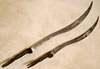
The author does not only suggest that the pearl could have two functions, he writes it. Pearl used for ‘the tears of the wounded’ were only for the very rich, in most of the weapons with these ‘pearls’ it is steel balls rolling, not pearls. Besides to use pearls was very unpractical as they are soft and will quickly be worn and drop out of the groove. To poison the edge itself would not have been a very good idea, as the user during the fight might happen to wound himself, so even a small wound could be fatal, but to poison the balls would mean no danger to the user, only to his enemy. The katar shown has steel balls, and it is not from the book. Thomas Tolbein Hendley was at the time he wrote the book Surgent Major in India, and a good friend of the Maharaja of Ulwar. Last edited by Jens Nordlunde; 2nd January 2005 at 02:33 PM. |

|

|
|
2nd January 2005, 09:45 PM
|
#2 |
|
Member
Join Date: Dec 2004
Location: Houston, TX, USA
Posts: 1,254
|
Most interestinly odd that these are set in grooves, rather than in slots that go all the way through the blade; such would be more common to my experience, daggers (sometimes full size swords, too) in Europe have been pierced with slots and holes to hold poison.
|
|
|
|
|
3rd January 2005, 03:09 AM
|
#3 |
|
Arms Historian

Join Date: Dec 2004
Location: Route 66
Posts: 10,862
|
Jens,
These are beautiful examples of very unusual katar set. The grooved channel with moving ball bearings (pearls) brings to mind a number of discussions over the years concerning edged weapons with this feature. The phrase typically applied seems to be 'tears of the wounded' or 'of the afflicted' in some cases. In folklore the pearl often symbolizes tears or sorrow, however despite this rather negative perspective it has found inclusion in many early medicinal remedies. While obviously pharmacologically inert, early medicine relied heavily on superstition and occult, and the attractive value of the pearl seemed well placed in various elaborate treatments. With this more positive perspective for the pearl, it seems unlikely of course that the poisoning idea would have any merit. It does seem typical for this assumption to have been considered by western observers, as many very unusual weapons which appeared in India seemed to evade explanation for thier strange features. The example given in another discussion of the scissors form of katar brought out attempts to explain its use including to worsen a wound, and you well explained the physical unlikelihood of that action. It is becoming more clear with investigation of the weapons of India, that many of the curious and innovative designs and features are intended for aesthetic and symbolic purposes, rather than practical applications. The observation that these grooves are channeled above the blade surface rather than pierced through the blade recalls also discussions of the tears of the wounded blades. It was suggested that such piercing may compromise the integrity of the blade in combat, so these may have been intended for parade or ceremonial use only. Since these katars have solid blade, they presumably are considered quite usable. Returning to the poison concept, there is a specific term used for daggers or swords with poisoned blades in India ...'abhradar' (Pant. p.235), so the concept was apparantly known there...but association with pearls has yet to be determined. Possibly Hendley's reference may have been metaphoric and referring to the deadly potential of the weapon with the unusual feature? It is well known that literature has often capitalized on such dramatic vehicles as 'poisoned blades' , such as Fredegonde, Queen of the Franks, who had iron knives 'caraxee' (hollowed) to hold poison (Boutell, 1868, p.93 "Arms & Armour in Antiquity and the Middle Ages")...and Hendley was of course privy to such literature. There is a great deal of symbolic metaphor imbued in the edged weapons of India, which has escaped the pragmatic observations of narrators and writers from the west. It is fascinating to consider the more subjective possibilities. Very best regards, Jim |
|
|
|
|
3rd January 2005, 09:53 AM
|
#4 |
|
Member
Join Date: Dec 2004
Location: Europe
Posts: 2,718
|
Hi Jim,
It may be like you say, or it may not. Like Hendley also writes: ‘In close combat a katar can be most fatal’. As he was a military surgeon, I guess that he knew what he was writing about, but when it came to the wounds a katar could make, but also when it came to the poison. Maybe he rather thought than knew about the poisoned pearls. Regards Jens |
|
|
|
|
3rd January 2005, 12:21 PM
|
#5 |
|
Member
Join Date: Jan 2005
Posts: 485
|
pearls
hi jens and jim,
the ones i have handled, although some were of good fighting form, they seem to show an artisan showing his art to its fullest. hendly, throughout his stay in india amidst his multiple roles in society over there (apart from his medical role, he was also hon. secretary of the jeypore museum and amongst the committee of several exhibitions of decorative arts) he showed a true passion for indian art. as well as the decoration of arms which he studied and (luckily for us) recorded, he was also involved heavily in other decorative and non-martial arms. for this reason, and this reason alone, i feel he was involved in what was relatively modern for his time (mid to late 19thC). his publications reflect this and so i think his 'poison' attribution could have possibly been folklore of the time. his attributions of the pieces in his ulwar book stemed from his own knowledge of the more modern pieces (which was extensive) but the descriptions of the older pieces came from the armouries accession notes, which could have been speculative. in his decorative arts book, he was in his element and it remains one of the most important books written on indian decoration, even though these were all of the 19thC. as all the 'tears of the wounded' swords seem to date from the 19thC, although fiegel/tirri/pant date theirs to 17thC, i feel this enforces the decorative purpose of these pieces. the 17thC attribution has long been debated, mainly due to tirri taking his from fiegel, and fiegel taking his from the piece in dehli catalogued by pant, and pant taking his from the toss of a coin  the piece in the V&A has a distinctly 19thC hilt, as has 4 others i have seen, as well as the ones documented and in museums. of course swords are rehilted but i have yet to see one that hints at an earlier date (as always i look forward to be proven wrong). as for the pearls. the V&A aquired an extensive collection of arms in 1964 from the collection of lord kitchener (after a long loan). amongst these was the well known sword of Dara Shukoh, which has been catalogued in various publications (arts of india for eg). this blade had a fabulous, almost black watered pattern, as did many others from the collection (elgood shows the early south indian swords from the same collection in his new book). hidden amongst these extremely important pieces (none of which are on show apart from the Dara Shukoh sword) is a small jambiya, of arabian form. the blade has this distinctive black watering and the fuller is channelled to incorporate 12-15 real pearls. it is the only piece i have seen with real pearls, which came from a collection formed in the 19thC. the piece is decorative but of typical jambiya form) and of the highest quaility. this hints at a court attribution, as many of his pieces were royal gifts (important swords, even for the time) during his role in india. i think these pieces hit into folklore around hendleys time, and steel balls may have been used to imitate this royal style and turned this type of sword into almost mythical proportion, hence the legends that started to circulate and continue now. indian art has always run alongside mythology and folklore, and the miniatures and sculpture through the centuries fully show this. even the courtly scenes of the 19thC tend to lend towards the fantasy in places, and as this was the only real form of recording history at the time, it is hard to distinguish between the two sometimes. sorry for not mentioning the pearled jambiya in the past, jens. i know how frustrating a description is without an image and i was waiting for the chance to supply you with both. |
|
|
|
|
3rd January 2005, 09:53 PM
|
#6 |
|
Arms Historian
Join Date: Dec 2004
Location: Route 66
Posts: 10,862
|
Hi Jens & Brian,
I think we all agree that many of the more elaborate Indian weapons as well as western observations on them were in degree whimsical and subject in many cases to certain folklore in traditional sense. In "Indian Firearm Curiosa" ("Arms & Armour" Vol.1, #1, p.81), Ian Bottomley states; "...Indian gunmakers enjoyed the patronage of clients who delighted in novelties. Guns were incorporated into other weapons such as axes,maces and swords...". Naturally this illustrates the climate of armourers in India, especially in the 19th c. , when unique and exotic looking weapons were quite in vogue with the many rulers of varied principalities. Probably these proved interesting as gifts in the diplomatic strains between rulers under the suzerainty of the British Raj as well. Bottomley (op.cit.) states further; "...all of these weapons, no matter how cunningly concealed or cleverly devised, were in reality highly impractical". I think this is for most of these 'weapons curiosa' typically the case, whether edged weapons or firearms, or both combined. As Tom Hyle mentioned, the concept of poisoned weapons seems to have been well known in folklore and tradition in most cultures. It seems the only actual application which seems undoubtedly established are the poison darts and arrows known in tribal warfare. For most edged weapons, the poison seems redundant as presumably the thrust or blow would prove mortal in most cases, especially with limited medical expertise available. With the dart or arrow, the wound potential is somewhat limited as a distanced projectile, thus the wound with a poisoned tip would prove certainly fatal regardless of its location anatomically. Much of the concept with 'poisoned weapons' is likely psychological, as is presumed with 'voodoo' where the conditioned response to implication is sometimes quite measurable with the victims reaction. All the best, Jim Last edited by Jim McDougall; 4th January 2005 at 12:19 AM. |
|
|
|
|
26th November 2017, 09:25 PM
|
#7 |
|
Member
Join Date: Dec 2004
Location: Europe
Posts: 2,718
|
I think this is an interesting subject.
Does anyone know if it was usual in India to use poisoned weapons? |
|
|
|
|
26th November 2017, 10:31 PM
|
#8 |
|
Member
Join Date: Apr 2011
Location: Moscow, Russia
Posts: 431
|
Pearls or beads in the blades have nothing to do with poison. The answer lies in the old Persian poetic momentum. "Shine of the blade" = "Shine of the pearl" = "Shine of life" (the life that had been taken away from a man who had been killed by the blade). While in the old language for the concept of "shine" ("shine of pearl", "shine of blade") had been used known for us word "jauhar". So the pearls in the blade is its "jauhar", the shine of the blade, the soul of the blade. We always make the mistake when trying to understand the Eastern traditional weapons only from the practical European point of view.
|
|
|
|
|
27th November 2017, 07:19 AM
|
#9 |
|
Arms Historian
Join Date: Dec 2004
Location: Route 66
Posts: 10,862
|
Jens,
Always an interesting topic, and good to see it back up again! Thank you. It seems we had a good look at this some years back, but we really never came up with anything conclusive. It seems that the presence of the term 'abhradar' referring to poison blades in the Indian glossary on weaponry certainly suggests this may have been an actual practice. However, as discussed before, and as you noted, poison on a blade could prove disastrous to the user of the knife as well as to the potential victim. Mercenary, interesting note about the pearls and the poetic metaphor about the blade and these pearls in Persian. I am curious about the term 'jauhar' though. It seems the Persian term 'poulad jauhardar' =waved steel, and refers of course to 'Damascus' or watered steel. The word jauhar in India refers to the practice of Rajput women and in dire situations their practice of self immolation; or alternatively the use of a dagger they carried (called by that name) to prevent indignity or capture. In India the term jauhardar foulad refers again to watered steel. ("Indian Arms & Armour", Pant, 1980) Perhaps there might be transliteration at hand? You are right about the misunderstanding of Indian arms being a prevalent circumstance in the west, and the very reason many of us here have worked this many years to learn more on them. I know Jens has studied these arms long before I met him nearly 20 years ago, and we have come a long way. |
|
|
|
|
27th November 2017, 09:52 AM
|
#10 | |
|
Member
Join Date: Apr 2011
Location: Moscow, Russia
Posts: 431
|
Quote:
I know very well who is Jens and very grateful to him for his advices and knowledge which are always very valuable to me. Above I wrote about all of us - it is very difficult to be modern European man and try to understand what was in old time on the other side of the world in a different type of society. |
|
|
|
|
|
27th November 2017, 10:59 AM
|
#11 |
|
Member
Join Date: Apr 2011
Location: Moscow, Russia
Posts: 431
|
Sometimes I speak about it. The problem with the knowledge of Indian weapons began when the European men started "studied" traditional Indian weapons in 19th. They were not ethnographers, art historians or culturologists. Just the brilliant British men who were interested in something curious from a mysterious distant country.
They were not in Japan. So we have genuine knowledge of Japanese weapons and excellent classification. They did not study diligently and did not classify Chinese weapons. Thank them for that. So we can something understand in Chinese weapons too. You know on what kind of sources Pant was based. It is not interesting. His books are good as encyclopedias, not more. Jauhar, jouhar, johar - a pearl, shine of pearl, essence (soul), quality, worth. In poetical texts "jauhar blade" was not "waved" or any "high-carbon" steel :-) We must remember that those people had another understanding about their weapons. They did not treat arms like just a piece of iron for murdering. They had many meanings for weapons, and a murder was the last of them. Jauhar. This is a more complex concept than just some kind of steel. But without a proper understanding of this word we could never understand what pearls are doing inside blades. Oh.. Indian word for self immolation in Persian was written the same way. Last edited by Mercenary; 27th November 2017 at 03:48 PM. |
|
|
|
|
27th November 2017, 04:16 PM
|
#12 |
|
Member
Join Date: Dec 2004
Location: Europe
Posts: 2,718
|
I have blades with steel bearings, pearls were also used, although they are very soft, but I have also heard about rubies being used.
It is true what Jim and Mercenary writes, that the logic we use to day can not be used if one want to understand how the Indian's thought centuries ago. How was the logic used in Europe centries ago, most certainly not like it is to day. Another thing is, that in India there lived Hindu's, Muslims - not all arrived at the same time, Arabs, people from Africa, Turky, Persia, Afghanistan, and a lot of other countries. It is likely that each of these groups had their own logic and their own believes. To try to understand this, it takes a lot of reading texts from authors of different origins. |
|
|
|
|
27th November 2017, 06:23 PM
|
#13 | |
|
Arms Historian
Join Date: Dec 2004
Location: Route 66
Posts: 10,862
|
Quote:
Very well explained Mercenary, and you are very right about the importance of striving for better understanding of ethnographic arms in their cultural context. Early writers for the most part did see the many forms and unusual styles of weaponry, but mostly as 'colonial' curiosities and souveniers to line parlors. Much of this derived from the Anglo-centric attitude, well seen in the writing of Sir Richard Burton. However writers like Egerton brought at least well documented observations and cataloguing of weapons classified into the areas which seemed to be the predominant regions of use. Burton as I have understood, regarded Professor Oppert, who was indeed interested in anthropology, as a bit over the top as he 'regarded too much toward the Indian arms as from metaphysical perspective'. Other writers followed suit, and stuck pretty much to categorization and arbitrary classifications, avoiding any deeper view into symbolism and meaning. this remained the case, until scholars like Jens entered the scope of study. Actually Jens was involved in the printing of one of the seminal modern works on these arms, "The Indian Sword" by Philip Rawson, 1967. This was actually a catalog work of classification study of the arms in the Victoria & Albert Museum. While this was 'more of the same', Jens wanted to move to the next level, and sought the answers to the ever unanswered deep questions that had been ignored by collectors and writers, who simply wanted classification. As his work continued, in 2004, Robert Elgood brought forward the outstanding reference, "Hindu Arms and Ritual", which at last placed in print the very perspective in which these Indian arms should be studied. While others had published articles which also did have that in degree, this reference pretty much 'put it on the map'. The Pant reference (1980) is as noted, with its flaws, but for some time had stood as a key reference, though its attention to more subjective aspects was also deeply lacking . It is quite well known that the Western inquisitiveness often, perhaps too much so, invents or contrives almost fanciful notions of how many unusual weapons are used in these native contexts. However, in many cases, these may not be as far off as we think, as in many cases, certain traditional , superstitious or even metaphysical concepts are represented in designs, motif and other elements. These, as you note, can only be well recognized by the true knowledge and understanding of the people who used the arms we study, and what THEY believed. This is what we know as the STUDY of ethnographic arms, not just collecting and cataloguing them. Good notes on the linguistics, and clearly there are transliteration issues, which constantly plague the efforts of those who involved in these studies. By discussing, as here, we achieve a broader view of the words or topics considered and can better understand the appropriate perspective. |
|
|
|
|
|
27th November 2017, 06:46 PM
|
#14 |
|
Arms Historian
Join Date: Dec 2004
Location: Route 66
Posts: 10,862
|
Jens,
we crossed posts. Good points on the diversity of cultures, religions and languages of India, which certainly has added to the difficulties in understanding of the weapons. These factors have made the study of the arms of India a most formidable field, and one often steered clear of by collectors and scholars for those reasons. It takes deep, focused and tenacious study to even scratch the surface of the deeper meanings which are inherent in these arms. They are indeed far more than simple tools of sinister purpose, and are icons representing the art and culture of the people who held and often used them. We have learned much from you, I know I have, and have ever been amazed by the obscure, esoteric and often very rare works you have constantly consulted , and which always presented these kinds of questions you have diligently pursued. Getting to the pearls. In our discussions over the years, it seems you noted that the placement of genuine pearls into these channels would be most difficult with the heat involved as they were placed into these. Also, it seems these channels were typically loaded with bearings, and that they were mostly for producing significant sound as they are wielded in parade or ceremonial circumstances. I always thought this feature was in line with such embellishments on temple swords, and other festoons which served as apotropaics on these arms. It seems like precious stones used in their talismanic connotations would be placed in hilt decoration as usual rather than imbedded in the blades in channels, but as you note, exceptions are always possible. |
|
|
|
|
27th November 2017, 10:49 PM
|
#15 |
|
Member
Join Date: Dec 2004
Location: Ann Arbor, MI
Posts: 5,503
|
I am wondering what kind of poison might have been applied to those balls.
Obviously, it was applied at the very late right before the battle: heat, UV light, humidity,rain, dust, dirt would degrade the organic constituents. The contact with internal tissues must have been very short, and no poison that comes to my mind would kill instantaneously ( otherwise, what's the purpose?) Hamlet was killed by the most toxic poison Claudius could find. However, before his death he was able to dispatch both Laertes and Claudius. Commodus stabbed Maximus with a poisoned blade. All of us know how it ended.... |
|
|
|
|
28th November 2017, 03:02 PM
|
#16 |
|
Member
Join Date: Dec 2004
Location: Europe
Posts: 2,718
|
I dont know which poison they used, but if it is true that they used poison on the steel bearings it must have been becourse the poison should only be inflicted if the wound was deep, and not be course someone cut himself by accident, but Ariel has a good point.
It is seldom poisonous weapons are mentioned in the litterature, but now and againg one can read about it. |
|
|
|
|
28th November 2017, 03:14 PM
|
#17 | |
|
Member
Join Date: Aug 2014
Location: Germany
Posts: 525
|
Quote:
I dont think, that the poison was applied to the blade to cause immediate death of the opponent but it can cause terrible aches, for example if someone uses stingray or box-jellyfish poison. And thats a major advantage, a game changer in a duell. A very light cut would be enough, to immobilise the opponent. Archers are a different topic, they make their arrows dirty with mud or excrement to cause long lasting or deadly infections. Roland |
|
|
|
|
|
28th November 2017, 05:38 PM
|
#18 |
|
Member

Join Date: Jul 2006
Location: Buraimi Oman, on the border with the UAE
Posts: 4,408
|
Poisoned blades are common in history. The usual mixture was from snakes. India and Persia are very much used to such and commonly you find poison on spears and arrows. In fact the Greek word for Bow was Toxon ! Another fatal substance deadly nightshade was called Strychnos... mainly the poison for spears.
Please see https://books.google.com.om/books?id...blades&f=false In fact the Persian punishment for poisoning someone ...more formally with say a poisoned cup... was to take the offender and place their heads on a large flat stone and then to take another stone and pound their heads to pulp. 
|
|
|
|
|
28th November 2017, 06:51 PM
|
#19 |
|
Member
Join Date: Apr 2011
Location: Moscow, Russia
Posts: 431
|
It remains to understand how deep the wounds must be in the case when the pearls or bearings in sabers were located at the base of the blade near the hilt
 A bit more. Is it so easy to make grooves in wootz? To put the pearls (!) or bearings inside blade that they can roll there freely? Only to smear it all with poison? The poison needed when the weapon only scratches, but does not penetrate into the body with the entire length and width of its blade Last edited by Mercenary; 28th November 2017 at 07:43 PM. |
|
|
|
|
29th November 2017, 09:00 PM
|
#20 |
|
Member
Join Date: Jul 2006
Location: Buraimi Oman, on the border with the UAE
Posts: 4,408
|
Part of the range of questions asks did India use poison on their weapons?
The answer is certainly yes since the reference https://books.google.com.om/books?id...&f=falsestates that Alexander encountered this when Indian troops fired poisoned arrows using viper and cobra poison. As alluded to by Jens the moral code at the time forbade the use of these toxins on weapons since Hindu Laws of Manu and the Brahmin and higher Castes prohibited it.  And certainly no; if consideration is given to the fact that a lot of myth and legend is built into the chronicles of his campaign.
Last edited by Ibrahiim al Balooshi; 29th November 2017 at 09:25 PM. |
|
|
|
|
30th November 2017, 09:44 AM
|
#21 |
|
Member
Join Date: Aug 2014
Location: Germany
Posts: 525
|
We also should not forget the psvchological effect of a poisoned blade.
If the poison is clearly visible, because of its green or maybe orange color, this could have a tremendous negative effect on the bravery of the opponent. Many things on historic battlefields were only made to scary the enemy. |
|
|
|
|
30th November 2017, 04:36 PM
|
#22 |
|
Member
Join Date: Dec 2004
Location: Europe
Posts: 2,718
|
It is interesting to see that using poison is very seldom mentioned in the books, so it is not easy to know how often it was used. Maybe this means that it was used often/seldom, so the authors did not think it was anything important to mention. I may add, that the same goes for spies, only very few books mention the use of spies, but when they do there seem to have been a lot of them.
|
|
|
|
|
30th November 2017, 04:36 PM
|
#23 |
|
Member
Join Date: Jul 2006
Location: Buraimi Oman, on the border with the UAE
Posts: 4,408
|
Indeed Marco Polo reported that dead bodies were catapulted over battlement walls to spread disease amongst the defenders.
|
|
|
|
|
9th December 2017, 09:55 PM
|
#24 |
|
Member
Join Date: Dec 2004
Location: Europe
Posts: 2,718
|
Yes, poisoneus snakes were also thrown over the walls, when a city were at siege.
However, something which surprices me is, that some writers mention that all the warriors were drugged before they went into battle. Some writers price the brave warriors, while others tell that they were heavely drugged - could have been a combination. |
|
|
|
 |
| Thread Tools | Search this Thread |
| Display Modes | |
|
|


 Linear Mode

