
|
 2nd May 2017, 03:34 AM
|
#1 |
|
Member
Join Date: Jun 2015
Location: Minneapolis,MN
Posts: 377
|
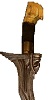
 A recently acquired tabak (from Apalit?)
Hello All,
I don't have this one in hand yet, and thus the pics are from the seller. I usually wait to post new pieces until I have them in hand, but I realized tonight that the tooled design on the scabbard of this tabak matches, nearly exactly, the design on a matulis I have from Apalit. The hilt shape also looks distinctly like others I know from Apalit. I suspect this then is also from Apalit Perhaps even the same maker. The matulis in question is the first (and longest) one here. http://www.vikingsword.com/vb/showthread.php?t=22118 I'll post more pics when I have it in hand. If I had to guess, I might place this at early 20th century? What do people think? Have fun, Leif |

|

|
|
2nd May 2017, 03:35 AM
|
#2 |
|
Member
Join Date: Jun 2015
Location: Minneapolis,MN
Posts: 377
|
And for comparison, the design on the previously posted Matulis
|
|
|
|
|
2nd May 2017, 04:35 PM
|
#3 |
|
Member

Join Date: Aug 2007
Location: Germany, Dortmund
Posts: 9,788
|
Hi Leif,
agree with nearly all your observations but I think that the scabbard is much younger as the tabak. The knife byself I would place between the 1920s until 1940s but the scabbard looks much younger. Courious to see your pictures. Regards, Detlef |
|
|
|
|
2nd May 2017, 11:18 PM
|
#4 | |
|
Member
Join Date: Jun 2015
Location: Minneapolis,MN
Posts: 377
|
Quote:
So it arrived today! Quick shipping. These are after a bit of light cleaning with soap, water, and for the brass ferrule, lemon juice and salt. Both the Blade and the scabbard are marked with the number "12." One side of the blade as what might have been intended to say "Apalit EB," but the stamp is unclear. I'm including side by side comparison of the tooled patterns on the tooled leather scabbard. They're nearly identical. The rear side of the scabbard shows similar construction. Also, does anyone have any thoughts on caring for the leather? It's rather "dry" at present. Thanks, Leif |
|
|
|
|
|
3rd May 2017, 09:41 PM
|
#5 | |
|
Member
Join Date: Aug 2007
Location: Germany, Dortmund
Posts: 9,788
|
Quote:
I use shoe polish for leather scabbards, it works great for me. Regards, Detlef |
|
|
|
|
|
18th June 2018, 06:59 AM
|
#6 |
|
Vikingsword Staff

Join Date: Dec 2004
Location: The Aussie Bush
Posts: 4,736
|
Leif:
You recently linked this thread in discussing another Apalit knife. I'm sorry I did not respond to your initial post--better late than never I guess. Thank you for posting this example of a tabak with an Apalit hilt. I have not seen such a combination before, and I associate the tabak more with Ilokano examples, sometimes with a sinan kapitan hilt (the head of a guy in a military cap). This same blade style is seen in a Negrito weapon form that Fox* labeled as a katana and which he says was used for combat. Very interesting mix of styles on your knife. Ian. * Fox, R.B. The Pinatubo Negritos: Their useful plants and material culture. Philippine Journal of Science 81: 260–361, 1952. [For a transcription of the text and copies of the figures, see here.] Last edited by Ian; 18th June 2018 at 07:17 AM. Reason: Added reference |
|
|
|
|
16th February 2020, 12:22 PM
|
#7 | |
|
Member
Join Date: Oct 2018
Posts: 714
|
Quote:

|
|
|
|
|
|
16th February 2020, 10:11 PM
|
#8 | ||
|
Vikingsword Staff
Join Date: Dec 2004
Location: The Aussie Bush
Posts: 4,736
|
Quote:
Again, thank you for the clarification. The designation "katana" has generated some discussion previously. Do you know the origin of this term in relation to the sword above? Can you also expand upon the "different classifications of Northern Luzon bolos, each with their own origin-area, handling nuances, and unique features." Attached are some pictures from the Macau Exhibition and the descriptions for each one in the associated catalog. Can you comment on the provenance/naming for each of these? In the catalog the first one was attributed to Southern Luzon (Batangas), the second to Northern Luzon, and the third was attributed also to Batangas (clearly incorrect--the hilt is Ilocano). The first two have chisel-ground edges. Quote:
Ian * On further consideration, I would say this one is also Northern Luzon. The hilt is typical of Tinguian knives and the blade shows the small cut-out feature adjacent to the hilt that is seen commonly on Tinguian knives. † The figural hilt on the last one is definitely Ilocano in origin, probably from Ilocos Sur, and is termed sinan-kapitan or Antonio Luna according to migueldiaz. Antonio Luna was an Ilocano hero of the Philippine Revolution. . Last edited by Ian; 16th February 2020 at 10:21 PM. |
||
|
|
|
|
17th February 2020, 02:00 PM
|
#9 | |
|
Member
Join Date: Oct 2018
Posts: 714
|
Quote:
The samples which can support my claim are, unfortunately, also confidential and cannot be uploaded, but I'll at least mention the number and dates of the samples. The Luzon Tabaks (210 and 211) are from Central Luzon, not Northern. At least 5 samples provenanced from that Central Luzon area- dated 1901, 1916, 1940, 1980s, and 2000s (with additional samples up to present-day) - exhibit similarities in blade profile, blade grind, scabbard, and hilt / scabbard patterns. Northern Luzon does not make chisel-ground blades. While 212 exhibits a figural that can be found in Ilocos Sur, its blade features are not consistent with the blunt bolo type from that area. 212 is a katana. There are at least 4 pieces (2 of them katanas) that have similar figurals. By conjecture, either an Ilocos-made figural was married to a katana blade, or the artisans in Pampanga are also able to make figurals. As to why it's called a katana, there are 2 reasons for that. The general reason, and one easily believable and practical- is that it DOES look like a katana because of its blunt tip. Last edited by xasterix; 17th February 2020 at 02:24 PM. |
|
|
|
|
|
17th February 2020, 02:21 PM
|
#10 |
|
Member
Join Date: Oct 2018
Posts: 714
|
Additionally, sir Ian: as I have gleaned from the elderly pandays in Ilocos, I have updated migueldiaz / sir Lorenz regarding the classification of Ilocos blades. The labeling of sinan- is only part of the classification. The complete classification runs thus:
Name of hilt (sinan-kapitan, sinan-Gabriela, sinan-bukelbukel, etc) + blade profile . For example, in this modern blade I got from Santa, Ilocos Sur, the formal classification would be "sinan-kapitan na bulong pagay." Bulong pagay is the blade profile. |
|
|
|
|
17th February 2020, 04:36 PM
|
#11 |
|
Member
Join Date: Aug 2007
Location: Germany, Dortmund
Posts: 9,788
|
Interesting discussion, thank's for that.
To learn more I would like to add my examples to the discussuion. The upper one I would call tabak, I've described it as from Luzon/Pampanga, end of 19th century. 47 cm out from scabbard. Second example is a katana, handle sinan kapitan, Luzon/Ilocos Sur, first quarter 20th century. 56,4 cm. Similar to the third example from the Macao exhibition. Third one I am unsure about, I would say that it's a tabak, can't say something about the exact origin but think Central Luzon, end 19th century(?), handle has had once wire binding. 62 cm. Any additional informations or remarks are very welcome. Regards, Detlef |
|
|
|
|
17th February 2020, 11:39 PM
|
#12 | |
|
Member
Join Date: Oct 2018
Posts: 714
|
Quote:
Greetings! Your labeling of 'tabak' is correct in a general sense, as I've stated earlier- in Tagalog, 'tabak' means combat blade. So technically even minasbads, matulis, dahongpalay, bulongpagay- all Luzon fighting blades- fall under the umbrella term 'tabak.' Would just like to clarify, is your first sample chisel-grind or convex? Regarding your second sample, it's wholly endemic from Ilocos, and it's not a katana. It's different from the sample in the Macau exhibition. The third one is a katana, and quite a long one. May I know the blade measurement in inches? |
|
|
|
|
|
18th February 2020, 09:05 PM
|
#13 |
|
Member
Join Date: Aug 2007
Location: Germany, Dortmund
Posts: 9,788
|
Hi Xas,
Hope you are fine! The first blade has a convex edge. How you would call it? And would you agree by the estimated origin? So the second piece is like guessed Ilocos (Sur?) and not a katana, how you would call it? Third one a katana, any guess about the exact origin? It's 24.4 inch long overall, blade 18.5 inch and 0,31 inch thick at the base/handle. A very heavy sword. Regards, Detlef |
|
|
|
|
19th February 2020, 12:41 AM
|
#14 | |
|
Member
Join Date: Oct 2018
Posts: 714
|
Quote:
For the first- oh so it's convex, I'd guess it to be of Apalit origin then. I'm not familiar with the blade profile, so calling it as a generic tabak is fine =) For the second, it's confirmed to exist (and is still being produced) in Ilocos Sur, but am still determining if it's also present in Norte (although not likely). It's termed as 'panggaw-at,' which is the Ilokano term 'for reaching.' For reference, I'm including a picture of my 2019-made sinan-Gabriela panggaw-at (along with a sinan-kapitan bulong pagay). For the third, as I understand it, all katana-type blades originated from Apalit. I don't think any other area produced that specific type. |
|
|
|
|
|
19th February 2020, 02:39 AM
|
#15 | |
|
Vikingsword Staff
Join Date: Dec 2004
Location: The Aussie Bush
Posts: 4,736
|
Quote:
Thank you for getting back to me about these examples. Before responding to your comments, I must say I am deeply disappointed to see information coming from anonymous panday and examples that are held secretly. I have been hearing of possible publications relating to similar sources that were being discussed more than 20 years ago, and never amounted to anything. Data held in this manner is really not helpful at all. Scholarship shares freely and without secrets. A while back, I wrote here on the work of Cole on the Tiguian and Ilocano people. I believe that your sources have overlooked the Tinguian in their analysis of the examples I have shown. For example, if you look at Figure 7 (no. 5) of Cole's work (which I reproduced in the referenced thread), you will see a blunt-ended sword that resembles a katana. This example was drawn in the early 1900s (1907-1908). Thus, the general style seems to be quite widespread in northern Luzon, and one could reasonably ask whether it originated in northern or central Luzon. Cole mentions that the swords of the Tinguian and Ilocano were highly prized and widely sought, and furthermore there has been a sizeable Ilocano population in Pampanga for a long time (according to Spanish and American census records). Is a knife made by an Ilocano in Pampanga an Ilocano or Pampangan knife (or both)? We can end up in a series of circular arguments without the kind of data that you suggest exists but is unavailable for wider study. Perhaps the weapon styles of some Northern and Central Luzon weapons are so inter-related that it makes little sense to separate Ilocano/Tinguian from Pampangan, because the distinctions are very subtle and may reflect a common historic source. With respect to your proposal regarding no. 212 from the History of Steel Exhibition, another possibility is that the "katana" style was indeed made in Ilocos Sur and your sources are incorrect. Lastly, the term katana seems to have been first recorded by Fox (1947) shortly after the conclusion of WWII and the Japanese occupation of the Philippines. Do you know if this term was present pre-WWII? As for its similarity to a Japanese katana, I guess that is possible but the similarity is not very close in terms of blade profile or length, more like a wakisashi in length (but not profile). Again, thanks for your reply. I appreciate the information. Regards, Ian. Last edited by Ian; 19th February 2020 at 04:04 AM. |
|
|
|
|
|
19th February 2020, 04:57 AM
|
#16 | |
|
Member
Join Date: Oct 2018
Posts: 714
|
Quote:
I understand your disappointment. The problem with the sharing of scholarly info freely and openly is that it can lead to plagiarism and data misattribution- with the advent of social media, this is very much a reality nowadays. There have been publications in the past which 'stole' information without the consent of the first-hand sources, leading to inconsistencies and misinterpretations of cultural data, the effects of which is felt until now in PH - notably, twisted history; lack of appreciation and undervaluation of cultural objects, even intellectual property rights complications. I also understand your view that academic references take precendence above other types of information- but take note that most of these references were done by foreign scholars who did not have full access to information on the ground. I've discovered time and again that the information written in many academic references regarding traditional blades are inconsistent or erroneous; and have concluded three reasons for this: 1) information was not shared by the natives fully with the researcher 2) there were things lost in translation 3) information was misinterpreted by the researcher. In fact, I now place higher value on oral tradition, especially by elderly pandays and other keepers of knowledge. Thus, I have to respect the wishes of people who did both academic and field research- talking with pandays and elders on the ground, going to historical places, looking for actual modern blade samples- to obtain updated information. I am sharing as much as I can because this forum was also a source of growth for me, even though a lot of previous erroneous data here was rectified or put into the correct perspective by my mentors. I understand that without specific, detailed proof my assertions here will always be put into question; but sadly I have to abide by certain limits. My mentors have long left this forum, but I linger because I find this a valuable place to obtain samples, and I acknowledge that most of you are also accomplished scholars in your own fields with access to old high-value pieces that may never return to Philippine soil. Regarding your question about delineations, on my mother's side- my grandmother is from Pangasinan, and my grandfather is from Ilocos Norte. Each area in the North- Pangasinan, Pampanga, La Union, Ilocos Sur, Ilocos Norte- have different versions of Ilokano as a language. There is clear delineation and pride on what is Ilokano (Ilocos-specific), Pangasinense (Pangasinan) and Kapampangan (Pampanga). In fact the non-Ilocos residents prefer not to be known as simply 'Ilokano.' It's not far-fetched to think that there's clear distinction between the blades they produced as well. The Indigenous People (IP) tribes' blades differ from the others. This was verified by an Ilokano who talked with the tribes' elders. The IP traditional blades are another matter altogether (another complication). With regard to the 'katana' being made in Ilocos Sur, I acknowledge that I may be mistaken, but I still hold on to my assertion. I only came to that conclusion because Ilocos Sur has its own version of blunt bolo which has a different build and label than 'katana,' the 'panggaw-at.' In terms of blade profile, the features of 'panggaw-at' are absent from that piece; but it adequately fulfills the features of a katana's. Lastly, I did mention that my source was featured by migueldiaz long ago- his name is Antonio Pader, and he's regarded as one of the Living Treasures of Ilocos. He's a 4th generation panday and artisan; his family has been forging and crafting blades well before the 1900s, and he is the heir of the accumulated knowledge of the pandays before him. There's no better source of information than him with regard to Ilocos Sur traditional blades. I've yet to conclude my research on Northern Luzon blunt bolos, but the way that it's going, there are more nuances than previously thought, and the current number of unique types may increase, once I've scoured Ilocos Norte as well. Last edited by xasterix; 19th February 2020 at 05:39 AM. |
|
|
|
|
|
19th February 2020, 08:58 AM
|
#17 |
|
Vikingsword Staff
Join Date: Dec 2004
Location: The Aussie Bush
Posts: 4,736
|
Dear Xas:
Again thank you for your patient reply. I am grateful for your sharing of what you have already. I do appreciate that you are in a difficult position. Ian |
|
|
|
|
19th February 2020, 08:23 PM
|
#18 | |
|
Member
Join Date: Aug 2007
Location: Germany, Dortmund
Posts: 9,788
|
Quote:
 Regards, Detlef |
|
|
|
|
|
19th February 2020, 11:46 PM
|
#19 |
|
Member
Join Date: Jun 2015
Location: Minneapolis,MN
Posts: 377
|
I just wanted to say thank you to both Ian and Asterix.
All of this has been fascinating to read. Have fun, Leif |
|
|
|
 |
| Thread Tools | Search this Thread |
| Display Modes | |
|
|


 Linear Mode

