
|
 1st December 2013, 03:23 PM
|
#1 |
|
Member
Join Date: Mar 2010
Location: Olomouc
Posts: 1,720
|
 North Cameroon sword
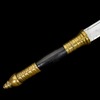
This will be on it's way to me soon. I have only one pic to share for the moment.
However I thought it would be interesting to start a discussion. It has similarities to a few pieces discussed here in the past. The blade has elements of one Martin posted in the past here. The hilt, with what looks to be a metal pommel is similar to one Stephen posted a few years ago here, although the guards differ in that mine is leather covered, the shape seems very similar however. There is also resemblance to some Kirdi guards and blades. I've made a little compilation image with a few of the swords I can find that seem to be in the same family. I find these fascinating personally as they seem to combine elements of takouba, kaskara and other sword forms and are usually quite sturdy and well made. |

|

|
|
1st December 2013, 04:09 PM
|
#2 |
|
Member
Join Date: Jan 2008
Posts: 1,436
|
Good looking sword Iain, seems there are various sub-styles and crossovers...
Wonder why the holes in the blade - for brass or copper studs ? Regards. |
|
|
|
|
1st December 2013, 04:12 PM
|
#3 | |
|
Member
Join Date: Mar 2010
Location: Olomouc
Posts: 1,720
|
Quote:
I'm still curious if these swords developed in form from takouba and kaskara or existed separately. Certainly takouba are prevalent in Cameroon in areas where the Fulani invaded or had influence. |
|
|
|
|
|
2nd December 2013, 09:02 AM
|
#4 |
|
Member
Join Date: Jan 2008
Posts: 1,436
|
Iain,
I was wondering if you are able to comment on a point of interest to me regarding such Sahel swords and their relatives, ie. the iron used for the blades... Are you able to identify the blades in the following terms ? :- a) Made in Europe and imported to Africa b) Forged in Africa from scrap European iron c) Forged in Africa from iron smelted there, using African iron ore d) Some other category ?? Do you have a view on whether the above types of metal have an impact on corrosion levels and patterns, at all ? Regards, Colin |
|
|
|
|
2nd December 2013, 09:10 AM
|
#5 | |
|
Member
Join Date: Mar 2010
Location: Olomouc
Posts: 1,720
|
Quote:
a) Yes, these are the simplest in some ways. The quality difference is usually pretty clear. b) Personally I'm not sure how to ID these. The finish, form, fullers etc. are what I usually go on to ID native versus non native. c) Yes, some items like Tebu, some arm daggers etc. where it seems pretty clear when local ore is used. d) I'd say none forged sheet metal items. Which are fairly easy to ID. I have noticed different corrosion tendencies on European blades and sheet metal blades. However so much comes down to storage conditions, I'm not sure about using it as an ID method when it comes to European versus native steel/iron. But I'm simply not much of a metallurgist! Iain |
|
|
|
|
|
14th December 2013, 10:13 AM
|
#6 | |
|
Member
Join Date: Jan 2008
Posts: 1,436
|
Quote:
Regards. |
|
|
|
|
|
14th December 2013, 11:23 AM
|
#7 | |
|
Member
Join Date: Mar 2010
Location: Olomouc
Posts: 1,720
|
Quote:
I've noticed the same and had also wondered if it had something to do with the steel source. However I've seen similar corrosion on older European blades from the area, so I wonder if it's perhaps more the environment than anything else? |
|
|
|
|
|
14th December 2013, 11:27 AM
|
#8 |
|
Member
Join Date: Mar 2010
Location: Olomouc
Posts: 1,720
|
I've received the sword in question. I am very, very pleased with it. The blade is one of the nicest and most subtly executed African blades I've owned. The fullering is superb.
The hilt is leather covered like a takouba and has a solid and heavy cylindrical pommel. Overall this is obviously a combat sword, sharp, well balanced. I'm fascinated by swords like these, cruciform hilt swords that are distinct from the kaskara and the takouba and this blade form in particular is very unique. Not the greatest photos again I'm afraid, nasty weather today and I had but a brief window outside before the rains started up again. |
|
|
|
|
14th December 2013, 11:43 AM
|
#9 |
|
Member

Join Date: Nov 2010
Location: Kuwait
Posts: 1,340
|
a very nice piece. Is the blade flexible? what are those holes inside the fullers?
|
|
|
|
|
14th December 2013, 12:06 PM
|
#10 | |
|
Member
Join Date: Mar 2010
Location: Olomouc
Posts: 1,720
|
Quote:
The blade does have some flex and spring. Tempered to some degree for sure. |
|
|
|
|
|
14th December 2013, 02:37 PM
|
#11 |
|
Arms Historian

Join Date: Dec 2004
Location: Route 66
Posts: 10,872
|
Regarding the holes which indeed often were filled with brass or copper, this was indeed as far as I have known, a talismanic gesture of sorts . This is something often seen on early Arab swords (as seen in Yucel) and seems to have certain corroboration in many early European blades with gold metal filled holes. It would be difficult to draw direct line of influence of course, but there are distinct similarities.
On the spotted corrosion, I also must disclaim any metallurgical skills, but personally have always thought perhaps such anomalies might result from inconsistency in the metals compounded in the blade or impurities pocketed in certain spots. In another perspective, there have often been somewhat fanciful discussions directed toward blood residue resulting in reactions between the biological components and metals. While not necessarily empirically proven as far as I have known, there is a degree of plausibility. Obviously weapons were typically cleaned after such contact, however if the weapon remained unattended and left in place for a period, perhaps corrosive action might occur over time. Things to consider 
|
|
|
|
|
15th December 2013, 03:02 AM
|
#12 |
|
Member

Join Date: Oct 2007
Posts: 2,818
|
Hi Iain,
As indicated earlier, this is a very fine sword. The visual quality of the blade, along with the forging laminations seen near the tip show that someone spent a lot of time getting this one made and finished very well. The presence of the unusual fullering arrangements, along with the clear and strong beveled cutting edges are a good indication the smith had very good knowledge on making fighting swords and I hope others surface in time because there seems to be a trend in the fullering style. I too am smitten with this primeval form, especially the swords with these quality blades from the region, however luckily for me, my actual collecting interests lay elsewhere. About the patterns of wear/rusting/pitting etc...I think the fact that a lot of these African knives swords are already tight in the sheaths and that the blade sits so close to the very thin timbers and leathers that this is how and why the condition ends as it is because there is nowhere for moisture to run to other than be kept between the two flat surfaces. I also think that the presence of these fullers on your sword and others from the region, allow for breathing between the two surfaces and that moisture can disperse easier...certainly a want in the wet seasons..of course to strengthen the blade too. Gavin |
|
|
|
|
15th December 2013, 09:54 AM
|
#13 | |||
|
Member
Join Date: Mar 2010
Location: Olomouc
Posts: 1,720
|
Quote:
Yes good points, these inserts do have a long tradition in various cultures and can of course be also observed in Southeast Asian arms as well and of course the famous Chinese seven star jian design. In the context of these African arms, I think this likely has something to do with the age old belief that iron is dangerous, even to the point of having evil connotations while gold, copper, brass are seen as opposing. Hence the use of brass on hilts and the Tuareg requirement to have brass and copper present on hilts. This also fits into a very broad characterization of smiths in these societies as possessing magic knowledge and typically being segregated from the rest of society to a certain degree. Again, in the case of the Tuareg this is particularly pronounced with the Inhædˤæn client caste of smiths/metal workers. In the context of this particular Cameroonian sword, iron was produced in fairly large amounts in the Mandara region at least. This continued until the 1930s, rapidly tailing off as scrap steel became commonly available. Iron formed a basic trade commodity and in bar form was widely exported. There is a reasonable probability then that this sword is made form iron smelted in a location like Sukur, which was engaged in fairly industrial production. Magnetite, or magnetic iron, collected from sandy stream beds was the source for the raw material. The quality of this ore and the local smelting processes in use resulted in an exceptionally good product. Even for agricultural tools Sassoon, who visited Sukur in 1962, notes that smelting was seeing something of a revival since imported European iron was considered much inferior. This industry again died out as iron was replaced as a communal currency with modern money. I'll turn over to Gav's post now since it fits into this quite nicely. Quote:
I am sure there are others about, but the only two I'm aware of, at least with photos online are my own and Martin's which seem very much of a pattern. Martin's other pieces from the region are also intriguing and were discussed some time ago here: http://www.vikingsword.com/vb/showthread.php?t=14500 The edges are quite good and interestingly, unlike some forms from this region, the fullering is carried out on both sides, rather than simply being a presentation 'face' like for example, the Guduf form. This all of course speaks the practical nature of the piece. Quote:
For the moment I would assign a tentative attribution to the general region in North Cameroon around the Mundang, Daba and Vere groups. There are many small groups in these areas and sadly the main source for even this tentative attribution (Wente-Lukas) doesn't give much detail to go on. Another distinct possibility is a connection with the Mandara/Wandala kingdom which represents more of the martial tradition this sword seems likely to be associated with. Iain Last edited by Iain; 15th December 2013 at 10:16 AM. Reason: More detail on attribution |
|||
|
|
|
|
15th December 2013, 09:42 PM
|
#14 |
|
Member
Join Date: May 2008
Location: Czech Republic
Posts: 862
|
Hi,
Let me, with delay, congratulate you, Iain, to the sword. This is really nice piece (I mean the blade;, the handle (at least its surface), as it used to be, was changed/"renovated"). This discussion is very interesting. Concerning the iron used for the blades (as Colin put the question), I agree this is 100 % category c - forged in Africa from the iron smelted here. If you don´t mind, I will come back to my sword - http://www.vikingsword.com/vb/showthread.php?t=12296 - as you can see. the lamination pattern is very strong, material is relatively dark (it is not possible to change the dark colour by polishing), the sword is relatively flexible (bent, but it is not possible to straighten it in hands). I did not see signs of corrosion. Re other category of the iron used for the blades: Afars use steel leafs from old truck suspensions to make their jellys currently. The "simply" grind it (no forging now). As far as corrosion is concerned, I would agree with Gavin, but maybe also temperature in connection with athmospheric pressure and dew point plays role. I seldom saw corodated jellys from Ogaden, but always bellawas from the Somali coast - both have leather sheaths. Comming back to interesting fullers - it resembles me some Cameroon Grassland old spearheads, and also the central fuller on this Vere long sword (http://www.vikingsword.com/vb/showthread.php?t=12730). Regards, Martin |
|
|
|
|
15th December 2013, 10:42 PM
|
#15 | |
|
Member
Join Date: Mar 2010
Location: Olomouc
Posts: 1,720
|
Quote:
Thanks for the very insightful comments. I always appreciate when you write something because you are lucky enough to travel in these regions. About the handle on my sword, for sure the leather on the guard and grip is a bit later. However the form, I mean the structure of the guard and pommel I think is original to the blade and of the same age.
|
|
|
|
|
 |
| Thread Tools | Search this Thread |
| Display Modes | |
|
|


 Linear Mode

