
|
 28th December 2012, 10:57 AM
|
#1 |
|
Member
Join Date: Jun 2011
Location: Abertridwr
Posts: 50
|
 SWORD FOR DISCUSSION
Happy Holidays everybody,
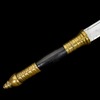
been routing through my collection trying to find an item for discussion and have found this sword. My personal opinion is that it African possibly Mandingo with Arab influences(straight kattara type handle) and the blade could be an english pipe back type blade maybe 1822.Total length in scabbard 91 cm Thanks in advance. Darren |

|

|
|
28th December 2012, 11:08 AM
|
#2 |
|
Member
Join Date: Mar 2010
Location: Olomouc
Posts: 1,720
|
Definitely Mandingo, based on the bronze pommel nub and the distinctive ribbing of the leather work.
There have been some theories about the type possibly being related to Omani saifs and kattaras spread by Arab traders. I am personally not entirely convinced of this. Others will doubtless be able to say more about the blade. This example is slightly unusual in that the hilt looks to be wood? Most examples encountered have leather covered hilts. |
|
|
|
|
28th December 2012, 11:18 AM
|
#3 |
|
Member
Join Date: Jun 2011
Location: Abertridwr
Posts: 50
|
Hi Iain,
Yes the hilt is wood with a metal type end pommel Thanks Darren |
|
|
|
|
28th December 2012, 11:57 AM
|
#4 | |
|
Member

Join Date: Oct 2007
Posts: 2,818
|
Hi Darren.
This is an interesting and complete sword and the pipe back is certainly a twist being EU in origin but the sword style overall taking the form of the much discussed Kattara. What is the white coloured binding around the ribbing? Is it coloured leather? Quote:
Looking at the very long history of Arab/African slavery, right up until very modern times I see the influence of these traders leaving such residue in Mandingo weapons. Many Africans took part in these trades so it seems likely also weapons of those they interacted with stayed behind. I have lost track of edged weapons types from other regions in Mandingo dress. It seem they loved all sorts. http://en.wikipedia.org/wiki/Arab_slave_trade http://en.wikipedia.org/wiki/Islam_and_slavery Gavin Last edited by freebooter; 28th December 2012 at 12:12 PM. Reason: Another link |
|
|
|
|
|
28th December 2012, 12:12 PM
|
#5 | |
|
Member
Join Date: Mar 2010
Location: Olomouc
Posts: 1,720
|
Quote:
I'm not throwing the idea out completely... But looking on the other side on the discussions we've had here about kattara - those in the region had actually wondered if there was influence the other way - from Africa! That's why I'm a bit on the fence about it. I'm no expert on the subject of the West African slave trade besides being familiar with the central Sahel aspects. However - My understanding from reading period sources like Barth, is that the trade in these regions was more likely to move north if not directly off the coasts and was conducted with North African Arabs and Berbers. The Oman/Zanzibar connection I haven't run across much mention of being active in West Africa rather in East Africa. And even for those that slaves that were moved east the transport and control was done by local elements like the Dyula merchants. That is not to say Omani merchants and slavers didn't perhaps turn up in Mandingo areas - I honestly don't know enough about it, but the shape of these weapons and the relatively simple design is not something that could not be arrived at locally. In much the same way that the kattara design seems to follow the function of mounting trade blades, perhaps the same was the case for these Mandingo weapons. There are also a lot of variants with them, different styles to the pommel pieces and from deeper into West Africa mounts with more pronounced pommels and guards. All the best, Iain |
|
|
|
|
|
28th December 2012, 12:18 PM
|
#6 |
|
Member
Join Date: Jun 2011
Location: Abertridwr
Posts: 50
|
Hi Gavin,
Just checked the white decoration and disappointed to find it is a type of plastic. This should help with the dating me thinks. Thanks Darren |
|
|
|
|
28th December 2012, 12:31 PM
|
#7 | |
|
Member
Join Date: Oct 2007
Posts: 2,818
|
Quote:
 I'll digest and ponder your thoughts Iain. Perhaps combined with Arab slavery or as a stand alone aspect, I wonder if the conversion to Islam had something to do with exposure to the Kattara form? From teacher, scholars and other travellers too? Gavin |
|
|
|
|
|
28th December 2012, 12:47 PM
|
#8 | |
|
Member
Join Date: Mar 2010
Location: Olomouc
Posts: 1,720
|
Quote:
Could certainly have happened that way! I'm honestly haven't focused on accounts of Arabs in these regions when I've been going through period materials. I will try to take a look later and see what I can find. Although most of the material I have on hand would relate more to Hausa areas. Its always been a puzzle to me why the takouba didn't take off in these regions, since it seems to have done so pretty much everywhere else in surrounding areas and ethnic groups, particularly after the Fulani jihads - but that's another topic and I don't want to derail this thread. So I've always been a little intrigued by Mandingo mounts as they are so different to anything else in the area. If they are the result of Arab influence, my question would be why don't we see these mount styles further east in the Sahel along the trade routes? Why does it only appear fairly far west? Darren, My guess is these weapons had the mounts refreshed with some regularity just like other swords in the Sahel region. My understanding is that the heat and atmospheric conditions are pretty tough on leather and it wears out and ages quickly. Could also be just a new decorative element added later to an older scabbard.  Its certainly an old blade and the whole ensemble looks to have good age. |
|
|
|
|
|
28th December 2012, 02:16 PM
|
#9 | |
|
Member

Join Date: Jul 2006
Location: Buraimi Oman, on the border with the UAE
Posts: 4,408
|
Quote:
Salaams Taffjones ~ Very interesting... This looks like a slavers sword perhaps carried as a badge of rank/office. Forget the plastic it is likely to be a replacement of an original leather corded decoration. I consider that the hilt transferred from the straight sayf in about 1750 a short while after its inauguration as the dancing sayf honorific to the Dynasty Al Bu Said which started in Oman in 1744. I tie the strong trade link of slavery with the African introduction of the long curved blade across the region (really more to do with German and other European blades then flooding into Africa) For a look at Oman Slave Trading in East Africa please see post #25 on http://www.vikingsword.com/vb/showthread.php?t=10455 Kattara for comments ~ in which I quote Tippu Tip or Tib (1837 - June 14, 1905), real name Hamad bin Muḥammad bin Jumah bin Rajab bin Muḥammad bin Sa‘īd al-Murghabī, (Arabic: حمد بن محمد بن جمعة بن رجب بن محمد بن سعيد المرجبي) who was a Swahili-Zanzibari trader of mixed descent. He was famously known as Tippu Tib after an eye disease which made him blind. A notorious slave trader, plantation owner and governor, who worked for a succession of sultans of Zanzibar, he led many trading expeditions into east-central Africa, involving the slave trade and ivory trade. He constructed profitable trading posts that reached deep into Central Africa. One of the major slave hubs being Zanzibar. I see no reason why swords traded along the slave routes didn't morph, switch and change and I see this as the most likely reason for the long handled Kattara developing from Africa into the Red Sea and Omani spheres because of this trade. I therefor attribute Kattara as African (European blades) coupled to the long Omani hilt after the Straight dancing Sayf(Saif) as a consequence of slave trading in Circa 1750 ad. That date an approximation based on the kick off date of the Dynasty Al Bu Said and the appearance of the dancing sayf. It should be noted that Tipu Tib was probably not the instigator of the spread of this weapon because he was only born in the early 19th C. (1837)His parental portfolio, however, indicates a load of experience in that part of the world doing the same work and placing them right in the frame for this weapon structure, use and spread)..viz; His mother, Bint Habib bin Bushir, was a Muscat Arab of the ruling class. His father and paternal grandfather were coastal Swahili who had taken part in the earliest trading expeditions to the interior. His paternal great-grandmother, wife of Rajab bin Mohammed bin Said el Murgebi was the daughter of Juma bin Mohammed el Nebhani, a member of a respected Muscat (Oman) family, and an African woman from the village of Mbwa Maji, a small village south of what would later become the German capital of Dar es Salaam. "German" Dar es Salaam must have been a key centre through which many Solingen and other European blades passed onto the Arab and African traders, though, after 1887. (See note below.) However ~ tons of blades were already in circulation and Germany was the main provider. Regards, Ibrahiim al Balooshi. Note; For further detail on Dar es Salaam see wiki encyclopedia which expounds ~ In the 19th century Mzizima (Swahili for "healthy town") was a coastal fishing village on the periphery of Indian Ocean trade routes. In 1865 or 1866 Sultan Majid bin Said of Zanzibar began building a new city very close to Mzizima and named it Dar es Salaam. The name is commonly translated as "harbor/haven of peace" or "abode/home of peace", based on the Persian/Arabic bandar ("harbor") or the Arabic dar ("house"), and the Arabic es salaam ("of peace") (cf. "Dar as-Salam"). Dar es Salaam fell into decline after Majid's death in 1870, but was revived in 1887, when the German East Africa Company established a station there. The town's growth was facilitated by its role as the administrative and commercial centre of German East Africa and industrial expansion resulting from the construction of the Central Railway Line in the early 1900s. Last edited by Ibrahiim al Balooshi; 28th December 2012 at 05:18 PM. |
|
|
|
|
|
28th December 2012, 04:18 PM
|
#10 |
|
Member
Join Date: Jun 2011
Location: Abertridwr
Posts: 50
|
Thanks for the wealth of information supplied so far Gavin,Ibrahiim and Iain. I have noticed that there is some type of marking close to the hilt. Which I have tried my best to show in the photographs. But my camera goes out of focus if I go any closer.
Thanks Darren |
|
|
|
|
28th December 2012, 06:23 PM
|
#11 |
|
Arms Historian

Join Date: Dec 2004
Location: Route 66
Posts: 10,857
|
The blade on this Manding sabre is German, indeed pipeback, and produced from around 1820s well through the 19th century. It is well established that many blades used on these sabres are from French presence in these Saharan regions, and many French blades were actually German produced.
I am unsure of the mark on the blade but it does not seem European applied, looks like an arc but what the rest would be not sure. Actually the connections between Zanzibar and these Mali regions in the Sahara seem fairly well established, though they were most certainly the result of networking these trans Saharan trade routes. The Manding were the merchants in Mali controlling these routes as I understand. There was prevalent slave trade activity from Zanzibar into the interior, which routes probably traversed Kenya then into Ethiopia, then to Darfur. In Darfur one of the centers of such activity was Sennar, where westward through Chad and Nigeria to Mali these traders went. There is a type of 'baselard' form hilt sword/dagger found in Morocco known as the s'boula. However Demmin (1877) classified one of these as a Zanzibar sword. This misclassification was carried forward by Burton (1884) and the error noted by Buttin(1933). It seems clear these were notably present in Zanzibar from thier indiginous provenance from Morocco, most plausibly from being among merchants returning on trade caravans. These are known to occur in Ethiopia in degree, even being inscribed in Amharic, suggesting of course examples being left there by traders coming through. With this instance of cross diffusion between Moroccan regions and the Zanzibar entrepot, I would suppose the possibility of the cylindrical hilt of the Manding sabre could be the source of the Omani kattara form, but I still feel the influence went the other direction. With the appearance of this hilt in Oman c.1744 as well described by Ibrahiim, more needs to be discovered on the possible origin period for these in Mali. I would note that the Kenyan seme' also has this type of cylindrical hilt without guard, and as noted these regions seem to have been along some of these trade and slaving routes. As far as I can recall, these seme' appear to be fairly recent in most cases, mostly 19th century. All best regards, Jim |
|
|
|
|
28th December 2012, 06:59 PM
|
#12 |
|
Member
Join Date: May 2008
Location: Czech Republic
Posts: 862
|
He constructed profitable trading posts that reached deep into Central Africa. One of the major slave hubs being Zanzibar:
I would just like to add to a.m. Ibrahiim´s remark about Tippu Tip, that there are edged weapons from central Africa in the museum in Stone Town in Zanzibar, weapons, which were surely brought by trade caravans from African inland. |
|
|
|
|
28th December 2012, 08:43 PM
|
#13 |
|
Member
Join Date: Mar 2010
Location: Olomouc
Posts: 1,720
|
Interesting discussion for sure.
However I would put in a small reminder/caveat that there is a sizable difference between trade in central Africa and the East African Coast, and the West African coast and the East African coast. See the attached map (1906) of Mandinka speaking peoples and their approximate range. The difference is quite a long ways and quite a lot of different ethnic territory. Regarding Tippu Tip, he was a ways off as well both south and east. Just to make things clearer - see the attached map of his claimed territory in central Africa and a map showing the location of the Congo river relative to the Niger river. My understanding of the East African slave trade is that it extended primarily into central Africa, not the western Sahel. After French and British abolition was there an increased demand to move slaves east and did this lead to increased contact with Arab and Swahili slavers and merchants? I am not sure but it's something worth looking into. Pretty much every source and article I have read regarding trade within Hausaland, Kanem Bornu and the Western Sahel discusses the transport of goods to the north - including slaves. It is important to remember the relative difficulties in transporting slaves over long distances. Attrition was already high within Western Sahel caravans, while local demand in the Hausa and Kanuri kingdoms produced a healthy market while the transatlantic trade was also close and much more profitable than moving slaves eastwards (see "A History of Nigeria" ~ Falola & Heaton). A large number of the slaves going to the North African coast seem to have been women (again, this is based on sources like Barth who saw the caravans first hand as well as even older sources like Ibn Battuta regarding the Mali Empire). The main question at least for me remains, why would a Mandinka speaking population in West Africa pickup up on an Omani Arab hilt style when the main sphere of Zanzibar slaving operations were not primarily based anywhere near that region. Why this hilt style over the neighboring styles they would have extensive contact with? If the hilt style transmitted the other way, into Oman via Africa the question remains... why that particular style over the other styles on the East African coast and the many styles in between. The majority of saber blades in Manding mounts are the result of French colonial activity with transmission from the western coasts - not overland trade via the east and German holdings in East Africa. There is not a particularly large proportion of these blades in the Sudan proper, Kanuri, Hausa or Tuareg areas while in areas with longer French colonial history like Senegal they occur frequently. Although perhaps I misunderstood Ibrahiim's point regarding Dar es Salaam. There is also still a question of Mandingo hilt attribution. See the attached compilation of Mandingo hilts. All of these are generally attributed to Mandinka speaking peoples - all are different and only two share a resemblance to a kattara. A lot of questions but important ones I think, I am still completely open minded to the idea that the kattara and these swords are connected and I would be the first to admit some of the visual similarities are striking. But a good vector of transmission either way seems a bit elusive.Then again maybe I'm just cantankerous, contrary and hard to convince.  All the best, Iain Last edited by Iain; 28th December 2012 at 09:10 PM. Reason: Adding another map! |
|
|
|
|
28th December 2012, 11:15 PM
|
#14 |
|
Member
Join Date: May 2008
Location: Czech Republic
Posts: 862
|

Yes Iain, there are really only Central African weapons in the Stone Town museum (e.g. Ganda shield, Binja or Azande sickle swords)....., sure no Mandingo weapons (and of course Omani and related weapons)
On the other side, if they brought Zande sword to Zanzibar, kattara (as a private weapon of trader or of the head of caravan) could reach Central Africa. What could be its further destiny ?? Who knows Trade connection of Guinea gulf countries with North Africa is clear. Best Martin |
|
|
|
|
29th December 2012, 08:53 AM
|
#15 |
|
Member
Join Date: Mar 2010
Location: Olomouc
Posts: 1,720
|
Hi Martin,
Thanks for the further info about the weapons in Stone Town. I agree anything is possible. One thing it would be good to find are dated examples of these sabres - not just dates of the blades but collection dates for the mounts. It would give some idea of the time frame. All the best, Iain |
|
|
|
|
29th December 2012, 10:16 AM
|
#16 | |
|
Member
Join Date: Jul 2006
Location: Buraimi Oman, on the border with the UAE
Posts: 4,408
|

Quote:
Salaams Iain, Brilliant maps ! I must say I didnt realise that the great slaver Tibbu Tip controlled such an enormous central area and apparently unlinked to any particular coast ~ In terms of the sword at #1 I think it wise to be cautious since nothing much can be attributed to its last known location since it could easily have travelled alone and unrelated to the facts on the ground. (Actually am I right in thinking that we dont have a clue where this one turned up?) Somewhere between lake Victoria and the Indian Ocean(OR THE ATLANTIC?) may well not be accurate enough !! What I think is interesting is the development timewise of an otherwise unknown structure called a Kattara which is not an Arabic term and which has no apparent specific history as such... or at least we are unable to pinpoint it. It just means a curved style and as you know often gets called a sayf just to confuse the issue. What seems plausible is the linkup with the long Omani Hilt and my hypothesis is as detailed in my last post in keeping with the influence from the Omani Dancing Straight Sayf... Even now the Omanis will bung a long hilt on most blades curved or straight just by extending the tang and applying a wood core and wrapping in leather...It is odd to the point of weird that no actual records exist about the forming of the Kattara sword. Regards, Ibrahiim al Balooshi. Last edited by Ibrahiim al Balooshi; 29th December 2012 at 06:28 PM. |
|
|
|
|
|
29th December 2012, 07:15 PM
|
#17 | |
|
Member
Join Date: Mar 2010
Location: Olomouc
Posts: 1,720
|
Quote:
Its a sword in Mandinka mounts and therefore there is very little reason if any to think it was collected somewhere else. No matter what the issue of kattaras, the sword that is the subject of this thread is clear in the ethnic group that mounted the blade, including hilt, leatherwork, pommel etc. Suggesting it turned up between lake Victoria and the East African coast is rather extreme extrapolation without a lot of cause. Cheers, Iain |
|
|
|
|
|
29th December 2012, 10:38 PM
|
#18 |
|
Member

Join Date: Nov 2010
Location: Kuwait
Posts: 1,340
|
The word Ktr كتر exists in the Arab language and as far as I know it refers to something high or long... sounds fitting.
|
|
|
|
|
30th December 2012, 07:19 AM
|
#19 | |
|
Member
Join Date: Jul 2006
Location: Buraimi Oman, on the border with the UAE
Posts: 4,408
|
Quote:
Salaams ~ I researched and did a cross section study on the word (using 25 university students as my sample base of discussion/ search etc... They came up with the word كتر ktr... meaning "knife like" however you may have another angle... My view is that kattara may have come from the English "cutter" not from the arabic... or translated in from an Indian word "Kattar." I think it is an interesting word switch but seems to evade capture precisely ... and like a lot of other derived words is lost in time ... however, perhaps one day a researcher will turn up the reason in some dusty museum document ~ Regards, Ibrahiim al Balooshi. |
|
|
|
|
|
30th December 2012, 07:24 AM
|
#20 | |
|
Member
Join Date: Jul 2006
Location: Buraimi Oman, on the border with the UAE
Posts: 4,408
|
Quote:
Salaams Iain ~ Quite agree... Mendinka. Regards, Ibrahiim al Balooshi. |
|
|
|
|
|
5th April 2026, 03:34 PM
|
#21 |
|
Member

Join Date: Dec 2004
Location: What is still UK
Posts: 5,997
|
Is this not a German 1859 blade? To me it would be from German East Africa rather than West Africa.
|
|
|
|
 |
| Thread Tools | Search this Thread |
| Display Modes | |
|
|


 Linear Mode

