
|
 14th November 2010, 01:59 AM
|
#1 |
|
Member
Join Date: Mar 2005
Posts: 373
|
 Crusiform bladed Dagger E Bay
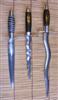
What is this dagger called? What is its' origin? There is a dragon and a wood spirit-like Head used as some of the decoration. Fluted blade is 47/8 inches overall length is 85/8 inches. It sold for $676.00.
Thanks, Steve |

|

|
|
14th November 2010, 02:45 AM
|
#2 |
|
(deceased)
Join Date: Feb 2005
Location: Centerville, Kansas
Posts: 2,196
|
Hello Archer,
I too was watching this dagger on epray. I am no expert by any means but to me it looks to be French. The Green Man and the European winged dragon make me think that the engraving could be English. Hopefully someone more knowledgeable will be along shortly to give a real answer as to where it is actually from. Sorry about the picture quality as I'm not very good at this. Robert Last edited by Robert Coleman; 14th November 2010 at 03:08 AM. |
|
|
|
|
14th November 2010, 03:19 AM
|
#3 |
|
Member
Join Date: Aug 2006
Posts: 608
|
Good call on the Green Man observation. Given the pagan / Celtic imagery (which while commonly associated with Celtic neopagan practices in the UK, was also known in Continental Europe), maybe it's an athame? I find the quality pieces with imagery associated with the wiccan religion usually command a good price.
|
|
|
|
|
14th November 2010, 05:37 AM
|
#4 |
|
Arms Historian

Join Date: Dec 2004
Location: Route 66
Posts: 10,862
|
This interesting little dagger is most likely a Victorian interpretation of the medieval dagger known as the misericorde. Essentially it was known as the 'dagger of mercy'. These narrow bladed daggers were meant to pierce vulnerable spots in armor to dispatch hopelessly wounded knights to save thier suffering and often used in close quarters combat similarly, though the veracity of such use of these may be largely myth.
This motif is intriguing as the 'green man' is indeed a pagan device, but was used a great deal in ecclesiastical architecture and motif, and particularly in the Victorian period during the neo Gothic revival trend. It apparantly was often seen used on the bottom of folding seats in churches which were termed the 'misericorde' (=mercy seat)as it provided support and some comfort for worshippers during long periods of standing during services. The green man symbolism is thought to represent rebirth or revival, and it is interesting to see the 'misericorde' concept occur on these seats as well as on this 'mercy dagger'. The floral motif usually consists of leaves, which is presumably where the 'green' term applies. Interestingly the dragon, in chivalric legend is sometimes seen as a symbol of resurrection and of renaissance, particularly in the Golden Fleece legends. It may also be seen as a symbol of prudence. It would be hard to say what purpose this dagger might have been intended to serve, but it seems extremely well made, and certainly would correspond with Victorian interest in legends of chivalry and the weapons used. All the best, Jim |
|
|
|
|
14th November 2010, 06:06 AM
|
#5 |
|
Member
Join Date: Mar 2005
Posts: 373
|
reply
Hi, Thanks, my thought was that more than one thread on past forums dealt with the Green Man in several cultures. Try as i might searches came up without any information. Steve
|
|
|
|
|
14th November 2010, 01:43 PM
|
#6 |
|
Keris forum moderator
Join Date: Aug 2006
Location: Nova Scotia
Posts: 7,297
|
Wow, that's a beautiful dagger.
Thanks Jim, for mentioning the use of the Green Man in churches throughout the British Isles. While this doesn't discount a pure pagan reference it shows the complexities of how pagan beliefs and lore linger in societies well after they turn for the most part to Christianity or other religions (you can still find many ancient pre-Islamic and even pre-Hindu beliefs still operating in Indonesia). That said we can easily find strong pagan reference to both the Green Man and the Dragon, though i would say that it is more likely that this dagger was not designed as a ritual athame. One can also find strong references to Arthurian legend in these symbols. I am inclined to think this an English dagger. This book might be interesting. |
|
|
|
|
16th November 2010, 07:27 PM
|
#7 |
|
Member
Join Date: Dec 2004
Posts: 1,247
|
I concur that it's not an athame.
Athames in the Wiccan sense post-date Gerald Gardner and WWII (although in theory, there should be some older ones somewhere). Additionally, they are more likely to have black handles and various magical symbols on them. The blades are also likely to be one or two edged, not cruciform. As the others have pointed out, the English have had a long fascination with various pagan symbols, so finding a dragon or green man in the decorations isn't a sign of a pagan tool. Best, F |
|
|
|
|
16th November 2010, 08:54 PM
|
#8 |
|
Member
Join Date: Aug 2006
Posts: 608
|
While not an athame per say, I still think - as per the question posted in the OP - the pagan symbolism likely contributed to the high price realized for what is in all likellihood a Victorian reproduction of an earlier form.
Wicca, while a rather contemporary expression of paleopagan ritual, is nonetheless the 2nd-fastest growing religion in the U.S., and Celtic-themed neopaganism has blown up in the UK as well. The presence of pagan symbology on the hilt is IMO a valid potential contributor to the high hammer price. 
|
|
|
|
|
16th November 2010, 10:58 PM
|
#9 |
|
Member
Join Date: Aug 2010
Location: Sydney Australia
Posts: 228
|
Hi Archer
What a lovely item. It may or may not be a Victorian reproduction, but it appears exquisitely chiselled rather than cast. In fact, this leads me to think it might be earlier. All the gothic Victorian period daggers I've come across were cast. But cut steel is a big investment in labour and time and most copyists don't seem to bother. If its 19th century I suggest it might be early 19th century. Or perhaps its 18th century. Indeed, in 18th century England they were cutting steel on many small swords - similar sort of work. I think it's English. The Green Man is usually English, to the best of my knowledge. Of course, all this is speculative. If you ever want to get rid of this spurious "Victorian reproduction" do let me know. |
|
|
|
|
16th November 2010, 11:14 PM
|
#10 |
|
Member
Join Date: Aug 2010
Location: Sydney Australia
Posts: 228
|
Sorry, I just noted that you don't own it.
My mistake. |
|
|
|
|
16th November 2010, 11:43 PM
|
#11 |
|
Member
Join Date: Aug 2006
Posts: 608
|
Hi Ron,
I guess I should have been a little more careful with my choice of words...  I would associate the symbolism (in particular the Green Man) with the Victorian-era Gothic revival movement and my comment as such was based on this observation. Maybe it is premature or incorrect to refer to it as a "reproduction," though I was under the (mistaken?) impression that by the turn of the 19th C., the use of stilettos had generally fallen out of favor, and associate the blade form with earlier (18th C.) preferences. In doing a little fact checking before posting this response, it appears there are references to the Gothic revival movement having actually begun earlier than I had thought.
|
|
|
|
|
17th November 2010, 05:25 AM
|
#12 |
|
Member
Join Date: Aug 2010
Location: Sydney Australia
Posts: 228
|
hi laEspada
I completely understand. The phrase Victorian reproduction is a bit misleading, but it's a revival piece of sorts. I will say I do have 19th century daggers with triangular blades, a little like this. It's more typical of French daggers I think. |
|
|
|
|
17th November 2010, 05:32 AM
|
#13 |
|
Member
Join Date: Aug 2010
Location: Sydney Australia
Posts: 228
|
The more I look at this, the more I like it.
it's a magnificent piece of work. I have an Indo-persian dagger with comparable cut steel etching, circa 1850. I don't think the price on this is high at all. |
|
|
|
|
17th November 2010, 04:56 PM
|
#14 |
|
Arms Historian
Join Date: Dec 2004
Location: Route 66
Posts: 10,862
|
The term 'Victorian Gothic' was primarily applied to the architectural phenomenon in England which seems to have evolved out of romanticism in England from about the 1740s. It would seem that there were leanings toward such romanticism already with the high society figures in England with the mysterious 'Hellfire Clubs' of c.1719 to well into the 18th century. As is well known, the so called Gothic novel came about in 1764 with Horace Walpoles "Castle of Otranto" which used the horror and foreboding atmosphere to great effect.
These Hellfire clubs were essentially a parody used in satirical sense toward religion, politics and other key contemporary matters, a sort of 'mens club' where wide range of otherwise socially unacceptable activities were engaged in. When the Duke of Wharton, founder of the original club was chastized by the King and it was disbanded, he subsequently went into Freemasonry, then powerfully forming into the secretive fraternal brotherhood present in England, Scotland and France, expanding further internationally. The other developed versions of the 'club' remained active however, one of the most infamous that overseen by Sir Francis Dashwood from 1749 to around 1760-66. These type of romanticized settings were the basis on which many aspects of neo Gothic classicism were formed, and which may be considered well in place in the 19th century. While we know Freemasonry was extremely well known by then, this weapon does not display symbolism particularly mindful of any of thier known themes. Still, mystery and illusion were extremely popular themes in many secretive socialogical deviations, which could of course include versions of occult and Wicca type groups. It is known that the much later Alastair Crowley even followed some of the ritual and ceremony from the hellfire groups. Again, this dagger does not seem to have anything to do with the ever misunderstood and mysterious 'athame', and the only reason the term pagan was associated with the motif is the green man and dragon are known from those times. It does seem English, despite the baroque styling which even though associated with French was not only popular in England, but worked well with these Gothic themes. The use of the stiletto was of course long obsolete, but just as with the also mysterious 'bombardiers stilettos' of Venice from much earlier, they survived as insignia of rank and as a secretive signal of insidious allusion. As there only artillery gunners were allowed to have such weapons, arcane symbols and measurements were engraved on many of these to suggest they were calibrated gunners stilettos, while actually the carrier was of more sinister purpose. These are the kinds of allusions that may well be in place here, and the dagger may be considered made for or commissioned by someone of means and with purposes known to them, rather than a known type of dagger with more defined use. The attachments are a gravestone, in variation of the green man theme using a skull, the Freemasons are keen on symbolism of the 'memento mori' (one day all will die). It is worthy of note that rebirth/ renaissance is often seen symbolized on weapons such has with the numbers 1414, which actually are from the Bible passage, when a man dies, shall he live again. The green man also carries rebirth symbolism. The other is Sir Francis Dashwood, dressed as St. Francis of Assisi in a depiction of the allegorical themes often used in these clubs. As usual, one of my own Gothic novels in describing this, but I like to write, so why not? All the best, Jim |
|
|
|
|
17th November 2010, 06:37 PM
|
#15 | |
|
Member
Join Date: Aug 2006
Posts: 608
|
Quote:
Good note - I would also add to it the 18th C. French origins of the Black Mass, itself a parody of the Catholic Mass. Long before the rise of 19th C. Hermeticism (largely credited with haven given rise to the modern occult movement), there was a long-existing anti-religious backlash practiced by members of the aristocracy, and it would not take a great leap to see how pre-Christian, paleopagan symbolism could serve a parodic purpose in line with these sentiments. However, I find the explicit representation of the Green Man to be too specific to dismiss any connection to paleopagan beliefs, even if such a representation of such beliefs wasn't meant to embody pagan ritual as much as it might have been meant to serve a purpose in line with the satirical anti-Catholic rituals that existed at the time. Thus, while not an athame per say, I don't think some type of ritualistic function can be completely ruled out, even if said function was rooted in parody as opposed to belief... ETA: While not an athame per say, given the nature of neopagan / Wiccan rituals and the function an athame serves in those rituals (which in all but the rarest of occasions is purely symbolic), I do not see how the form of the dagger would preclude its use as such, and still maintain the symbology could make this a very attractive acquisition for a well-to-do Wiccan, thus contributing to the realized price.
Last edited by laEspadaAncha; 17th November 2010 at 06:54 PM. |
|
|
|
|
|
17th November 2010, 08:59 PM
|
#16 |
|
Keris forum moderator
Join Date: Aug 2006
Location: Nova Scotia
Posts: 7,297
|
Gentlemen, i would hate to see us go off on a wild "green man" chase here much as we did with the "satanic dagger" posted some time back (Esmerelda and Notre Dame). Certainly there is no denying that the origins of the Green Man are a pagan one, but again, let me remind you all just how much the image has been used again and again throughout the British Isles in Christian iconography in churches. There is no parody in purpose for it's use in the architectural elements of some of England's classic churches.
http://www.google.com/images?q=green...w=1417&bih=689 Furthermore the Green Man plays an important role in Arthurian Legend, which, of course, we can find much paganism in, though it clearly was given renewed interest and attention in the Gothic Revival from which most of us seem to think this dagger originates from. Therefore i find nothing to support that this was ever intended to be a "pagan" blade, athame or otherwise. Fearn is also indeed correct that an athame is specifically a double-edged blade so this clearly does not qualify. Would a neo-pagan or Wiccan today find this blade of interest. Undoubtably! I know i find it interesting and desirable. But then, i assume that many of you are not Wiccan or neo-pagan and you also find it interesting. So i don't think we can look to a well-off Wiccan as the reason this dagger sold for this price. Besides, though interested in it, no Wiccan would use a triple edged blade as an athame. This blade commanded this price for the same reason it commands our attention here. It is beautiful, unusual and well crafted. And allusions that we make to it having a pagan origin is pure unsupported conjecture. Though i equally have no proof to show it is not the case i believe that a logical examination of the interests of the Gothic Revival times and the art it produced should be enough of an explanation for the themes carved upon this dagger. 
|
|
|
|
|
17th November 2010, 10:42 PM
|
#17 | |
|
Member
Join Date: Aug 2006
Posts: 608
|
Quote:
I guess that's my point... that the symbolism present on the dagger would make it a desirable acquisition for a practicing neopagan or Wiccan. Of course it will be of interest to a collector or purveyor of antique arms and armor. I simply am stating the addition of other potential interested parties - again, due to the symbolism - may have contributed to the realized price. |
|
|
|
|
|
17th November 2010, 10:50 PM
|
#18 |
|
Member
Join Date: Aug 2010
Location: Sydney Australia
Posts: 228
|
Hi laEspada
It's possible. It would be a shame though. As no practicing Wiccan is likely to appreciate it for its true merits or its immense cultural and historical interest. I can only hope it was bought by a collector. I am one collector who would have paid that price if it were legal or easy for me to import daggers of this type into Australia. Ron |
|
|
|
|
17th November 2010, 11:06 PM
|
#19 |
|
Member
Join Date: Aug 2010
Location: Sydney Australia
Posts: 228
|
Apologies to Wiccans who also happen to be arms and armour collectors. You of course are exempt from that sweeping generalisation.
|
|
|
|
|
18th November 2010, 01:17 AM
|
#20 |
|
Member
Join Date: Dec 2004
Posts: 1,247
|
I'm not a Wiccan, but I figure that if members of any religion happens to hold a particular type of knife or sword sacred, it's really helpful to help them take proper care of their implements, whether it's a keris, an athame, a kirpan, or a druid grove's ceremonial sickles and swords.
We all like our blades, after all. No reason not to focus on our shared interests. My 0.00002 cents, F |
|
|
|
|
18th November 2010, 02:30 AM
|
#21 | |
|
Keris forum moderator
Join Date: Aug 2006
Location: Nova Scotia
Posts: 7,297
|
Quote:
Do i have to point out that Gerald Garnder, the father of modern Wicca, was the author of Keris and Other Malay Weapons. A sweeping generalization indeed... 
|
|
|
|
|
|
18th November 2010, 03:21 AM
|
#22 |
|
Member
Join Date: Aug 2010
Location: Sydney Australia
Posts: 228
|
Do i have to point out that Gerald Gardner, the father of modern Wicca, was the author of Keris and Other Malay Weapons.
Mmmmm...no, this I did not know. thank you, very interesting. Is this the same Gerald Gardner who published studies on witch hunts in medieval Europe? This just happens to be what my postgraduate history dissertation was about. Fearn, as for sacred knives and weapons, I couldn't agree more. I am a practicing Tantric Buddhist, which is perhaps more of a contradiction/paradox for an arms collector than being a Wiccan. Many of the Tibetan knives under discussion here are items used in the tantric rituals I practice. Though I don't personally use those knives, or even own any......yet. If there are Wiccans out there who have Tibetan tantric knives or implements they'd like to swap for potential athames, drop me a line. We need to talk.
|
|
|
|
|
18th November 2010, 09:10 AM
|
#23 |
|
Member

Join Date: Dec 2004
Location: What is still UK
Posts: 6,000
|
I love gothic horror flims, my favourite film is "Dracula A.D, 1972" even if it is a bit silly. I like most of all the black mass scene with the "White Noise" album "Elecric Storm" sound track.
The artwork seen on this dagger is to my mind far to mature to have anthing to do with, you know what. It is the same Victorian taste as this box by Placido Zuloaga 1833-1910 Iron, counterfeit-damascened gold and silver, with applied gold and silver mounts, interior lined with stamped leather. held in the V&A. Also this "Minton & Co" candlestick 1859. All under the term "The Renaisssance Revival" Sadly the pub down the road called the Wyvern with the appropriate pub sign. Is not a Hell Fire Club last time I poped in. Perhaps I do not know the secret nod or wink  . .
|
|
|
|
|
18th November 2010, 12:35 PM
|
#24 |
|
Keris forum moderator
Join Date: Aug 2006
Location: Nova Scotia
Posts: 7,297
|
Thanks for these postings and exactly my point....and i sooooooo want that box!!!

|
|
|
|
|
19th November 2010, 03:55 AM
|
#25 |
|
Arms Historian
Join Date: Dec 2004
Location: Route 66
Posts: 10,862
|
Actually Gerald B. Gardner does happen to be the author of the notable work "Keris and Other Malay Weapons" (1936). His interests in occult coupled with his being an anthropologist, and his field work in SE Asia led to this work, but it would seem that his focus was on the anthropological aspects and ethnographic elements with these weapons rather than outright collecting of them simply as weapons themselves. I believe he saw them as importantly associated esoterica corresponding to his metaphysical beliefs.
While the use of votive or ritual weapons in established practices of certain religious or group followings, is often well established, it does not necessarily suggest that members or followers are inherently weapons collectors in general. In most cases the weapons are collectively used by the group or held in sacred places where ceremonies take place. Obviously this would not preclude personal acquisition of a weapon appropriately themed for an individual, as may well be the case with this dagger. All best regards, Jim |
|
|
|
|
19th November 2010, 04:21 AM
|
#26 | |
|
Keris forum moderator
Join Date: Aug 2006
Location: Nova Scotia
Posts: 7,297
|
Quote:
|
|
|
|
|
|
19th November 2010, 06:15 AM
|
#27 | |
|
Arms Historian
Join Date: Dec 2004
Location: Route 66
Posts: 10,862
|
Quote:
All the best, Jim |
|
|
|
|
|
19th November 2010, 07:11 AM
|
#28 |
|
Keris forum moderator
Join Date: Aug 2006
Location: Nova Scotia
Posts: 7,297
|
Well, i wasn't speaking of Tantric Buddhist groups as i have little knowledge of their workings. But i can say with some confidence that my statement does indeed apply to a fairly wide sweep of neo-pagan practices that use edge weapons edged weapons in their rituals.
I must also note that an unusually high number of my friends in this wide sweep of neo-pagan traditions (and i am not really talking about Freemasons or Fraternal Brotherhoods BTW when i speak of "Ceremonial Lodge Traditions") have a keen interest in edged weapons and that many do indeed collect them to some degree. Certainly not all, but the percentage is higher than my non pagan friends. I must qualify that, of course, by stating that most of my friends are neo-pagans.
|
|
|
|
|
19th November 2010, 09:50 AM
|
#29 |
|
Member
Join Date: Aug 2010
Location: Sydney Australia
Posts: 228
|
Well then, perhaps neo-pagans broadly like knives and the like. Unlike many practicing buddhists, who would regard this as negative.
I have actually bought some very crude home-made satanic-looking daggers in markets - items poorly made with goat's heads. I've since sold them. And though they'd be quite deadly in an assault, they were unimpressive in every other respect. It wouldn't suprise me if these were made by neo-pagans, considering the fact that there are reportedly so many popping up everywhere. The fact is, while many neo-pagans may also be interested in items of historical interest, their religion in no way impels them to practice with items of genuine historical worth. And for the most part, they are no more educated in historical matters than most sectors of the populace. If they have to own a sword or a dagger, they can as easily pick up some nice witchy looking 20th century fantasy item. I suspect many do. |
|
|
|
|
19th November 2010, 03:51 PM
|
#30 | |
|
Keris forum moderator
Join Date: Aug 2006
Location: Nova Scotia
Posts: 7,297
|
Quote:
BTW "most sectors of the populous" are really sadly informed on historical matters and seem to have little to no interest in them. As a college instructor i encounter this on a daily basis even amongst those seeking higher education. Interestingly, i have also found that most modern pagans indeed do have a keen interest in history. So if you like i am willing to debate this point from my own personal observations and experiences. Making a point that the crude, homemade "satanic" daggers you once owned were unimpressive is like saying that the a crudely fashioned crucifix that was once owned and loved by a fervent believer of the Catholic faith was unimpressive. That is, of course, if what you owned truly were ritual tools which were held as sacred by their owners. Many "sacred" items indeed appear "unimpressive" to people outside their own faith. Many Indonesian Dukuns (shaman) for instance, will use the most unassuming tools in their work. Next to a master work keris of royal regalia their own blade might appear to be crudely fashioned and "unimpressive". Yet to him and the people he treats it is a most powerful spiritual tool. And lastly Ron, please do not confuse neo-paganism with satanism. It's insulting. Neo-pagans are not going to be making daggers for satanist and they are not satanists themselves. This is not really the forum for such a discussion, but if you like to educate yourself further on the subject you can find plenty of info on the web about it. Though it's just a start try Wikipedia. http://en.wikipedia.org/wiki/Neopaganism Last edited by David; 19th November 2010 at 04:48 PM. |
|
|
|
|
 |
| Thread Tools | Search this Thread |
| Display Modes | |
|
|


 Linear Mode

