
|
|
|
 21st June 2010, 06:12 PM
|
#1 |
|
Member
Join Date: Mar 2010
Location: Olomouc
Posts: 1,720
|

As always thanks for your informative input Jim.
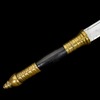
I should mention the first example, having checked my notes, was actually collected in Cameroon - so your observation is quite correct! While I'm no expert in European cavalry blades I'd be very surprised if this blade is not native. The fuller is roughly forged with poor symmetry in places. On the second one, yes, blade is of typical quality. A much lighter weapon, both in actual weight and feel. |

|

|
|
21st June 2010, 06:57 PM
|
#2 |
|
Member

Join Date: Dec 2004
Location: What is still UK
Posts: 6,025
|
These are rather nice. The one with the metal pommel I assume is a copper/tin/zinc alloy rather than aluminium? I think the blades look great and I might say; are they really a copy of European forms? I post pictures of mine. Like yours it too has rough/crude look but there is nothing crude about the flexible nature to the slashing ability of the blade. It has been suggested to me that it is in fact a re-worked European blade but as you can see from the pictures, I strongly believe that it is not. I am very lucky to have a club to go with these swords. I was horrified by the price I paid for it, but now I am thinking I did jolly well
 . .
|
|
|
|
|
21st June 2010, 07:14 PM
|
#3 |
|
Member
Join Date: Mar 2010
Location: Olomouc
Posts: 1,720
|
Hi Tim, yes the solid hilt is brass. These swords have an amazing feel in the hand. I think they'd have no problem to do the job intended. One can imagine coupled with a swiftly running camel the results would be rather dramatic.
As for your sword... I have no idea what you paid for it, but I'm guessing if you ever get bored with it I can be persuaded take it off your hands for the same or more.  It's really an outstanding piece. As for a reworked European blade... I think there is a tendency to under estimate the amount forging work done natively. There is a tendency when one finds a good quality blade to automatically assign a European attribution - perhaps sometimes a bit hastily. Personally I prefer the native made stuff. More cohesive in my tastes. It's really an outstanding piece. As for a reworked European blade... I think there is a tendency to under estimate the amount forging work done natively. There is a tendency when one finds a good quality blade to automatically assign a European attribution - perhaps sometimes a bit hastily. Personally I prefer the native made stuff. More cohesive in my tastes.Couple of questions about your sword... Any idea from the balance and weight what lies under the leather on the hilt? Metal pommel and grip? I've already encountered a couple of takouba with wood cores for the grips. I'm trying to figure out if it means anything in terms of pinning down tribal and ethnic group. |
|
|
|
|
21st June 2010, 07:18 PM
|
#4 | |
|
Arms Historian

Join Date: Dec 2004
Location: Route 66
Posts: 10,867
|
Quote:
You are very welcome indeed!!!  Good observation on the cavalry type sabre blade, and it does appear atypical of the typical European production characteristics. As has been mentioned, the skills of native armourers in these regions has often and long been underestimated. |
|
|
|
|
|
21st June 2010, 07:42 PM
|
#5 |
|
Member
Join Date: Dec 2004
Location: What is still UK
Posts: 6,025
|
No the club was expensive the sword was exactly half the price.
The sword blade is 61cm long so really a short infantry weapon. It is written that the bulk of pre 1906 Sudanic forces were infantry. I think the handle has a wood core as opposed to fabric or metal. This lends a slight weight forward nature to the weapon. The club has a metal core. |
|
|
|
|
22nd June 2010, 08:36 AM
|
#6 |
|
Member
Join Date: Mar 2010
Location: Olomouc
Posts: 1,720
|
The club is certainly impressive. I imagine the full leather covering was partly for superstitious reasons (not touching iron or steel) and partly for preservation of the metal itself.
Did they come from the same collection? They seem very well matched. Did you ever arrive at a tribal attribution? |
|
|
|
|
22nd June 2010, 05:59 PM
|
#7 |
|
Member
Join Date: Dec 2004
Location: What is still UK
Posts: 6,025
|
I got them years apart but they are so well matched. The club is a wood stick with a metal knob then covered in leather.
|
|
|
|
 |
| Thread Tools | Search this Thread |
| Display Modes | |
|
|


 Hybrid Mode
