
|
|
|||||||
 |
|
|
Thread Tools | Search this Thread | Display Modes |
|
|
 28th May 2026, 06:40 PM
|
#1 |
|
Member
Join Date: May 2026
Posts: 5
|
 Ottoman 19th century, seeking help with identification
Hello everyone,
I'm an enthusiast of ethnic and antique arms from Latin America, and I recently acquired this Ottoman yatagan which I've been researching. I'd love to share what I've found so far and ask for your help to go further. What I know: The blade bears silver koftgari decoration with two cartouches of Ottoman Arabic inscriptions. With the help of AI tools I was able to read: Tawakkaltu 'alā Allāh — "In God I have placed my trust" Māshā'Allāh · Sāhib Hüseyin — "What God wills · The owner is Hüseyin" The date 1274 H (1857/1858 AD) appears engraved after the inscription, following the horror vacui tradition. The handle is bone with a characteristic kulak (ear-shaped) pommel. The bolster is copper with tulip-shaped carnelian inlays, all intact. The opposite face of the blade carries a circular geometric maker's mark which I have not been able to identify yet. My question: Based on the blade style, the kulak pommel and the maker's mark, would you say this is Balkan production — possibly Prizren (Kosovo)? Any help identifying the maker's mark would be greatly appreciated. Thank you in advance for your time and knowledge. |

|

|
|
28th May 2026, 08:27 PM
|
#2 |
|
Member
Join Date: Aug 2007
Location: Germany, Dortmund
Posts: 9,788
|
Welcome to the forum Johnny!
Yatagans are not something I am knowledgeable about but what I can say is that I am pretty sure the handle scales are not from bone but from walrus ivory!  And I guess that your nice sword comes from Bosnia instead of Kosovo but this is just a guess. We have a lot of people here who will be able to tell you much more than I am! Regards, Detlef Last edited by Sajen; 29th May 2026 at 09:06 AM. |
|
|
|
|
30th May 2026, 05:23 PM
|
#3 |
|
Member
Join Date: Feb 2023
Posts: 251
|
First of all using AI to translate old ottoman or persian language is very bad decision.
Find a person that deals with those languages it is much better choice. Yatagan is made in Bosnia, it has caracteristic copper parazvana decorations found mainly on bosnian workshops, handles are walrus, it is clearly seen christaline. Those are red adriatic corals not carnelian, and round ones should also be corals but not striped but polished. Round koftgari work is decoration inlay it is not makers mark, makers name is writen right to the year, year is 127 but it should be 5 not 4, that canot be 4 i dont know what it is, (my translator isnt available now), Sometimes they would write last three numbers but not in this case it isnt that old. All in all usual bosnian yatagan. |
|
|
|
|
31st May 2026, 02:04 PM
|
#4 |
|
Member
Join Date: May 2020
Posts: 1,038
|
welcome !
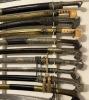
the year could be ٥ ٧ ١٢ 1275 AH = 1858 with ٥ (the 5) being written a little above the other 3 numbers, that would be my guess.... That date would be in line / correspond with the Bosnian yataghans you can find made between 1800 - 1878 And the stones are indeed very nice Adriatic coral; carnelian is mostly used for bichaqs and the handle / grip looks indeed like walrus...could be ivory but am not sure about the latter as you are new on the forum, some more info on this cold weapon: on cornelian or carnelian : https://www.vikingsword.com/vb/showp...0&postcount=12 a little on yataghans : https://jatagani.hismus.hr/webe/oruzje.htm and scroll to the top : http://www.vikingsword.com/vb/showth...highlight=Kozo material to compare your very nice yataghan, you can find here: http://www.vikingsword.com/vb/showth...ghlight=zagreb examples of coral, see enclosed pics Last edited by gp; 31st May 2026 at 05:19 PM. |
|
|
|
|
31st May 2026, 04:08 PM
|
#5 |
|
Member
Join Date: Aug 2007
Location: Germany, Dortmund
Posts: 9,788
|
And not to forget, I would clean the sword a little bit!
|
|
|
|
|
31st May 2026, 04:57 PM
|
#6 | |
|
Member
Join Date: May 2020
Posts: 1,038
|
Quote:
you have a very very nice one! My compliments ☼ Last edited by gp; 31st May 2026 at 05:30 PM. |
|
|
|
|
|
|
|


 Hybrid Mode
