
|
 21st February 2026, 08:02 PM
|
#1 |
|
Member
Join Date: Dec 2004
Location: Bay Area
Posts: 1,770
|
 Mandingo Daggers
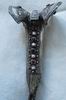
There is a tendency to label every West African dagger as Mande. Not sure is this is always correct, but I do believe the group of daggers shown here is indeed Mande. This is still a very broad definition, similar to labeling something as Slavic or Turkic in a way, so it would be great if at some point we can do a little better.
The British Museum shows three similar daggers, all collected in the first half of the 19th century, one of which was collected in Guinea, one in Sierra Leone and the final one in the Bijagos islands. https://www.britishmuseum.org/collec...1852-0930-35-a https://www.britishmuseum.org/collec...ject/E_Af-5319 https://www.britishmuseum.org/collec...f1878-1101-521 Based on this, a distribution from what is today South Senegal to Sierra Leone is possible. It would be interesting to learn more about these knives. |

|

|
|
22nd February 2026, 04:22 PM
|
#2 |
|
Arms Historian

Join Date: Dec 2004
Location: Route 66
Posts: 10,867
|
This is an excellent topic Teodor!!! and it is indeed perplexing when trying to classify these areas of African edged weapons by using such a broad brush. With my very basic understanding of these weapons, mostly I am familiar with the familiar sabers with open hilt and knob type pommels. I have one (pictured) and I have always regarded it (and the type) as Mandinka, from Mali regions.
Your post piqued my interest to look further into this, and learned a great deal on the terminology here, which I hope I can add properly. I had always thought these sabers (not yet familiar with other variations in form) were termed 'Mandingo' swords. Apparently this term is not correct, and was more aligned with colloquial terms popularized in a book and subsequent film (1975) titled "Mandingo". While hoping to avoid the unfortunate subject matter, it seems that the distasteful application of this term pertains to West African slavery, while the term in the dictionaries is listed as a people of West Africa in or near upper Niger Valley. Apparently it is deemed a linguistic classification referring to MALINKA and several other groups, varying in different references. The point is that properly the term is MANDINKA (also Malinke) and refers to the people inhabiting S. Mali; Gambia, Senegal; and E.Guinea.....who are indeed linguistically linked with the MANDE language. So it seems that MANDE is a rather safe was to classify the variations of these weapons which are indeed from these regions, and tribal groups of several other Mande speaking nations including Soninke, Susu, Yolunka, and Vai Bissa. I hope I have described this at least somewhat correctly, and hoped to point out the dilemma in trying to regionally or tribally classifying these weapons, which clearly seem to have certain unique character while having overall similarities. One of the most daunting factors would be the inherent movements of tribal peoples as well as the complex trade networks through these regions. I was under the impression that the Mandinka were in control of the trade routes in and around Mali. I see now that that would be an entirely ineffective rule of thumb, but the point is that the diffusion of the basic character of the weapon forms and elements would have easily been carried widely. One of the most notable features of the Mandinka saber that always intrigued me was the FLARED SCABBARD TIP, very much like those on Sudanese kaskara. I always wondered why this feature became situated on these sabers of the Mandinka, but were inherent to the Sudan, exclusively as far as I could find. I think you are right Teodor, we can do better in classification, but probably more by qualifying the general classification used, and adding qualifiers or sub-classification terms or notes, such as possible other tribal features. For example, dagger of Mande form with character associated with Gambia or a certain tribal group. As I was once reminded by a well known author on ethnographic arms, "weapons have no geographic boundaries". This is true, however, there is substance to the propensity of a type in a certain context, and that is where the classification likelihood is centered. As always, wanted to keep it brief  Best regards Jim |

|
|
|
22nd February 2026, 11:13 PM
|
#3 |
|
Member
Join Date: Dec 2004
Location: Bay Area
Posts: 1,770
|
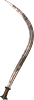
In "Panga Na Visu", the first dagger shown is similar to the group in my opening post. The second is one with a flared tip scabbard. I have one of these as well. A knife in the Quai Branly with a similar scabbard is described as Wolof, from what is nowadays Senegal and Gambia.
|
|
|
|
|
23rd February 2026, 01:52 AM
|
#4 |
|
Arms Historian
Join Date: Dec 2004
Location: Route 66
Posts: 10,867
|
That is so interesting!
Begs the question, what does this 'flared' or 'spatulated' design element on scabbards represent, and which region did it originate? Years ago an archaeologist specializing in the Sudan told me this design had iconographic origins from ancient Meroe. If that was the case, then how and why does it become significant in the Mande linguistic regions? Not meaning to deviate from the original topic concerning classification, but these 'regional' characteristics do seem to have bearing. |
|
|
|
|
23rd February 2026, 08:10 AM
|
#5 | |
|
Member
Join Date: Jan 2023
Location: Spain
Posts: 57
|
Quote:
Indeed, there are rock reliefs from the Meroitic period in Classic Antiquity where flared scabbards can be seen. However, they dissapear from Sudanese art and can't be seen in Medieval Nubian depictions. Had they, in fact dissapeared? Are they just absent from art? Another possibility is that they did rise in West Africa during the Middle Ages independently. The earlier sources do not give clues either way as to whether the scabbards of sabers had these spatulated tips, so basically we start seeing them in the record as the same time as kaskaras. But the flared tip might be drawing on indigenous traditions. Leatherworking in the Mande-speaking world is very associated to the Soninke and lineages of Soninke descent (for example, Mandinka leatherworker lineages often claim a connection to the Soninke). After the fall of Ghana, there was a diaspora, and the Soninke people became dispersed around the region, and often had connections to trade. An element in Soninke mythology is the Bida snake, that in oral traditions is related to the rise and fall of Wagadu (Ghana). And snakes are also important in general in traditional religions of the area. So the flared up scabbards might be drawing on this theme. But was this actually the case? We do not know, because there is no evidence. Until someone digs up a 16th century tomb in Sierra Leone, for example, and finds one, we do not have a clue of the origin of the flared tip. |
|
|
|
|
|
23rd February 2026, 08:57 AM
|
#6 |
|
Member

Join Date: Dec 2023
Location: City by the Black Sea
Posts: 351
|
I've already shown this short sword/dagger; the tip of the scabbard has a completely different shape.
I'm more interested in the brass wire inlay on wood. Inlay is also found on Ikul (Cuba) daggers, but the technique is completely different there. The handle shape is also somewhat similar. |
|
|
|
|
24th February 2026, 12:51 AM
|
#7 | ||
|
Member
Join Date: Dec 2004
Location: Bay Area
Posts: 1,770
|
Quote:
Quote:
|
||
|
|
|
|
24th February 2026, 07:58 AM
|
#8 | |
|
Member
Join Date: Aug 2007
Location: Germany, Dortmund
Posts: 9,788
|
Quote:
|
|
|
|
|
|
24th February 2026, 11:27 PM
|
#9 |
|
Arms Historian
Join Date: Dec 2004
Location: Route 66
Posts: 10,867
|
While the discussion originally pertains to the classification spectrum of Mande sphere weapons, I had noted the distinct feature of the flared tip scabbard which occurs also in Sudan with kaskara scabbards.
So using the occurrence of such features on other 'Mande' associated weapons with similar features, actually which are bulbous rather than flared, the question is what do these represent, as well as decorative character. The potential for snake related potential is brought up. By analogy, in India there are the swords with disc like features which are termed by collectors, 'cobra swords' referring to the flared hood of the cobra snake. These seem to be primarily situated in Uttar Pradesh in Northern India with the Pahari people and also connected to Hindu Rajputs. The chakra (=disc, wheel) is a weapon of Shiva, which is what this feature actually represents, not a cobra or snake. The disc appears typically at the root of the blade, however there are examples of Hindu basket hilt with the disc at distal end of blade, with a serrated (nagan) blade. These are the kinds of situations we end up with in trying to determine what sort of symbolism is being represented and hoping to apply that to the determining regions the feature commonality might denote. Again, while off the course of the subject weapons, just an illustration of the situation. |
|
|
|
|
26th February 2026, 06:31 PM
|
#10 | |
|
Member
Join Date: Jan 2023
Location: Spain
Posts: 57
|
Quote:
In high status shortswords and knives the pommels tend to be more bulbous and in leather hilted examples they tend towards cilindrical, but it is essentially a continuum of the same shape. The pommels are more uniform in the sense that they have a similar construction, but on the guard you either have a cilindrical round hilt or a more extended area. Some have both, one when sheathed and one unsheated (typical of sabres). There is a lot of variation because of regional and cultural styles expected in an area as large as Senegal to Sierra Leone to Segou, but it points to a common origin, a macrofamily of weapons (like the enormous La Tene family of swords from classical antiquity to the Middle Ages). Just an idea I have had for a time. |
|
|
|
|
 |
|
|


 Linear Mode

